

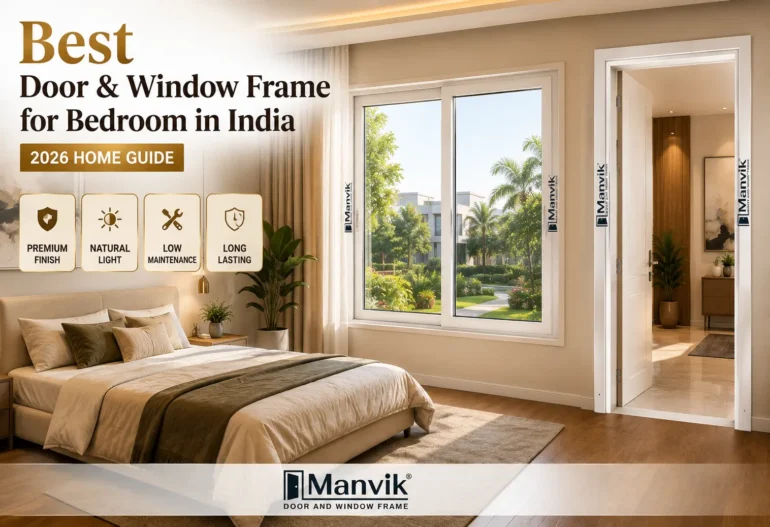
Choosing bedroom doors and windows is not only about appearance. The frame material can affect maintenance, durability, ventilation planning, design compatibility and long-term comfort. Homeowners often search for the best door and window frame for bedroom use, expecting a single “correct” answer — but the reality is more practical. Bedrooms have unique requirements around privacy, natural light, sound and airflow, and the right frame depends on your specific home, climate and lifestyle.
This guide walks through everything a homeowner, architect, builder or contractor needs to evaluate before ordering bedroom door and window frames in India — from material comparisons to climate-specific advice, common mistakes, and a practical buying checklist.
What Is the Best Door and Window Frame for Bedroom?
The best door and window frame for bedroom use in a home is not a specific material or design, but depends on the individual. The right one will be determined by the characteristics of your project:
- Exposure to climate and weather in the local area
- Your long-term commitment to the care you are prepared to give. Your willingness to give long-term care.
- Calculate costs of further building work or redevelopment.
- The style of interior design (modern / traditional / minimalist)
- Size of window and size of opening in the wall.
- The amount of air that needs to be circulated through the room. The amount of ventilation necessary in the room.
- Requirements for privacy (especially in an apartment, in a very populous zone)
- The bed faces one of the walls where there is sunlight.
- Vulnerability to rain, particularly in coastal and/or high rain areas
- Overall requirements you set by your architect/builder
Instead of trying to come up with one “best” answer, it’s better to think of a quick decision making process and keep in mind what is important to YOU in your bedroom.
Quick Decision Summary
| Requirement | What to Consider |
|---|---|
| Low maintenance | Compare upkeep needs across materials — painting, polishing, cleaning frequency |
| Traditional appearance | Consider materials and finishes that suit classic or heritage-style interiors |
| Modern design | Look at slim profiles, clean lines and contemporary finish options |
| Custom sizing | Check whether the manufacturer can produce non-standard door and window sizes |
| High sun exposure | Consider how the frame and glazing perform under prolonged sunlight |
| Ventilation | Select a window type and opening style that supports adequate airflow |
| Privacy | Consider window placement, glass type and opening direction |
How to Choose the Best Door and Window Frame for a Bedroom
It’s important to know some of the factors that you must take into account before you compare materials. These all apply to any material you select.
Bedroom Location
A first floor bedroom with the view of a boundary wall will have different security and privacy requirements compared to a 3rd floor bedroom with an open view. Corner bedrooms frequently have frame exposure on two sides, bringing in more sun and rain. Before deciding on the placement of frames and windows, note which of the walls are oriented toward a neighboring building or the street or open land.
Exposure to climate and weather change. Climate and Weather Exposure
A wall exposed to direct afternoon sun for several hours varies over the years from a shaded south facing wall (as the day is relatively short in the Northern hemisphere in the context of Indian weather which means that in many places its orientation is east/west with regard to the sun and south/west with regard to the monsoon rains). In coastal areas, high rainfall areas, or dusty areas, it should be considered when choosing materials and when planning the maintenance of the frame.
Natural Light
In the bedrooms, moderate levels of natural light are helpful, but can be controlled to help keep the room dark at night. The amount of daylight that can enter the window also depends on the size, type and window placement height, and should be determined based on curtain or blind requirements, not just window frame selection.
Ventilation
Generally, a cross ventilated room (air on one side and out on the other) performs better than a single big window. The type of opening mechanism (sliding, casement or both) directly impacts the amount of air that can pass through the window, which is significant in certain rooms of the house that do not have air conditioning units or during transitional seasons.
Privacy
Sometimes, a privacy strategy is required for rooms on the ground floor of a house, for rooms overlooking a shared corridor in apartment block developments, or for houses that are situated near to other properties. It could involve frosted or textured glass, a raised window sill, movable window louvers, or window placement, not the type of material used for the window.
Noise Considerations
If a bedroom is on a road or main street, or shares a wall with an existing road or busy street, it could be worth considering a closer frame fit and the correct thickness of glass. Even a well-fitted frame that isn’t perfectly tight doesn’t stop outside noise from coming through, but it can make a significant difference if it’s fitted and the gaps are minimal.
Maintenance Requirements
Some materials require maintenance in the form of painting or polishing periodically, some require occasional cleaning of tracks and hardware, and some are generally low touch once installed. Consider the amount of time that you and/or your household help can commit to maintaining the frames in the coming 5–10 years, being realistic.
Interior Design & Style
The frame is an element that one can see in the room. A chunky wooden frame will look great in a traditional interior and not so great in a modern apartment. Ensure that the frame’s appearance and tonality are in harmony with the overall decor of the room
Framing Size and Wall Opening
What frame sizes and window configurations are practical will depend on the available wall opening, wall thickness and the window head’s proximity to a beam. This should be checked and verified prior to the completion of materials or design.
Proper budgeting and the long-term value of your business.
A budget is not just for the initial frame purchase, but also includes the cost of installation, maintenance over the years and the duration of the frame’s useful life before it needs to be replaced or repaired. The initial investment can be a bit more expensive but can lead to savings on ongoing maintenance costs.
Best Door Frame Materials for Bedrooms in India
Among the sources of bedroom door frames, the homeowners generally consider a certain few common types. Here’s a practical look at each, without declaring one is best for all.
PPGI Door Frames
New residential construction includes the use of PPGI (Pre-Painted Galvanized Iron) door frames, which are increasingly being used for bedroom doors across India.
- Aesthetic: Different pre-painted finishes; profiles can be made to look simple and modern.
- Maintenance: Typically does not need to be repainted or polished In the way wood needs to, because the finish is factory applied.
- Durability: Built to avoid the issues that affect materials like wood, such as warping/bug damage, but performance will often depend on an installation’s quality and choice of product.
- Moisture considerations: Pre-painted galvanized construction is designed to be more moisture tolerant than untreated wood, but the installation and sealing at the wall junction should still be careful.
- Design flexibility — Can be manufactured to size, enabling matching match non-standard openings.
- Door availability: Supplying in standard and custom size, depending on the manufacturer.
- Site installation of many PPGI systems, including a weld-free and rivet technology frame
- Who should consider it: Builders of new homes, renovation projects that need low long-term maintenance since PVC is virtually dent-proof, and where sizing is consistently standard or custom.
- Key limitations: Just as with any frame material, correct installation and wall preparation, product specifications can vary significantly from manufacturer to manufacturer for each specific project.
Wooden Door Frames
New residential construction includes the use of PPGI (Pre-Painted Galvanized Iron) door frames, which are increasingly being used for bedroom doors across India.
- Appearance: Different prepainted finishes; profiles can be made to look simple and modern.
- Maintenance: Typically does not need to be repainted or polished In the way wood needs to, because the finish is factory applied.
- Durability: Built to avoid the issues that affect materials like wood, such as warping/bug damage, but performance will often depend on an installation’s quality and choice of product.
- Moisture considerations: Pre-painted galvanized construction is designed to be more moisture tolerant than untreated wood, but the installation and sealing at the wall junction should still be careful.
- Design flexibility — Can be manufactured to size, enabling matching match non-standard openings.
- Door availability: Supplying in standard and custom size, depending on the manufacturer.
- Site installation of many PPGI systems, including a weld-free and rivet technology frame
- Who should consider it: Builders of new homes, renovation projects that need low long-term maintenance since PVC is virtually dent-proof, and where sizing is consistently standard or custom.
- Key limitations: Just as with any frame material, correct installation and wall preparation, product specifications can vary significantly from manufacturer to manufacturer for each specific project.
uPVC Door Frames
uPVC is primarily observed for its usage in window purposes, although it can be used for some sort of door frame applications as well which include some bedroom doors and adjoining locations. upvc sliding window india
- Aesthetics: neat, even finish usually available in white and a few other standardized colors or laminate finishes
- Maintenance: Mostly low-maintenance, and only require easy surface cleaning.
- Durability: Will not rust or rot, performance may be inconsistent between grades and reinforcements.
- Moisture: Does not suck in moisture like wood making it an excellent choice for the humid states.
- Design freedom: Restrictions not so much in custom carving profile variation like wood or PPGI but still on the panel and finish level where the options are flourishing.
- Bespok: Depends on System and profiles available with the manufacturer upto October 2023.
- Requires manufacturer installation (with the right fit and sealing)
- Best Uses: Restrooms, utility spaces, and fewer actual select bedroom programs where low-upkeep is the concern.
- Key limitations: Design and color range typically not as broad compared to wood or painted metal systems.
Top 5 Window Frame Materials in India for Bedrooms
For bedroom windows, PPGI, uPVC, aluminium and wood remain the most compared systems using a similar evaluation method.
PPGI Window Frames
- Design: Available in slim to moderate profile thicknesses (depending on system) for modern and functional looking builds.
- Maintenance: The pre-painted finish applied at the time of manufacture generally minimizes repainting.
- Profiles shape: Profile sizes are variable per manufacturer and product line — check profile dimensions against the size of your window and how you plan to design it.
- Window configuration Continues to be sliding, fixed (depending on product range)
- Climate considerations: Built to resist the weather but performance is dependent on installation quality, sealing and product specification
- Ventilation Requirements — Sliding PPGI window systems can provide satisfactory ventilation according to the opening width built into the frame.
- Glazing compatibility — Works with most standard glass; check your project-specific glazing compatibility with the manufacturer.
uPVC Window Frames
- Design: Clean, modern appearance with smooth finishes; widely used in urban residential projects.
- Maintenance: Low-maintenance and easy to clean.
- Profile size: uPVC profiles are generally engineered for good sealing and weather resistance.
- Window configuration: Available in sliding, casement, and combination configurations depending on the manufacturer.
- Climate considerations: Performs well against moisture and does not rust; heat expansion characteristics should be checked for very high-temperature regions.
- Ventilation requirements: Casement uPVC windows can offer wider clear openings for ventilation compared to some sliding systems.
- Glazing compatibility: Commonly used with double glazing for sound and thermal insulation, where budget allows.
Aluminium Window Frames
- Design: Slim profiles suited to modern and minimalist interiors; widely used in apartments and contemporary villas.
- Maintenance: Generally low-maintenance, though anodized or powder-coated finishes should be checked for long-term coating durability.
- Profile size: Naturally slim due to material strength, allowing larger glass area relative to frame size.
- Window configuration: Common in sliding systems; also used in fixed and casement configurations.
- Climate considerations: Aluminium conducts heat, which can be a consideration in very hot climates without thermal break systems.
- Ventilation requirements: Sliding aluminium windows are widely used for balanced ventilation and space efficiency.
- Glazing compatibility: Compatible with a range of glass types, including tinted and toughened glass.
Wooden Window Frames
- Design: Offers a warm, traditional appearance that suits heritage and classic interior styles.
- Maintenance: Requires periodic polishing, painting and termite treatment.
- Profile size: Can be custom-milled to different widths and styles.
- Window configuration: Commonly used in casement configurations.
- Climate considerations: More sensitive to humidity and moisture without proper treatment; less common in very high-rainfall or coastal exposure areas unless well-maintained.
- Ventilation requirements: Casement wooden windows can provide a wide, unobstructed opening for airflow.
- Glazing compatibility: Compatible with standard glass options.
PPGI vs Wood vs uPVC vs Aluminium: Which Is Better for Bedroom Frames?
| Factor | PPGI | Wood | uPVC | Aluminium |
|---|---|---|---|---|
| Appearance | Clean, factory-finished; multiple colors | Natural, warm, traditional | Uniform, modern | Slim, contemporary |
| Maintenance | Low — no repainting typically needed | Higher — periodic polish/paint, termite check | Low — simple cleaning | Low — occasional cleaning |
| Moisture considerations | Designed for weather resistance; installation quality matters | Sensitive without proper treatment | Performs well in humidity | Generally performs well; check coating quality |
| Design flexibility | Custom sizes and profiles available | High — carving, custom shaping | Moderate — depends on system | Moderate to high — slim profiles |
| Suitability | New builds, renovations, custom projects | Traditional and heritage interiors | Budget-conscious, low-maintenance projects | Modern apartments and villas |
| Custom sizing | Available, subject to manufacturer capability | Flexible via carpentry | Depends on manufacturer system | Depends on manufacturer system |
| Climate considerations | Confirm specification for your region | Needs treatment for humid/coastal areas | Good in humid conditions | Check thermal performance in hot climates |
| Long-term care | Generally low ongoing care | Requires consistent upkeep | Low ongoing care | Low ongoing care |
| Installation | Weld-free/rivet systems available in some product lines | Requires skilled carpentry | Manufacturer-specified installation | Manufacturer-specified installation |
This comparison is meant as a starting point for discussion with your architect, contractor or frame manufacturer — actual suitability should be confirmed against your specific wall type, budget and local climate conditions.
Also read:-
Why Bedroom Requirements Are Different from Other Rooms
Living rooms, kitchens and bathrooms are dealt with differently than bedrooms which means you have to think about the way, a door and window frame should be selected.
- Bedroom are functionally private spaces — privacy matters more than in dealing with shared living spaces.
- Ventilation has to operate quietly and continuously, including at night, without requiring a completely open window for safety or privacy.
- The main point is that natural light has to be controllable—brighter during the day and completely blocked at night—which plays a role more than frame material into where your windows are placed in size.
- Hopefully the comfort while sleeping leans partly on the how adequately does the frame seal from outside temperature, dirt and sound.
- In smaller bedrooms, how a window or door can open will also be tied to your furniture placement so the opening mechanism is a key decision early on.
- Make window easy to reach and operate without disturbing the furniture bed, wardrobe, study table etc. near the window.
- The direction in which a door opens affects the floor area that can be used, so it must always be planned in relation to the bed and furniture layout!
- Noise isa bigger factor at night, so frame fit and sealing quality are particularly meaningful for guest bedrooms facing
Which Type of Window Is Best for a Bedroom?
There isn’t one window configuration that suits every bedroom — the right type depends on room size, wall orientation, ventilation needs and furniture layout.
Sliding Windows
Slide horizontally along a track; do not require outward or inward clearance space.
Casement Windows
Hinged on one side and open outward (or occasionally inward) like a door, offering a wide, unobstructed opening.
Fixed Windows
Do not open; used purely for natural light and views, often combined with an operable window alongside.
Combination Windows
Mix fixed and operable sections — for example, a large fixed panel with a smaller sliding or casement section for ventilation.
Window Type Comparison
| Window Type | Ventilation | Space Requirement | Operation | Natural Light | Privacy | Best For |
|---|---|---|---|---|---|---|
| Sliding | Moderate, depends on opening width | No outward/inward clearance needed | Easy, smooth operation | Good | Adjustable via glass/curtains | Compact bedrooms, balcony-facing walls |
| Casement | Wide, full-opening ventilation | Needs outward clearance | Simple hinge operation | Good | Adjustable via glass/curtains | Larger bedrooms, garden-facing walls |
| Fixed | None (non-operable) | No clearance needed | Not operable | Excellent | High (no opening) | Statement views, paired with operable windows |
| Combination | Good, from operable section | Depends on design | Mixed operation | Excellent | Adjustable | Larger windows needing both light and airflow |
Are Sliding Windows Good for Bedrooms?
Especially if space is not too spacious, sliding windows are feasible for many bedrooms when furniture placed adjacent to the window. They do not call for clearance outside the room or inside, hence are suitable in small bedrooms, near balconies or when curtains and furniture otherwise hunt Down the way of an outward-open frame.
- Space-efficient: Sliding windows do not swing open, but slide along a track.
- Ventilation: The sliding window can only usually open about halfway (the panel slides into the other half of the window) so it is not a wide opening but moderate and worth checking if your room needs more airflow.
- Furnishing: Since no space needs creating for a swing radius, furniture can go right up to the window; unlike with a casement design.
- Convenience: Easy to open and close, even for members of the family who struggle with shutter hardware
- Size of opening window: Two glass sizes can be manufactured larger sliding windows with a special configuration that they consist two or three tracks.
- Add ons: Mosquito mesh panels as well as privacy screens, such as fabric films or frosted glass to be mounted on the sliding system are part of many product ranges.
The other reason sliding windows may not be a good option is when you want to achieve the largest possible unobstructed opening for airflow — this would be where a casement window would probably work better. The decision depends on the layout of your bedroom, your orientation requirements and ventilation needs
How to Choose the Right Bedroom Door Frame
Use this practical checklist before finalizing your bedroom door frame order:
- Measure the opening correctly — height, width and depth of the wall opening.
- Check wall thickness to confirm frame depth compatibility.
- Consider door shutter size and how it pairs with the frame.
- Consider opening direction relative to the room layout and furniture.
- Check finished floor level, especially if flooring is being installed after the frame.
- Choose the frame material based on maintenance, budget and design fit.
- Consider maintenance realistically for the next several years.
- Match the bedroom design — traditional, modern or transitional style.
- Confirm installation requirements with your contractor or the frame manufacturer.
- Check manufacturer recommendations for your specific wall type and project conditions.
How to Choose the Right Bedroom Window Frame
A similar checklist applies to bedroom windows:
- Window size relative to the wall opening and room proportions.
- Direction and orientation of the wall — east, west, north or south facing.
- Sun exposure and how many hours of direct sunlight the window receives.
- Ventilation needs based on room size and whether air conditioning is used.
- Privacy requirements based on surrounding buildings or street visibility.
- Window operation — sliding, casement, or fixed, based on space and furniture layout.
- Glass requirements — clear, frosted, tinted or toughened, depending on the location and privacy needs.
- Frame material based on maintenance expectations and climate.
- Maintenance commitment realistically expected from the household.
- Security requirements, particularly for ground-floor bedrooms.
- Custom sizing needs if the wall opening doesn’t match standard sizes.
Best Door and Window Frame for Bedroom in Different Indian Climates
An important factor that determines your evaluation of bedroom frame options is India’s diverse regional climate.
Hot and Dry Areas
In extreme heat with low humidity, concentrate on frame materials and finishes that will not fade over time or sun exposure. The better sealed, the more dust stays out during dry windy weather. Contact your manufacturer to ask about durability of the finish in direct sunlight for an extended period.
Hot and Humid Areas
In humid coastal or tropical climates, moisture resistance will be of particular concern. Proper sealing at the wall joint and moisture-proof materials go a long way toward averting future dilemmas. If you are opting for wood, make sure that it is treated and seasoned properly.
Heavy Rainfall Areas
It also means working hard to keep rain out of homes in these high-rainfall areas through superior sealing of frames, careful drainage around window sills and picking the best type of material moisture resistance. Check with your contractor how water runoff is directed away from the frame, especially for any windows facing the wind in wet weather.
Dust-Prone Areas
Tighter frames with good seals minimize dust infiltration in dusty regions. Dust accumulation in tracks can impair smooth operation over time, which is why sliding racks should also be cleaned without effort.
Urban and High-Noise Areas
Frames fitted properly with little space and value permitting thicker glass or twofold coating are a decent frantic in rooms looking through bustling streets or thick urban regions to ease outside noise. Noise reduction depends on the material choice, but frame fit and installation quality matter too.
Bed Room PPGI Door and Window Frames
So what is PPGI (Pre-Painted Galvanized Iron)A-frame system that has become widely used in Indian residential construction, including bedroom doors and windows as many homeowners are shifting towards a more economical alternative than traditional wood with the least amount of follow up/downstream services.
- PPGI door and window frames are usually selected for bed bedroom applications, when home appliance house owners want:
- You can find out more about claims several options might the finish pre-painted susceptible repainting needed only after period standard situations.
- Custom sizing for non-standard spaces in the bedroom that is particularly common to both new construction and renovations.
- Less maintenance scheduling as the finish applied at the factory is typically less maintenance than untreated timber.
- Installation planning according to the construction site duration times of today, e.g. with weld free and rivet technology systems designed for assembly on-site without welding;
Manvik Door Frames manufactures PPGI Door Frames and PPGI Window Frames for residential and project applications across India including custom sizes door frames of bedrooms & other rooms. We supply weld-free and rivet technology door frames primarilyimed at easy installation in new house building as well as renovations. We make recommendations based on standard wall thickness, opening size and finish choice but we recommend if you’re specifying for bedroom applications to have a discussion with us as well as each home and wall type is slightly different — the right frame one project may not be right another!
Common Mistakes to Avoid When Choosing Bedroom Door and Window Frames
- Choosing only based on appearance, without checking maintenance or durability considerations.
- Ignoring wall thickness, leading to frame-fit mismatches during installation.
- Ignoring finished floor level, especially when flooring is installed after the door frame.
- Choosing the wrong window opening style for the available clearance and furniture layout.
- Ignoring ventilation requirements, resulting in a stuffy room, especially in non-air-conditioned bedrooms.
- Ignoring privacy, particularly for ground-floor or street-facing bedrooms.
- Not checking maintenance requirements before committing to a material that needs regular upkeep.
- Selecting a frame without confirming the exact size, leading to costly on-site adjustments.
- Ignoring furniture placement, which can restrict door swing or window opening direction later.
- Not considering climate, particularly moisture and sun exposure specific to the region.
- Ignoring installation requirements, including whether the chosen system needs specialized fitting.
- Choosing without comparing long-term maintenance across the materials being considered.
- Overlooking custom sizing needs for non-standard bedroom openings.
- Not confirming glass type compatibility with the frame system for privacy or noise needs.
- Skipping a check on manufacturer support for post-installation questions or adjustments.
What Should You Check Before Buying Door and Window Frames?
Before placing an order, confirm the following with your architect, contractor or frame manufacturer:
- Exact measurements of every door and window opening.
- Wall thickness at each opening location.
- Window and door sizes matched against available frame ranges or custom capability.
- Finished floor level to avoid frame height mismatches.
- Opening direction for doors and operable windows.
- Window operation style — sliding, casement or fixed.
- Ventilation requirements specific to each bedroom.
- Privacy needs based on the room’s location and surroundings.
- Frame material suited to your climate, budget and maintenance expectations.
- Finish preference — color, texture and overall look.
- Installation requirements, including whether the system needs specialized fitting or tools.
- Manufacturer support for queries, adjustments or future replacement parts.
- Custom sizing requirements for any non-standard openings in your home.
Bedroom Door and Window Frame Design Ideas
Your bedroom’s overall interior direction is what the right picture frame for your space.
- Modern minimalist style bedrooms tend to work best with low-profile frames in neutral or matte finishes, maintaining a lower profile.
- Frames with slightly thicker profiles and warm shades are often more suited to traditional homes, reflecting the style of classic Indian residential design.
- Some designs can also mimick wood on certain finishes of non-wood frame systems, providing a similar appearance to natural wood but with different system qualities.
- For contemporary homes, clean lines with larger glass sections and muted colors of framing which disappear in the wall tones are preferred.
- Types of windows with sliding systems and slim door frame profiles are better suited for space-efficient compact bedrooms because they don’t reduce usable wall space.
- In larger bedrooms, you have more options available for casement windows, combination window designs or larger door openings without restrictions from space.
- In this case, handover flats have proven to be very much picked up with the legitimate case of aligning with frame decision inside the overall direction on the structure as far conflicting stipulations imposed by street-situated framework.
- With fewer shared-structure constraints, however, villas may allow for more customization in features such as frame size or finish and window configuration.
All the elements of your bedroom frame design; bed, side tables etc. must relate to each other not just internally but also externally with your window treatments and door windows finishes joining their voice
Frequently Asked Questions
Q1. What is the best door and window frame for a bedroom?
A. There is no single best option for every bedroom. The right frame depends on your climate, budget, maintenance preference, design style and the specific window or door size involved. PPGI, wood, uPVC and aluminium each offer different advantages — comparing them against your bedroom’s actual requirements is the most reliable way to decide.
Q2. Which material is best for a bedroom door frame?
A. It depends on your priorities. PPGI door frames are often chosen for lower long-term maintenance and custom sizing, wood suits traditional interior styles but needs more upkeep, and uPVC works well in areas prioritizing moisture resistance. Compare maintenance, budget and design fit before deciding.
Q3. Which window frame is best for a bedroom in India?
A. PPGI, uPVC, aluminium and wood are all used in Indian bedrooms depending on the project. Consider your region’s climate, the window’s sun and rain exposure, and how much maintenance you’re comfortable with, rather than assuming one material works everywhere.
Q4. Are PPGI door frames good for bedrooms?
A. Yes, PPGI door frames are a practical option for bedrooms, particularly for homeowners who want a factory-finished look with generally lower maintenance compared to raw wood. Suitability still depends on your wall type, budget and design preference, so confirm specifications with the manufacturer.
Q5. Which is better for bedroom windows: uPVC or aluminium?
A. Both have strengths. uPVC generally offers good moisture resistance and a clean, uniform look, while aluminium offers slimmer profiles suited to modern designs. The better choice depends on your climate, design preference and the specific window configuration you need.
Q6. Are sliding windows good for bedrooms?
A. Yes, sliding windows work well in many bedrooms, especially compact ones or those with furniture near the window, since they don’t need outward or inward clearance. They offer moderate ventilation; if maximum airflow is the priority, a casement window may suit better.
Q7. What type of window provides the best ventilation for a bedroom?
A. Casement windows generally offer the widest, most unobstructed opening for airflow since they swing fully open. Sliding windows provide moderate ventilation and work well where space is limited. The right choice depends on your room’s layout and available clearance.
Q8. Which door frame requires the least maintenance?
A. Factory-finished systems like PPGI and uPVC generally require less ongoing maintenance than untreated or poorly treated wood, since they typically don’t need periodic repainting or polishing. Actual maintenance needs still depend on product quality and installation.
Q9. How do I choose the right size door frame for my bedroom?
A. Start by measuring the exact wall opening — height, width and wall thickness — along with the finished floor level. Share these measurements with your frame manufacturer to confirm standard or custom sizing options that match your specific opening.
Q10. What should I consider before buying a bedroom window frame?
A. Consider window size, wall orientation, sun and rain exposure, ventilation needs, privacy requirements, frame material, maintenance expectations and whether custom sizing is needed. Confirming these details upfront helps avoid mismatches during installation.
Q11. Is a wooden door frame a good choice for a bedroom?
A. Wood can be a good choice for bedrooms where a traditional aesthetic is a priority, but it generally requires more maintenance — periodic polishing, painting and termite checks — compared to factory-finished alternatives. It’s a reasonable option if you’re prepared for that upkeep.
Q12. How does climate affect the choice of bedroom window frames?
A. Hot, dry regions call for frames and finishes that handle sun exposure well; humid or coastal areas need strong moisture resistance; heavy-rainfall zones need careful sealing and drainage detailing; dusty regions benefit from tight-fitting frames. Matching the frame to your local climate reduces long-term issues.
Q13. Which window frame is suitable for a hot climate in India?
A. In hot climates, homeowners often evaluate frame and finish durability under prolonged sun exposure, along with how well the material handles heat without warping or fading. PPGI, uPVC and aluminium are commonly considered, but confirm specific performance details with your manufacturer for your region.
Q14. Can I get custom-size door and window frames for my bedroom?
A. Many manufacturers, including PPGI frame producers like Manvik Door Frames, offer custom sizing for non-standard bedroom openings. Share your exact measurements and project requirements with the manufacturer to confirm what’s achievable for your home.
Q15. How do I choose between PPGI, wood, uPVC and aluminium frames?
A. Compare each material against your specific priorities — maintenance tolerance, budget, climate, design style and custom sizing needs. There’s no universal winner; the best choice is the one that matches your bedroom’s actual conditions and your household’s long-term maintenance preferences.
Looking for the Right Door and Window Frames for Your Bedroom?
If you’re building a new house, renovating a bedroom, or managing a residential or builder project, Manvik Door Frames can help with:
- PPGI Door Frame requirements
- PPGI Window Frame requirements
- Custom sizes for non-standard openings
- New house and renovation projects
- Residential and commercial requirements
- Builder and contractor requirements
- Bulk enquiries for multi-unit projects
- Product information and specifications
- Quotation requests for your project
Reach out to our team to discuss your bedroom door and window frame requirements, and we’ll help you find a specification that fits your project’s actual conditions.
Also read:-
Weather Resistant Window Frames
Protect Your Home from Extreme Heat


