

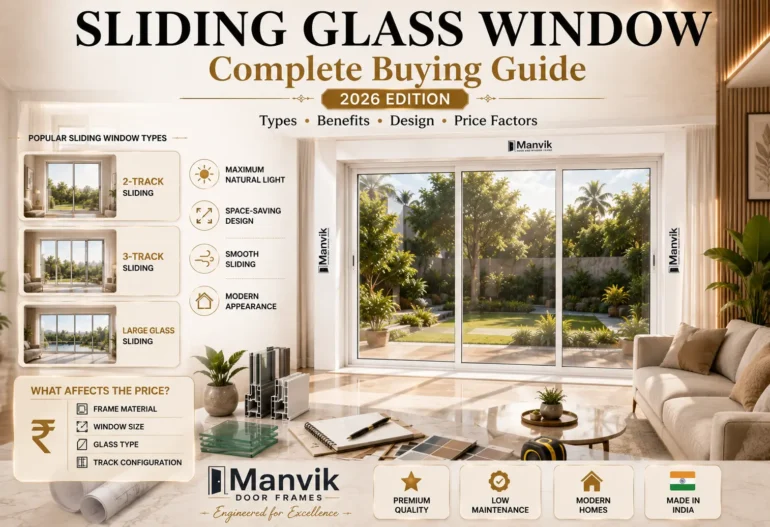
Buying a sliding glass window sounds simple until you’re actually standing in front of a quotation with track counts, glass specifications, and three frame materials you’ve never had to compare before. Most buyers start out looking for something that opens smoothly, lets in light, and doesn’t leak during monsoon — and end up needing to make decisions about corrosion resistance, panel configuration, and roller hardware they didn’t know existed. uPVC sliding windows in India
Sliding Glass Window: Complete Buying Guide, Types, Benefits & Price Factors (2026)
This guide walks through what a sliding glass window actually is, how it works, which designs suit which rooms, what drives the price, and how frame materials — including PPGI, aluminium, uPVC and wood — stack up against each other. Manvik Door Frames manufactures PPGI sliding glass windows and door frames, and that option is covered here alongside the others, with its strengths and its limits laid out honestly rather than oversold.
Key Takeaways
- A sliding glass window opens horizontally along tracks instead of swinging outward, which makes it a strong choice where floor or wall space is limited.
- Frame material (PPGI, aluminium, uPVC, or wood), glass type, and hardware quality matter more to long-term performance than the number of panels alone.
- Toughened and laminated glass are the standard safety choices for Indian homes; double glazing and Low-E glass add thermal and acoustic performance at extra cost.
- Sliding glass window price in India depends on size, frame material, glass specification, track count, hardware, and installation — there’s no single fixed rate.
- PPGI sliding glass windows are worth considering where structural strength and low maintenance matter, but aluminium, uPVC, and wood each remain the right answer in specific situations.
- Installation quality and post-purchase maintenance affect lifespan as much as the product itself.
Sliding Glass Window — Quick Answer
A sliding glass window is a window system where one or more glass panels move horizontally along a track instead of swinging open. It’s chosen for space efficiency, natural light, and easy operation, and is commonly used in living rooms, balconies, kitchens, and commercial facades where a hinged window would need clearance it doesn’t have. choosing the best window frame material
What Is a Sliding Glass Window?
In essence, the sliding glass window is constructed from just a handful of components: frames (the exterior structure which holds everything made of PPGI aluminum, uPVC or wood) Glass panels have tracks built within the frame to allow for movement, rollers that are attached to the base of the window that allow it to glide through the window, and finally, an locking mechanism to secure the window once it’s shut.
Instead of hinges that move a sash either outward or backward and inward, sliding windows are able to move along the wall. A few panels remain in place while the others move behind or ahead of them. This is the reason sliding windows do not require the same clearance that the casement or awning windows demands — an essential aspect for walkways and balconies as well as rooms that are meticulously planned.
How Does a Sliding Glass Window Work?
The system is simple; however, each component has to work in the right way in order for the window to function efficiently for a long time instead of months.
- Frame Installation The outer frame is secured to the wall, at a level and square, and tracks run along the top and bottom.
- Panel positioning Glass panels are placed inside the frame and are fitted with rollers at the bottom.
- Track engagement Rollers are placed within the grooves of the track that help the panel move as it is pulled or pushed sideways.
- Slide motion One panel (or several, for a multi-panel system) moves horizontally and overlaps that fixed panel once it is open.
- Locking A locking latch, also known as a multi-point lock, connects between the fixed frame (or frame) for the purpose of locking the frame to closed.
- Sealing weather stripping as well as drainage channels inside the track is designed to control water and airflow in the event of a window being closed.
What goes wrong in most cases is with the hardware Cheap rollers wear away tracks, collect dirt and dust, and windows begin to stick after a few years. It’s an installation and hardware issue, not a frame-material problem, so it’s important to check it out regardless of the frame material you pick.
Benefits of Sliding Glass Windows
Efficiency in space Because it doesn’t swing, the windows can be used in tiny balconies and narrow verandas as well as rooms where furniture arrangement would interfere with hinged sliding sashes.
Nature light big windows with thin frame profiles allow more light for each square foot of the wall than other windows.
Ventilation: Based on the panel’s configuration, the window can open from a tiny gap up to approximately half of the size of the window.
Wide-views are ideal for balconies and living spaces as well as ground-floor rooms that face a street or garden The sliding windows let the outside in without any visible hinges or frames that block the view line.
Contemporary appearance: A flat and linear shape suits modern architectural styles better than a protruding casement or sash.
Easy of use A properly-installed sliding window can be opened and closed by a gentle hand press No cranking or latching mechanism is required.
Flexibility in design The sliding systems are able to scale from a compact kitchen window up to complete walls in living rooms.
There are trade-offs too. The sliding windows usually have less ventilation space over a similar casement window (since the same panel will always be over the entire opening) The track needs to be cleaned regularly to ensure smooth glide. This doesn’t mean that they are incompatible They’re worthwhile to be aware of before committing.
Types of Sliding Glass Windows
2-Track Sliding Glass Window
The most simple and popular design is two panels operating across two parallel tracks, each panel being fixed and the other sliding (or each sliding towards the middle). It is ideal for bedroom and kitchen doors that require simple illumination and ventilation, rather than a broad and dramatic opening. Simpler and less expensive than multi-track; however, their maximum area of openness is restricted to about half the width of the window.
3-Track Sliding Glass Window
Third track is added, which allows three panels, usually two sliding and one fixed, or the three panels to be moved. It is ideal for large openings, like living spaces and bigger balconies that require an open space or mesh screen panel that is not losing a glass screen. Cost slightly higher because of the additional hardware and track, as well as the frame having a slight increase in depth.
Multi-Track Sliding Window
There are four or more tracks that can be used to create large openings—typical in balconies with large openings or verandas as well as commercial façades. The panels may stack on top of one another in full view and create a nearly unobstructed view. This requires precision setup and high-quality rollers because more panels require more moving parts that need to be aligned.
Fixed + Sliding Window
Combining the fixed (non-opening) glass panels with the possibility of sliding panels. It is useful when you need an expansive glass space for views and light, but you only require a part of it to be open, typically in living spaces or commercial fronts of stores. It reduces the cost of hardware on fixed sections while allowing airflow when needed.
Corner Sliding Window
Two windows that slide together in a corner of the building, often using a corner post and often designed to reduce the frame visible at the corner. The ideal choice for bedrooms and living rooms which wrap around corners and in which great views are paramount. It requires careful planning of the structural layout since two window systems intersect at either a load-bearing or nonload-bearing corner intersection.
Large-Panel Sliding Window
Utilizes smaller, more expansive glass panels than smaller ones. They’re often used with frameless profiles to create an almost frameless appearance. It is ideal for modern homes or farmhouses as well as premium commercial or residential projects that value views that are unimpeded. More expansive panels are heavier; therefore, the specifications for the track and rollers need to be matched to the glass’s size and weight.
Sliding Glass Window Design Ideas for Modern Homes
The design choice is usually based on to the amount of glass you would like to be visible to the frame and which finishes will best complement the frame’s interior or exterior.
- Simple design frame with slim lines and large glass panels without visible grille—works well with modern interiors.
- Large glass panels with fewer divisions with maximum views, usually coupled with sliding and fixed arrangements.
- Frames in a dark or black finish is a striking design that’s becoming popular for modern Indian houses and work particularly well with light-colored walls.
- The appearance of wooden frames is available on PPGI aluminum, uPVC, and PPGI with textured coatings. This gives an attractive look and feel but without the hassle of real wood.
- Ceiling-to-ceiling sliding glass is a common feature in balconies and living spaces in which the aim is to blur the line between outdoor and indoor spaces.
- Window with a corner that allows panoramic views of bedrooms and living spaces.
- Windows that slide down balconies are generally 3 or 2 tracks and sized to fit the opening of the balcony, typically coupled with mesh panels.
- Living room with large sliding windows Multi-panel or big-panel designs for the maximum lighting and air flow.
- Windows for kitchen sliding are smaller and focused on ventilation, usually placed above sinks or counters.
- Windows for bedrooms sliding Balance between privacy glass and light Sometimes, they are used in conjunction with blinds or curtains.
- Windows that look like villas that have bigger openings, high-end hardware, usually larger panels, or multi-track.
- Window sliding for apartments Compact 2-track system that can be used with normal rectangular openings.
- Sliding windows in the farmhouse: large windows that connect living areas with outdoor patios and sit-out areas.
Sliding Window Design Photos & Inspiration
The following are design concepts a buyer or publisher can use as a brief for photography or renders — not existing photographs.
| # | Design Name | Best For | Recommended Glass | Recommended Frame | Design Description |
|---|---|---|---|---|---|
| 1 | Minimalist 2-Panel | Apartments | Toughened clear | uPVC or PPGI | Slim sightlines, single fixed + single sliding panel |
| 2 | Wide 3-Track Living Room | Living rooms | Toughened + Low-E | Aluminium or PPGI | Three-panel system opening onto a balcony or patio |
| 3 | Floor-to-Ceiling Balcony Slider | Balconies | Laminated safety glass | Aluminium or PPGI | Full-height panels maximising view and light |
| 4 | Black-Frame Contemporary | Living rooms, study | Toughened clear | Powder-coated PPGI/aluminium | Dark frame against light walls for contrast |
| 5 | Corner Wraparound Window | Bedrooms, corner rooms | Toughened + tinted | Aluminium or PPGI | Two sliding sections meeting at the corner |
| 6 | Kitchen Ventilation Slider | Kitchens | Frosted lower panel, clear upper | uPVC or PPGI | Compact 2-track above the counter |
| 7 | Mesh-Screen Balcony Slider | Balconies | Toughened clear | Aluminium or PPGI | 3-track with dedicated insect-mesh panel |
| 8 | Wooden-Finish Traditional Slider | Villas, farmhouses | Toughened clear | Wood-finish uPVC or PPGI | Textured wood-look coating, classic profile |
| 9 | Large-Panel Frameless Look | Premium homes | Toughened, thicker spec | Aluminium or PPGI | Minimal visible frame, large single panels |
| 10 | Fixed + Sliding Combo | Living rooms, offices | Toughened + Low-E | Any | Large fixed centre panel with sliding sides |
| 11 | Bedroom Privacy Slider | Bedrooms | Frosted/tinted lower half | uPVC or PPGI | Balances daylight with privacy |
| 12 | Multi-Track Veranda Slider | Verandas, farmhouses | Toughened clear | PPGI or aluminium | Four or more panels stacking fully open |
| 13 | Tinted Solar-Control Slider | West/south-facing rooms | Tinted or reflective | Aluminium or PPGI | Reduces heat gain and glare |
| 14 | Double-Glazed Acoustic Slider | Homes near traffic | Double-glazed | uPVC or PPGI | Prioritises noise reduction |
| 15 | Compact Study-Room Slider | Study rooms, home offices | Toughened clear | uPVC or PPGI | Small, efficient 2-panel unit |
Sliding Glass Window for Home — Where Should You Use It?
Living Room
Priority is usually maximum light and view, so 3-track, multi-track, or fixed + sliding configurations with larger glass panels tend to work best. Toughened or Low-E glass is a common pairing if the room gets strong afternoon sun.
Bedroom
Balance of daylight and privacy matters more here. Smaller 2-track or 3-track windows with tinted or frosted lower panels, paired with curtains or blinds, are typical.
Kitchen
Ventilation and easy cleaning take priority over view. Compact 2-track sliders positioned above the counter or sink, often with a mesh option, work well.
Balcony
Weather exposure, safety, and ease of operation matter most — covered in detail in the next section.
Study Room
Smaller openings with good daylight and minimal distraction; a compact slider with clear toughened glass is usually sufficient.
Villa
Larger openings, often multi-track or large-panel, with premium hardware and finish given the scale of the project and typically higher exposure to wind and weather.
Apartment
Standard 2-track or 3-track sliders sized to fit existing openings, prioritising cost-efficiency and low maintenance in shared-building settings.
Farmhouse
Wide openings connecting indoor and outdoor living spaces call for multi-track or large-panel systems, often with a durable, low-maintenance frame given the more exposed setting.
Sliding Glass Window for Balcony
Balconies put more demands on a sliding window than most interior rooms, since the window is directly exposed to wind, rain, and sun, and often sits at height.
- Safety — toughened or laminated glass is the standard recommendation for balcony applications given the exposure and, in upper floors, the fall-risk if glass breaks.
- Ventilation — a 2 or 3-track configuration usually gives enough openable area without compromising the frame’s weather sealing.
- Views — larger panels and slimmer frames maximise sightlines, which is usually the main reason buyers choose sliding over casement for balconies.
- Wind exposure and rain protection — check that the frame and track system include proper weather sealing and a functioning drainage channel; this matters more on higher floors and exposed facades.
- Child safety — where young children are present, consider restrictor locks or a design that limits how far the panel can open, and confirm the glass specification meets your building’s safety requirements.
- Locking systems — a functioning multi-point or secure single-point lock matters more on a balcony than an interior room, given the height and outdoor access.
- Maintenance — balcony windows accumulate more dust, grit, and rain residue in the tracks than interior windows, so more frequent cleaning is generally needed.
- Frame selection — corrosion resistance and weather performance matter more here than in a sheltered interior window, which is one reason PPGI, aluminium, and uPVC are all commonly used on balconies rather than untreated wood.
None of this is a substitute for a structural or safety assessment specific to your building — check local building code requirements and consult your installer or architect for balcony glazing on upper floors.
Sliding Glass Window Panels Explained
2-Panel Sliding Window
One fixed, one sliding panel. The simplest configuration, suited to smaller openings like kitchen or bedroom windows.
3-Panel Sliding Window
Typically two sliding and one fixed, or all three moveable. Suits medium-to-large openings such as living rooms and balconies.
4-Panel Sliding Window
Common in wide openings where more openable area is wanted without going to a full multi-track system; panels often pair up and slide toward each side.
Fixed + Sliding Panels
A large fixed panel for view and light, combined with one or more smaller sliding panels for ventilation — common in living rooms and commercial storefronts.
Multi-Panel Systems
Five or more panels for very wide openings such as verandas and facades, where panels stack behind one another when fully open.
| Panel Type | Best For | Opening Potential | Space Requirement | Typical Application |
|---|---|---|---|---|
| 2-Panel | Small to medium rooms | Up to ~50% of width | Low | Kitchen, bedroom |
| 3-Panel | Medium to large rooms | Up to ~60–65% of width | Moderate | Living room, balcony |
| 4-Panel | Wide openings | Up to ~50% of width per side | Moderate to high | Wide balconies, living rooms |
| Fixed + Sliding | Rooms needing view + limited ventilation | Limited to sliding section only | Low to moderate | Living room, office |
| Multi-Panel | Very wide openings | High, panels stack fully open | High | Veranda, facade, farmhouse |
Choosing panel count comes down to opening width, how much ventilation you actually need versus fixed glass for view, and budget — more panels mean more tracks, rollers, and hardware, which raises cost.
Which Glass Is Best for Sliding Glass Windows?
Toughened Glass
Heat-treated for strength; if it breaks, it fractures into small, less-hazardous pieces rather than sharp shards. The standard safety choice for Indian residential and balcony applications.
Laminated Glass
Two or more glass layers bonded with an interlayer that holds the glass together even when cracked. Preferred where added security or sound reduction is a priority, and often specified for higher-floor balconies.
Double-Glazed Glass
Two glass panes with a sealed air or gas gap between them, improving thermal insulation and reducing noise transmission compared to single glazing. Adds cost and frame depth requirements.
Low-E Glass
A coating that reflects infrared heat while allowing visible light through, reducing heat gain in hot climates and heat loss in cooler ones. Useful on west or south-facing openings with strong sun exposure.
Tinted Glass
Reduces glare and some heat gain by adding colour to the glass itself; a lower-cost alternative to Low-E for basic solar control.
Frosted/Privacy Glass
Obscures visibility while still transmitting light — common for bathroom, kitchen, or lower bedroom panels where privacy is needed without blocking daylight.
| Glass Type | Safety | Privacy | Thermal Performance | Noise Control | Natural Light | Typical Application |
|---|---|---|---|---|---|---|
| Toughened | High | Low | Standard | Standard | High | General residential/balcony |
| Laminated | High | Low | Standard | Above average | High | Balconies, security-focused areas |
| Double-Glazed | Standard | Low | High | High | High | Noisy or extreme-climate locations |
| Low-E | Standard | Low | High (heat control) | Standard | High | Sun-exposed facades |
| Tinted | Standard | Moderate | Moderate (glare/heat) | Standard | Moderate | Sun-exposed facades, offices |
| Frosted/Privacy | Standard | High | Standard | Standard | Moderate | Bathrooms, ground-floor bedrooms |
The right specification depends on the application — thickness and exact performance figures should come from your glass supplier or manufacturer based on your window size, wind load, and local building code, rather than a generic recommendation.
Which Frame Material Is Best for Sliding Glass Windows?
There’s no one “best” frame material—each material performs differently based on the application, the budget, climate, and the maintenance needs.
(Pre-Painted Galvanized Iron) frames are constructed from galvanized steel to resist corrosion. They are then finished in the factory to provide extra protection. They generally provide high strength and rigidity to frames and have low maintenance. But their performance is heavily dependent on the coating’s quality and accuracy. PPGI door frames
The aluminum frames are light, natural, and corrosion-resistant. They are offered in thin profiles that are suitable for modern-day architecture. They work well in all Indian climates and have been a popular selection for both residential and commercial sliding windows.
UPVC frames are polymer-based options that are popular for their low maintenance requirements, high insulation (acoustic and thermal), and ability to withstand termites and moisture. They are the most popular option in humid coastal areas and areas that are sensitive to noise, but massive or large-sized openings require reinforced uPVC profiles.
Wood frames have a timeless design and are naturally insulating; however, they require regular maintenance, such as sealing, painting, or polishing — in order to stop warping, moisture, and termite harm, especially when it is hot in Indian climates.
What Is a PPGI Sliding Glass Window?
The word “PPGI” means “pre-painted galvanized iron.” A PPGI sliding glass window is made of steel that is first galvanized and then coated with zinc for resistance to corrosion. Then, it is coated at the factory using an anti-corrosion color coating prior to being shaped into the frame’s shape.
Frames are constructed using high-quality cutting and joining. Tracks are constructed into the base of the profile for glass panels. The hardware (roller handle, locks, and rollers) can be included to make up the complete operating system. Since the coating is applied prior to production, the edges of the cut are the primary point at which the corrosion resistance is reduced when it is not finished properly, an aspect worth asking the maker.
Key Features of PPGI Sliding Glass Windows
When it is a matter of fact, PPGI frames are associated with the following:
- Structural Strength Steel generally provides more rigidity per thickness than aluminum or UPVC. This can result in thinner frame profiles to support the same amount of load.
- The resistance to corrosion, which is offered through the galvanized zinc layer together with the pre-painted coating, although the amount of protection is determined by coat thickness and the quality.
- Resistance to moisture and weather is relevant to the facades of balconies as well as exposed ones, which also rely on the integrity of the coating and details for installation (sealing and drainage).
- low maintenance The coated PPGI frame usually requires less frequent painting than wood and requires less maintenance than uPVC profiles exposed to extreme temperatures.
- Manufacturing precision Steel frames are fabricated with precise tolerances and allow for seamless panel operation.
- Flexible design, and customised sizes Custom sizing and design flexibility PPGI frames are able to be made according to the project’s specifications for commercial and residential usage.
This is a good opportunity to be clear the actual performance of a window is contingent on PPGI grade and coating as well as accuracy of the manufacturing process, choice of hardware, quality of installation, exposure conditions, and continuous maintenance. It’s not based just the name of the material. A poorly coated or poorly installed PPGI window won’t perform as well as an aluminum or uPVC window, and in reverse.
PPGI Sliding Window Technology at Manvik Door Frames
Manvik Door Frames manufactures PPGI sliding glass doors and frames by using particular manufacturing methods:
- Weld-Free Technology frames joints are joined without welding. This is designed to prevent heating distortions and damage to coatings that welding may cause to joints.
- Rivet Technology: Mechanical joints that are riveted can be utilized in the frame assembly procedure instead of or in conjunction with welding or adhesive joints.
- Manufacturing and finishing precision frames are made and then finished according to the openings that are specified.
- Custom-designed dimension frames are able to be made to specific sizes that meet the needs of commercial or residential customers.
They are processes for manufacturing that are not certified or tested outcomes. Ask Manvik Door Frames directly for specific technical documents, warranty conditions, or specification sheets prior to submitting an order.
PPGI vs Aluminium vs uPVC vs Wood Sliding Glass Windows
| Factor | PPGI | Aluminium | uPVC | Wood |
|---|---|---|---|---|
| Strength | High rigidity per thickness | High, lightweight | Moderate; reinforced profiles for larger spans | Moderate, depends on species |
| Durability | High, if coating is well-maintained | High | High, resistant to rot/termites | Moderate, needs upkeep |
| Corrosion Resistance | High (galvanized + coated) | High (naturally resistant) | Not applicable (non-metallic) | Not applicable |
| Moisture Resistance | Good, coating-dependent | Good | Very good | Requires sealing/treatment |
| Weather Performance | Good | Good | Good, strong in humid/coastal climates | Variable, weather-sensitive |
| Maintenance | Low, occasional cleaning | Low | Very low | Higher — periodic sealing/painting |
| Design Options | Growing range of finishes | Wide range, slim profiles common | Wide range, including wood-finish coatings | Classic aesthetic, natural finishes |
| Thermal Considerations | Moderate (steel conducts heat) | Moderate unless thermally broken | Good natural insulation | Good natural insulation |
| Customization | Project-specific sizing available | Widely customizable | Widely customizable | Customizable, more labour-intensive |
| Cost Considerations | Varies by grade, coating, and project | Varies by profile and finish | Varies by profile and reinforcement | Generally higher due to material and labour |
| Residential Use | Suitable | Widely used | Widely used, especially humid regions | Suitable, traditional preference |
| Commercial Use | Suitable for structural applications | Very common | Less common at large commercial scale | Uncommon at commercial scale |
| Long-Term Value | Good if coating quality is high | Consistently good | Good, especially low-maintenance priority | Depends on maintenance commitment |
Choose PPGI if you want a strong, low-maintenance frame and are comfortable evaluating coating quality and manufacturer track record, especially for custom or larger openings.
Choose Aluminium if you want a well-established, widely available option with slim modern profiles and consistent performance across most Indian climates.
Select uPVC if minimal energy maintenance and thermal insulation and resistance to termites or humidity are important to you specifically in coastal and sensitive areas.
Choose wood if classic style and aesthetics is more important than reducing maintenance costs and you’re prepared for frequent maintenance.
Sliding Glass Window Price—What Determines the Cost?
Price is influenced by a mix of elements more than factor:
- Frame Material—PPGI aluminum, uPVC, and wood each have different materials for base and manufacturing costs.
- Window sizes Larger openings require more material as well as more robust hardware.
- Panels and tracks The more panels generally refer to more tracks and rollers as well as locking hardware.
- Glass thickness and specifications such as toughened, laminated, double-glazed, and low-E glass can be priced differently.
- Hardware quality of the roller as well as lock types and finish on the handle affect the cost.
- Finished powder coating and anodizing, as well as custom colors, can be added costs.
- Customization sizes that are not standard or requests for design can increase the costs for fabrication.
- Quantity bulk or project orders usually have distinct pricing from single-window purchases.
- Installation labor: The site’s conditions and the height of the floor affect installation costs independently of the window.
- Location of the project and transportation Delivery distance and accessibility to the site can be added in the final.
There aren’t any the fixed rupees here since prices vary too widely depending on the specification of the client and their supplier. be able to provide an estimate that is that is based on the exact specifications you have.
Sliding Glass Window Price in India
The cost of sliding glass windows in India differs significantly based on the frame’s material and size as well as the glass’s specifications and the hardware—there is no one standard price that is applicable across the various cities or even project kinds. Basic 2-track uPVC or aluminum window featuring toughened glass typically costs less than a large multi-track PPGI or aluminum system that has double-glazed or laminated glass as well as top-quality hardware.
| Factor | Potential Cost Impact | Why |
|---|---|---|
| Size | Higher for larger openings | More material, glass, and structural hardware required |
| Frame Material | Varies by material and grade | Base material cost, coating/finish, and fabrication differ |
| Glass | Higher for laminated/double-glazed/Low-E | Additional processing and material layers |
| Tracks | Higher for 3-track/multi-track | More profile, hardware, and installation complexity |
| Hardware | Higher for premium rollers/locks | Better hardware improves longevity and smoothness |
| Customization | Higher for non-standard sizes/finishes | Custom fabrication and design work |
| Installation | Varies by site and floor height | Labour, access, and site preparation |
| Quantity | Often lower per unit for bulk orders | Project-scale manufacturing efficiencies |
If you need current, verified pricing, request a quotation directly from the manufacturer for your specific size, material, and glass specification — reputable suppliers will clarify whether installation and GST are included in any figure they provide.
Does Sliding Window Design Affect Price?
Yes, design options add on top of the base material and the glass price:
- A 2-track design tends to be the most cost-effective design.
- 3-track designs are more expensive due to the additional panel, track, and hardware.
- Multi-track styles are the most expensive among normal configurations due to the size of the panels as well as the accuracy needed to ensure seamless functioning.
- Corner Designs usually add expense because of the structural and design complexity involved in the fabrication of the junction.
- Large-panel styles will cost you more per square foot due to the fact that the heavier glass requires sturdy frames and stronger hardware.
- Customized designs (non-standard dimensions, shapes, or even finishing) come with a cost for fabrication.
- Hardware that is premium (heavy-duty rollers, multi-point locks) costs more, but in general increases the lifespan and ease of use.
- Design or performance glass (low-E double-glazed, laminated) costs more than normal toughened glass.
How to Choose the Best Sliding Glass Window for Your Home
- Take measurements of the opening precisely and accurately, encompassing dimensions, width, and height. depth of the frame.
- Select the location such as living space and balcony, kitchen or bedroom, etc. This determines the shape of glass and panels.
- Select a frame’s material according to your preferences for maintenance, climate, and financial budget.
- Choose the glass suitable for the area and use toughened glass as the baseline, laminated, or double-glazed when security, noise or thermal performance is more important.
- Select 2 tracks to meet normal needs, or 3 tracks or multi-track to open up more space and more airflow.
- Configuration of the select panel is based on the amount the panel needs to be opened versus remain fixed.
- Verify the for rollers Ask questions about the material of the roller and its load rating, in particular for heavier or larger panels.
- Verify the locking mechanism and confirm that it is compatible with the window, especially for balconies and windows on the ground floor.
- Take into consideration the weather’s exposure, such as balconies and higher floors, which require more drainage and sealing than windows that are sheltered inside.
- Compare maintenance specifications across materials you’re looking at.
- Think about the lifetime value and not only cost upfront—hardware finish and coating quality impact the performance of windows later.
- Choose an experienced supplier or manufacturer and inquire about specifications and references, as well as clear quotes.
Sliding Glass Window Buying Checklist
Frame material selected (PPGI or aluminium, uPVC or wood) The glass type chosen (toughened or laminated, double-glazed / low-E / tinted or frosted) The glass specification is confirmed by the manufacturer Number of tracks selected (2 3 tracks / 2 tracks / multi-track) Panels selected Checked for quality of the roller Security system verified Drainage provisions verified Weather sealing confirms Frame color/finish chosen Accurate measurements taken Plan of installation confirmed Warranty conditions agreed with the manufacturer’s maintenance requirements were understood. Support from the manufacturer and contacts finalized Final quotation accepted and then reviewed. sliding windows for home
Common Mistakes to Avoid When Buying Sliding Glass Windows
- The only way to determine price is by The cheapest alternative is typically the most affordable because of a specific reason, such as the coating or hardware.
- Do not ignore the safety of glass—the use of glass that is not toughened in the areas of high traffic or balconies is a frequent and preventable oversight.
- Unskillful measurements Incorrect opening measurements can lead to gaps, seal issues, or windows that do not meet at all.
- Rollers that are cheap, rollers of poor quality, break down quickly and can be one of the main causes for a “sticking” sliding window.
- Locking systems that are weak are particularly dangerous for balconies and windows on the ground floor.
- Incorrect track selection—not specifying tracks to accommodate a large or heavy-panel opening can cause difficulties with operations.
- Insisting on weather conditions—failing to account for rain and wind as well as sun exposure when choosing the glass or frame.
- Doing nothing about maintenance by choosing the most maintenance-intensive material and not being equipped for the ongoing maintenance it demands.
- Frame material selection without thinking about the intended use What works to create a safe interior window might not be suitable for an open balcony.
- A poor installation A quality window won’t perform as well when it is installed off-level or not properly sealed.
Sliding Glass Window Installation—What Buyers Should Know
Quality of installation can have as big an influence on how the sliding window functions just as does the window itself.
- An exact measure of opening prior to making.
- Alignment of the frame The frame should be placed at a level, square position. Even minor misalignments can cause problems for operation.
- Track alignment tracks should be level and flush to ensure easy panel motion.
- Glass fit The panels are placed into frames and inspected for gaps that are even.
- Adjustment of rollers The rollers are adjusted and checked for an even, smooth movement.
- Lock alignment: Locking components are checked to ensure proper engagement.
- Weather-seal gaskets as well as sealants are applied to the perimeter of the frame.
- Drainage Track: Drainage points are inspected to avoid the pooling of water.
- Final examination The window is closed, opened, and then locked several times in order to verify the operation is smooth before the final sign-off.
A professional installation is well worthwhile -a window that is well made that is not installed correctly will cause difficulties (sticking or leaking, misalignment) quicker than a simple window properly installed.
How to Maintain Sliding Glass Windows
- Cleaning tracks Remove dust, grit and dirt from tracks frequently to ensure that the rollers are moving at a smooth pace.
- Cleaning glass Make use of an ordinary glass cleaner. Avoid abrasive products that may scratch the coatings or cause tinting.
- Inspection of the roller Check regularly to see if the roller is worn, especially for windows you use daily.
- Checking the locks Make sure that the lock mechanism is fully engaged and it isn’t loosening.
- Cleaning the drainage channels Clear drainage channels so that water won’t get soaked during rainstorms.
- Seal Inspection Check the weatherstripping for cracks or holes that could allow in air or water.
- Cleansing frames Cleanse frames regularly; stay away from harmful chemicals that can damage the coatings or finish.
- Regular professional inspection is recommended for bigger commercial multi-track installations; regular inspections with a qualified professional will catch the issues prior to them becoming expensive.
Where Can Sliding Glass Windows Be Used?
The sliding glass windows are utilized in a variety of types of buildings: houses and apartments and villas, farmhouses, hotels, offices and schools, showrooms, and many other commercial properties. Certain applications—specifically schools, hospitals, and commercial facades with high rises—typically have specific local building codes or safety regulations, and so the requirements must be verified by your contractor, architect, or your local authority than relying on general guidelines.
When Should You Consider a PPGI Sliding Glass Window?
PPGI is an option to consider when:
- The strength of the structural structure is the most important aspect relative to the thickness of the frame such as more large open spaces that are custom-designed.
- The importance of low maintenance is important, and you’re confident in assessing manufacturing and coating quality instead of basing your decision on brands’ names alone.
- Contemporary construction projects require frames to be fabricated according to specific dimensions.
- The commercial applications profit from steel’s strength and structural qualities.
- Applications for residential use when a potential buyer needs the durability and properties PPGI gives over aluminum or uPVC.
- Value over time will be more significant than the cheapest upfront cost in the event that coating performance and track record of the manufacturer provide the necessary support.
PPGI isn’t always the ideal option for all projects aluminum, uPVC, and wood all have their own advantages in particular situations as described in the section on comparisons above.
Why Consider Manvik Door Frames for PPGI Sliding Glass Windows?
Manvik Door Frames focuses specifically on PPGI production to make sliding glass windows and door frames. They use weld-free and rivet-joint technologies to create their procedure, with precise manufacturing as well as customizing sizes available to meet commercial as well as residential needs, as well as requests for bulk projects.
For specific details for your project such as delivery coverage, lead times, and warranty conditions, as well as technical specifications sheets, get in touch with Manvik Door Frames directly, because these specifics vary per project and must be verified instead of being presumed.
Sliding Glass Window Pros and Cons
| Pros | Cons |
|---|---|
| Space-efficient — no swing clearance needed | Maximum openable area is less than an equivalent casement window |
| Large glass area for natural light | Tracks need periodic cleaning to stay smooth |
| Easy, low-effort operation | Hardware quality significantly affects long-term performance |
| Suits both residential and commercial use | Multi-panel and large-panel systems cost more |
| Wide range of frame material and glass choices | Poor installation can undermine even a good-quality window |
| Modern, adaptable aesthetic | Corner and custom designs add structural/fabrication complexity |
Which Sliding Glass Window Should You Choose?
To create a contemporary house, consider a slim-profile aluminum or PPGI frame with a big-panel or fixed-and-sliding arrangement and high-quality or low-E glass.
To build balconies: Think about a 2- or 3-track system that has laminated or toughened glass and the confirmed drainage detail and seal such as PPGI, aluminum, or uPVC.
To open a wide opening: Consider a multi-track or large-panel setup with strong hardware that can handle the load of the panel, made from aluminum or PPGI.
for a lower-maintenance option: Consider uPVC or an adequately coated PPGI frame Both of them require lower maintenance than wood.
In the case of commercial projects: Consider PPGI or aluminum for strength and sizing that is custom-made to scale.
To meet customized PPGI needs: Consider Manvik Door Frames to make project-specific PPGI sliding windows, especially when custom measurements or large quantities are required.
Get a Quote for Your Sliding Glass Window Project
No matter if you’re looking to install a single balcony window or you’re planning to specify sliding glass windows for an entire commercial or residential construction, it’s helpful to communicate your ideas with an expert from the manufacturer who will guide you through the materials, glass, and hardware options that will be appropriate to your window’s opening and the place of installation.
- Request a Quote for PPGI Sliding Glass Windows
- Discuss Your Window Requirements
- Get Custom Size Options
- Contact Manvik Door Frames
- Enquire About Bulk Project Requirements
- Become a Dealer
Frequently Asked Questions About Sliding Glass Windows
1. What is a sliding glass window? A sliding glass window is a window where one or more glass panels move horizontally along a track, rather than swinging open on hinges. It’s used where space efficiency, light, and easy operation are priorities.
2. How does a sliding glass window work? Rollers attached to the base of each panel sit in a track built into the frame. Pushing or pulling the panel moves the rollers along the track, letting the panel glide open or closed, where it’s then secured with a lock.
3. What is the price of a sliding glass window? Price depends on frame material, size, glass type, number of panels/tracks, hardware, and installation. There’s no fixed rate — get a quotation based on your exact specification.
4. What is the sliding glass window price in India? Prices vary widely by material, size, and glass specification across Indian suppliers. Request a written quotation from a manufacturer that specifies whether installation and GST are included.
5. Which sliding glass window design is best for homes? It depends on the room — large-panel or fixed + sliding designs suit living rooms and balconies, while compact 2-track designs suit kitchens and bedrooms.
6. Are sliding glass windows good for homes? Yes, for most Indian homes they offer a good balance of light, ventilation, and space efficiency, provided the frame material and glass are matched to the room’s exposure and use.
7. Which sliding glass window is best for a balcony? A 2 or 3-track system with toughened or laminated glass, a secure lock, and confirmed weather sealing and drainage is generally best suited to balcony use.
8. Which glass is best for sliding windows? Toughened glass is the standard safety baseline; laminated, double-glazed, or Low-E glass are added where security, noise, or thermal performance need to be higher.
9. How many panels should a sliding glass window have? It depends on opening width and how much ventilation versus fixed view you need — 2 panels for smaller openings, 3 or more for wider ones.
10. What are sliding glass window panels? Panels are the individual glass sections within the window frame — some fixed, some sliding — that together make up the full window system.
11. Which material is best for sliding window frames? No single material is universally best. PPGI, aluminium, uPVC, and wood each suit different priorities around strength, maintenance, budget, and aesthetics.
12. What is a PPGI sliding glass window? A PPGI sliding glass window uses a frame made from Pre-Painted Galvanized Iron — steel that’s galvanized for corrosion resistance and pre-painted at the factory before fabrication.
13. Are PPGI sliding glass windows durable? Durability depends on coating quality, manufacturing precision, and installation, not the material name alone — a well-made PPGI window can be very durable, while a poorly coated one will underperform.
14. PPGI vs uPVC sliding windows: which should I choose? Choose PPGI for structural strength and custom sizing; choose uPVC for very low maintenance and strong thermal/acoustic insulation, especially in humid climates.
15. PPGI vs aluminium sliding windows: which should I choose? Both offer good strength and low maintenance; aluminium is more established with wider slim-profile options, while PPGI can offer higher rigidity per frame thickness.
16. Do sliding glass windows reduce noise? Standard single-glazed sliding windows offer limited noise reduction; double-glazed or laminated glass options improve acoustic performance noticeably.
17. Are sliding glass windows energy efficient? Efficiency depends on the glass specification (Low-E, double-glazed) and frame sealing quality rather than the sliding mechanism itself.
18. How do you clean sliding window tracks? Remove loose debris with a brush or vacuum, wipe with a damp cloth, and dry the track before operating the window again — avoid harsh chemicals that could damage the frame finish.
19. How long can a sliding window last? Lifespan varies significantly by material, coating/finish quality, hardware, installation, and maintenance — ask your manufacturer for expectations specific to your chosen specification.
20. What should I check before buying sliding windows? Check frame material, glass specification, track/panel configuration, hardware quality, locking system, and get a clear, itemised quotation from the manufacturer.
21. Which sliding windows require less maintenance? uPVC and well-coated PPGI or aluminium frames generally need less upkeep than untreated or poorly maintained wood frames.
22. Can sliding windows be customized? Yes — most manufacturers, including PPGI specialists, offer custom sizing, panel configuration, and finish options for residential and commercial projects.
23. Are sliding windows suitable for Indian weather? Yes, when paired with the right glass and frame material for the specific climate and exposure — coastal, high-humidity, and high-heat regions each call for slightly different specification choices.
24. Which sliding window is best for a bedroom? A 2 or 3-track window with a mix of clear and privacy (frosted/tinted) glass, sized to balance daylight with privacy, generally works well.
25. Which sliding window is best for a living room? Larger 3-track, multi-track, or fixed + sliding configurations with clear or Low-E glass typically suit living rooms best, maximising light and view.
Conclusion
A sliding glass window is ultimately a set of trade-offs — panel count against cost, glass performance against budget, frame material against maintenance appetite. There’s rarely a single “best” answer; there’s a best answer for your specific room, climate, and budget. PPGI, aluminium, uPVC, and wood all have a place, and Manvik Door Frames’ PPGI sliding glass windows are one credible option among them, particularly where structural strength and low maintenance are priorities. The right next step is usually to get accurate measurements and a written, itemised quotation before deciding. upvc sliding window india


