

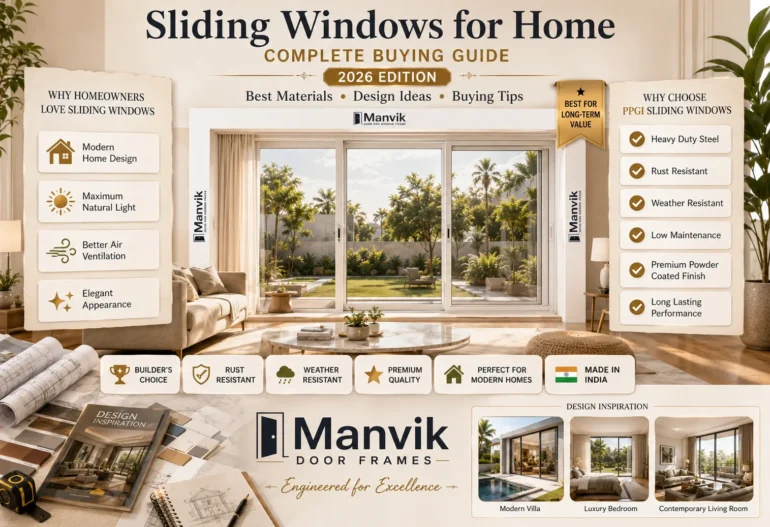
Sliding Windows for Home: If you have ever stood in a showroom trying to decide between uPVC, aluminium, wood, or a metal window system, you already know the problem: every brand says their material is “the best.” It isn’t. Each material is best for something — a certain budget, a certain climate, a certain look. This guide is written to remove the guesswork. It compares sliding window materials honestly, including PPGI Sliding Windows (Pre-Painted Galvanized Iron), so you can pick the right one for your home instead of the one with the loudest marketing. japani chaukhat
Key Takeaways
- Compared to swing casement windows, sliding windows help utilize space and glass while being more practically beneficial.
- The material used for the frame will dictate the windows’ strength and maintenance needs as well as the windows’ lifespans. Sliding windows made with PPGI, uPVC, aluminium, and wood will all have different attributes and considerations after 10 to 15 years.
- PPGI Sliding Windows (Pre-Painted Galvanized Iron) offer iron’s strength and steel’s corrosion resistance, making the windows a great option where having a low maintenance product is important.
- Value is in the specification. Corners are especially important to look at — how they are welded, frame gauge, coating thickness, and glass — should all be considered.
- The material will greatly affect the cost and value of the windows, as wood has the best aesthetics but the worst maintenance, the lowest cost is typically offered from uPVC, and the best sightlines from aluminium, with the best strength and low maintenance coming from PPGI.
Sliding Windows for Home
Sliding windows consist of glass panels (sashes) that slide horizontally along a top and bottom track instead of swinging open. One of the main advantages is the unobtrusive view. They also conserve wall and floor space. Because of these features, they are practical selections for homes and apartments, particularly in balconies, kitchens and living areas. There are four common frame materials: PPGI (metal), uPVC, aluminium and wood. Each of these common materials for sliding windows have different trade-offs for cost, durability, maintenance and appearance. Because of these factors, the right frame material for most Indian homes will most likely depend on the budget, the local weather and the maintenance factor.
What Are Sliding Windows for Home?
Sliding windows are fitted with rollers in one or more sashes which are designed to slide along tracks in the window frame. Rather than the inward or outward swinging motion of casement windows, sliding windows feature a lateral motion. For home design, sliding windows are ideal for places with limited space, for instance, balconies, walkways, corridors, or kitchen worktops.
Sliding windows are better for space management as they can be larger than casement windows and are still just as easy to operate. This is why there are so many sliding windows in new Indian apartments and independent homes, to bring in more light with larger windows that are more functional.
The frame material distinguishes sliding windows from one another and is what most of this guide will cover. Although a uPVC sliding window and a PPGI sliding window may appear identical from a distance, in daily use they perform very differently over the next decade or fifteen years of exposure to the elements.
Benefits of Sliding Windows for Home
Space efficiency. Because sash windows slide, you can utilize the entire room, and curtains and furniture will not be obstructed. They also won’t impose on balcony space.
Improved ventilation. Sliding windows typically feature larger glass panes, thus providing more airflow and letting more light in.
Long-term functionality. Sliding windows also are a better option because the sash has a simplified design, which has significantly less moving parts than hinge-operated windows.
Design flexibility. Sliding windows can be designed for almost any space. They can be used as full-height windows, small windows, kitchen windows, etc. They also can be built with different frame finishes, mesh, grills, frosted glass, and tinted glass.
Weather performance (material-dependent). Since sliding windows are customizable in design, the performance of the windows also can be customized by the material. This is also a large reason the material comparison is in this guide.
Sustainability considerations. Steel-based frames are seamlessly recyclable, and Sustainability is heightened with a window that has a service life of 20+ years. This is reduced from a window that needs to be replaced ever 8-10 years. uPVC is also recyclable, but is not as readily available in India. For construction projects that have sustainable building certification as a goal, frame recyclability is a factor to consider for talks with your suppliers, as is durability.
Popular Types of Sliding Windows
Two-Track Sliding Windows
The simplest model is with two sashes on parallel tracks containing one fixed and one operable sash. Because of their design, they are relatively inexpensive and easy to maintain, which makes them appropriate for most living room and bedroom openings.
Three-Track Sliding Windows
A third track is included to allow a mosquito mesh panel, positioned in between the two glass sashes, or to allow both sashes to slide open for full ventilation.
Multi-Track Sliding Windows
Designed for wide openings with several feet long spans as commonly seen in villas and large living rooms. These designed allow several sash for light and air distribution.
Corner Sliding Windows
Forming an unobstructed, panoramic view, corner sliding windows combine two sliding window units and can have a very slim post and glass junction or none at all. They are popular in modern design for villas and high-rise apartments with an impressive view.
Best Materials for Sliding Windows
PPGI Sliding Windows
What is PPGI? PPGI stands for Pre-Painted Galvanized Iron. These are iron sheets that are dipped in hot zinc for galvanization, then painted with a colored lacquer that is baked on for UV protection and an extra protective finish, which is also an aesthetically pleasing feature. For the purpose of this guide, we will henceforth refer to these products as PPGI Sliding Windows.
Manufacturing process. PPGI window profiles are roll-formed from galvanized steel coil into precise sections of frame and sash and then fully assembled to finished window units. Since the zinc coating is applied prior to the paint coating, the protection from corrosion is built into the metal as opposed to being just a surface coating.
Corrosion resistance. The zinc-iron coating provides sacrificial corrosion protection to the steel. If the paint surface is scratched, the zinc coating will still protect that area from corrosion, unlike painted metal that has no galvanizing.
Precision manufacturing. PPGI coil is roll-formed to very small tolerances, therefore frame sections fit together accurately, which will also affect sash operation and how well the window seals from dust and water over time.
Weld-Free Technology. Traditionally, metal windows are welded at the corners. This can also create heat-affected zones, which result in finish inconsistency and corrosion. Weld-free corner construction eliminates this by mechanically fastening the frame sections.
Rivet Technology. Another advanced fastening method employed in the assembly of modern PPGI window systems is rivet fastening. Rivet fastening secures corners and components of the frame, without the heat stress welding creates. This enhances the finish and results in uniform structural integrity.
Low maintenance. Apart from the occasional cleaning, PPGI sliding windows require no upkeep compared to wood which requires repainting, sanding, and resealing.
Long service life. When galvanizing and coating of the PPGI window systems are done correctly, they will last for decades in both residential and commercial applications.
Suitable applications. PPGI sliding windows can be employed in residential houses, villas, apartments, and even in some institutional and commercial projects. They are particularly useful in projects that require high strength and a wide span with a metal frame and an ultra-thin sightline.
Thermal and acoustic behavior. PPGI Windows with a double glazed or laminated unit improve the thermal performance of the windows, particularly in extreme climates, however, the multi-chambered uPVC profiles are more thermally efficient. In regard to acoustics, PPGI windows are frequently specified for projects, such as houses located along busy roads, due to the combined steel frame and proper gasket sealing of the frame which offer excellent acoustic performance.
Color and finish options. PPGI sliding windows come in a uniform range of finishes, from standard whites and greys to wood-textured and custom RAL shades. Because the paint layer is baked and bonded to the galvanized coil during manufacture, PPGI sliding windows eliminate the variability of finishes on-site, as is the case with wood or field-coated metal.
Weight and handling. PPGI profiles are lighter than solid steel sections, but they retain most of the rigidity of steel. This allows larger sashes that are built with PPGI profiles to slide easier over years of use. Heavier, poorly designed metal frames will sag and drag the sashes along the frame track.
uPVC Sliding Windows
uPVC is rigid, solid PVC, that is multichambered for insulation. It will not rust or rot, and is mostly unaffected by moisture. It has good thermal and acoustic insulation due to its chamber system. When compared to other modern building materials, it is generally the most economical. uPVC comes in various colours with wood grain laminates but is most often found in white.
uPVC has lower structural strength, and is more prone to brittle failure and loss of colour from UV exposure. Reinforcing the rePVC with metal will allow for larger profiles, but will increase the overall cost. uPVC will not be affected by termites and will not require repainting, therefore its maintenance is lower than metal framing, but will have a lower maximum structural strength.
Aluminium Sliding Windows
Aluminium is a light and strong metal. When used in a powder-coated framework, Aluminium is reasonably corrosion resistant in most environments. Compared to other materials, Aluminium is an excellent choice for maintaining a slim sightline, and is regularly used to achieve large openings in modern architecture. This is a large reason Aluminium is regularly used in villa facades and floor to ceiling glazing.
The drawbacks: Regular (non-thermally broken) aluminium transfers heat and cold quickly, affecting the temperature in a room causing condensation in certain climates. In coastal or humid climates, lower quality finishes on non-thermally broken aluminium can be affected over time if the finishing coating is not high quality. Aluminium profiles that are thermally broken (with insulation between the inner and outer frame) solve the heat-transfer problem, but are more expensive than standard aluminium profiles.
Wooden Sliding Windows
No synthetic material can fully replicate the aesthetic of natural wood. Quality hardwoods can last for decades and even centuries. However, those decades of durability only come with a cost of time for maintenance. Wood needs to be sealed, polished, and treated for pests. In addition, wood is more likely to warp due to the humidity in the air and its maintenance cost has the potential to be the highest out of all the materials we are examining, especially when considering the cost of the wood itself.
Different species of wood can also have very different maintenance costs. For instance, kiln-dried, and seasoned hardwoods are much less likely to warp and be a maintenance issue than untreated wood. For homeowners that are interested in the look of wood but want to avoid the maintenance, there are some options that look similar to wood but are actually a composite of PVC and metal, laminates, and treated wood. Although these are better maintenance options, they look different than wood.
PPGI vs uPVC vs Aluminium vs Wood Sliding Windows
| Parameter | PPGI Sliding Windows | uPVC | Aluminium | Wood |
|---|---|---|---|---|
| Strength | High (steel core) | Moderate | High (in thermally reinforced profiles) | Moderate to High (species-dependent) |
| Durability | Very High | High | High | Moderate (climate-dependent) |
| Maintenance | Low | Low | Low to Moderate | High |
| Weather Resistance | High | High | High (finish-dependent) | Moderate |
| Corrosion Resistance | High (zinc-coated) | Not applicable (non-metal) | Moderate to High (coating-dependent) | Not applicable (prone to rot instead) |
| Moisture Resistance | High | High | High | Low to Moderate |
| Lifespan | Long | Long | Long | Moderate (with upkeep) |
| Appearance | Modern, slim, colour options | Clean, uniform, limited texture | Sleek, contemporary | Natural, traditional, warm |
| Cost vs Lifetime Value | Strong value over time | Budget-friendly upfront | Mid-to-premium | Premium upfront + ongoing upkeep cost |
| Best Applications | Villas, independent homes, commercial, high-strength needs | Budget & mid-range residential | Modern facades, large glazing | Traditional/heritage-style interiors |
How to read this table honestly: if your priority is upfront cost, uPVC often wins. If your priority is a slim, high-strength frame with strong corrosion resistance and low long-term upkeep, PPGI sliding windows are a strong fit. If you want the biggest possible glass area with the slimmest sightlines, aluminium is architecturally attractive. If aesthetics and tradition matter more than convenience, wood remains unmatched — provided you’re prepared for the maintenance that comes with it.
Myth vs Fact: Sliding Window Materials
Here are some common window myths you’d want to ensure you don’t fall for.
Myth: “Metal windows always rust.” Fact: Some metal windows rust because they have poor quality coatings where the metal is left unprotected. PPGI sliding windows are steel windows. The steel is first coated with zinc to provide a sacrificial anode for rusting, and is then painted.
Myth: “uPVC windows turn yellow and brittle within a few years.” Fact: Some cheap and poorly made uPVC windows can discolour and become brittle due to UV exposure. However, good quality and UV resistant thermoplastic windows from reputable manufacturers do not have these issues and therefore have a longer service life.
Myth: “Aluminium windows make rooms hotter in summer.” Fact: While uncoated, standard structural aluminium bar stock can transfer heat readily, thermally broken aluminium profiles have a significantly lower rate of heat transfer.
Myth: “Wood is always the most expensive option.” Fact: The price for wood can vary by species. Some laminated wood finishes can be less expensive than higher quality metal or uPVC. Wood can be more expensive in the long run due to the cost of maintenance compared to other alternatives.
Myth: “All sliding windows perform the same regardless of brand.” Fact: The performance of a sliding window after installation can vary greatly based on the frame gauge, the thickness of the window frame coating, the quality of the glass, the quality of the hardware, and the quality of the corner joins (welded versus mechanically fastened).
Modern Homes and Sliding Windows
Villas. The best option are sliding windows that go from floor to ceiling and Corner Sliding Windows. Since Villas lack buildings that are right next to them, they are able to provide better views. PPGI sliding windows are best used in these types of homes as they are both strong and have a modern style.
Apartments. Utilizing space in the best way possible is very important. A good example are sliding windows with between two to three tracks. These windows are space efficient, and when coupled with mesh, allow for ventilation and are secure and easy to clean.
Farmhouses. Since farmhouses are more in the country, they are able to have wider windows. Grills also help make the windows secure. These windows are Multi track sliding windows, or a combination of sliding and fixed windows.
Offices. For control of glare, privacy, and balance of daylight, narrow frame sliding windows with tinted or frosted glass work best. Commercial offices use PPGI and aluminum because they are low maintenance and strong in the sliding windows.
Commercial Buildings. Since these windows need to withstand a lot of sliding, PPGI sliding windows and aluminum with large multi-track systems are great for commercial use.
Room by Room Design Inspiration
Living Room. Since the living room is the largest light source in the house, they are best designed with large Multi-track systems or floor to ceiling sliding windows. These are best framed with a very narrow aluminum or PPGI frame to keep the focus on the view.
Let’s consider what finishes would work best in each room!
Privacy and light control are the two main priorities in the bedroom. Frosted or tinted glass panels with a two-track sliding window strike great balance. Along with a lower-maintenance frame, hold up better, and break up less of the calming low-fuss nature of the room.
In the kitchen, you need the ability to keep the room ventilated to clear cooking smoke and steam. Front sliding windows are works best for the room in the moisture and grease menu. PPGI, uPVC, and powder-coated aluminum hold up better than wood.
The main one room in the house that generally doesn’t contain wood (because it has the weakest moisture resistance) is the bathroom. Frosted or textured glass window units enhance privacy while wood frame windows with a moisture sealing system are the main choice in this room.
Wide sliding windows would be best in the balcony to enhance the view and allow for great cross ventilation. Because of how direct the weather is, things like drainage, corrosion resistance, and frame protection really matter here the most.
How to Choose the Right Sliding Windows for Home
- Start with your climate. Coastal and high-humidity regions benefit from corrosion-resistant materials with strong zinc or powder coatings; hot, sun-intensive regions benefit from UV-stable finishes and good thermal performance.
- Match the material to the room. Kitchens and bathrooms see more moisture and grease — low-maintenance, moisture-resistant frames like PPGI or uPVC are usually a better fit than wood.
- Decide your maintenance appetite. If you don’t want a recurring maintenance schedule, rule out wood early and compare PPGI, uPVC, and aluminium instead.
- Check frame strength versus sightline. If you want large glass panels with slim frames, ask specifically about the profile’s wind-load rating, not just its appearance.
- Confirm the glass type. Tempered or laminated glass is the safer choice for most homes; double-glazing helps in noisy or extreme-climate locations.
- Ask how the corners are joined. Weld-free or rivet-jointed construction (used in PPGI systems) tends to hold its finish and structural integrity better over time than heat-welded joints.
- Get a written specification, not just a price. Frame gauge, coating thickness, glass thickness, and hardware brand should all be documented before you order.
Sliding Window Buying Checklist
Use this checklist when you’re comparing suppliers or quotes side by side:
Frame material confirmed (PPGI, uPVC, aluminium, or wood) with a written specification
Frame gauge / profile thickness disclosed, not just “premium grade” claimed verbally
Coating type confirmed for metal frames (zinc-galvanized + paint for PPGI; powder-coat grade for aluminium)
Corner joint method confirmed (weld-free / rivet-jointed vs traditional welding)
Glass type and thickness specified (float, tempered, laminated, or double-glazed)
Number of tracks and sashes matches your ventilation and space needs
Hardware brand and warranty on rollers, locks, and handles documented
Mesh, grill, or tint/frost requirements included in the quote, not added later
Drainage and sealing details explained for your specific site conditions
Installation and after-sales support terms confirmed in writing
Expert Tip
Ask every supplier the same question in the same words: “What is the frame gauge and coating specification, and how are the corners joined?” The clarity — or vagueness — of the answer tells you more about quality than the glossy brochure will.
Sliding Window Price Factors
Sliding window pricing is influenced by several factors rather than a single number, so treat any quote without specifications attached with caution:
- Frame material — PPGI, uPVC, aluminium, and wood each have different base material and fabrication costs.
- Frame gauge / profile thickness — a heavier-gauge, better-engineered profile costs more but performs better under wind load and daily use.
- Glass type and thickness — plain float glass costs less than tempered, laminated, or double-glazed options.
- Number of tracks and sashes — three- and four-track systems cost more than a simple two-track window.
- Size of the opening — larger openings need reinforced hardware and profiles, which affects price per square foot.
- Additional features — integrated mesh, grills, tinting, frosting, and multi-point locking hardware all add to the final cost.
- Installation complexity — site conditions, floor height, and finishing work (sills, sealing) factor into the total project cost.
Rather than comparing a single “price per square foot” figure across brands, ask each supplier to break down material grade, glass spec, and hardware — that’s the only way to compare like-for-like.
A Note on Installation
The sliding window itself won’t make a big difference in window performance if it’s not installed properly. Before your installer starts working, you may want to confirm a few details. Here are a few things worth noticing. Make sure the opening is properly measured and square prior to the frame being fixed. Make sure the frame is anchored with the correct fasteners to your wall type whether it is RCC wall, brick wall, or block wall. Make sure the gaps are properly sealed. Weatherproof sealant should be used to seal the frame and wall gaps. Make sure the frame is sealed during the installation. The slope on the frame sill should also be outward. The slope should be away from the building and toward the frame. Water should be guided away and not allowed to pool against the building window. Quality of window installation is rarely included in the quote, but window performance is affected by the quality of the frame as well.
Common Buying Mistakes
Here are some common mistakes found when buying windows.
Most people do a price comparison without looking at specs. Quotes are cheaper for a number of reasons including a thinner frame, lower grade glass, cheaper/basics hardware, etc. It is not because they are more cost effective.
Some people look at the price of metal frame windows and do not look at the quality of the zinc coating and the quality of the paint. These are two very important factors determining the life of the window.
There are people that like leaving wood as a raw finish. Leaving wood as a raw finish does not work for areas of high humidity, like the bathroom. Leaving raw wood for a coastal facing bedroom or bathroom is high risk and a bad decision, unless you plan on doing upkeep.
Many do not consider tracks and drainage design. Poor drainage will cause leaking no matter how good the frame material is. You should always as how the window will handle rain.
Most people do not consider the safety of the glass for high wind areas. This includes safety and wind load ratings of the glass as well.
Warranty details are often overlooked. After the third year of use, the availability of spare parts matters more than they do when the window is first purchased.
Maintenance Tips for Long-Lasting Sliding Windows
- To prevent the rollers on the tracks from wearing down, dust and debris need to be removed from the tracks every couple of weeks with either a brush or a vacuum.
- Metal and uPVC frame surfaces should be dusted off with a soap and water solution. Abrasive cleaners should be avoided.
- Track operation can be kept smoother with silicone lubricant once every six months.
- Cracked or compressed rubber gaskets and seals should be replaced because they keep dust and water from getting in.
- Moisture can be kept out of wooden frames by either sealing or repainting every time the manufacturer recommends.
- To prevent water from pooling at the drainage channel sill, the drainage channels should be checked before the monsoon season.
Why Builders & Architects Choose PPGI Sliding Windows
Builders and architects increasingly specify PPGI sliding windows in their designs for villas, residential, and commercial projects because of the advantages PPGI sliding windows offer. For example, PPGI sliding windows combine the advantages of slimmer frame sightlines, performance in balancing wind loads, and strength. Additionally, the zinc-based corrosion protection helps minimize callbacks during window frame installations, and large orders completed with weld-free or rivet-based methods of construction help facilitate the consistency of PPGI sliding windows. This is beneficial for projects having multiple window frames, and all the window frames having to be the same.
Although the advantages of PPGI sliding windows may be attractive, there is no reason to believe that PPGI sliding windows will be the optimal choice for all of the projects. For example, a heritage bungalow may use wood timber sliding windows, and a budget apartment may use uPVC sliding windows. However, for residential and commercial projects which incorporate a modern design with a combination of performance and low maintenance, PPGI sliding windows are often specified.
PPGI sliding windows are often specified for large multi-unit developments such as residential apartment buildings, gated communities, schools, and hotels because of the challenge of integrating unit consistency in windows. Other methods of sliding windows, such as metal windows which are site painted or site fabricated, often show visible differences in finishes from unit to window due to environmental conditions. In contrast, factory pre-painted PPGI profiles are “site ready” and painted in a quality-controlled environment. For these reasons, project architects for large multi-unit developments where consistent window units are as important as the performance of each window unit, prefer and design with PPGI sliding windows.
Why Choose Manvik Door Frames
Manvik Door Frames manufactures premium PPGI Sliding Windows and PPGI Door Frames built on Weld-Free Technology and Rivet Technology — engineered for a precise fit, corrosion-resistant performance, and a clean, modern finish. Here’s what that means for you:
- Precision Manufacturing — roll-formed profiles fabricated to tight tolerances for smooth, long-lasting sash operation.
- Weld-Free Technology — mechanically joined corners that protect the coating and structural integrity of every frame.
- Rivet Technology — a fastening method that avoids heat-affected zones and keeps the finish consistent across every unit.
- Corrosion-Resistant Design — zinc-galvanized steel cores built for long-term weather exposure.
- Custom Sizes — sliding windows fabricated to your project’s exact opening dimensions.
- PAN India Supply — factory-direct delivery for homeowners, dealers, builders, and developers across the country.
- Technical Support — guidance on frame selection, glass specification, and installation from a team that manufactures the product itself.
Custom & Bulk Sliding Window Orders
Homeowners aren’t the only ones reading a guide like this — architects, contractors, dealers, and developers often need custom sliding windows at scale rather than a single unit. Whether you’re sourcing for one villa or specifying windows across an entire residential project, factory-direct manufacturing means custom sizes, consistent finish quality across large order volumes, and bulk pricing that a retail showroom typically can’t match. If you’re evaluating suppliers for a multi-unit project, ask specifically about lead times for bulk orders, consistency guarantees across batches, and whether the manufacturer offers on-site technical support during installation — these details matter more at scale than they do for a single window.
Related Reading
- What Is PPGI? A Complete Material Guide
- PPGI Door Frames: Features & Benefits
- Best Window Frame Material — A Comparison
- uPVC Sliding Windows in India: What to Know
- Best Door Frame Manufacturers in India
Frequently Asked Questions
1. What are sliding windows for home? Sliding windows for home are windows with two or more sashes that move horizontally along a top-and-bottom track, rather than swinging open — a space-saving design suited to most rooms and elevations.
2. Which sliding windows are best for home? The best choice depends on your priorities: PPGI sliding windows suit those wanting strength and low maintenance, uPVC suits budget-focused buyers, aluminium suits slim-sightline modern designs, and wood suits traditional aesthetics with higher upkeep tolerance.
3. Are sliding windows good for homes? Yes — they’re space-efficient, allow more glass area and natural light, and are generally easier to operate day-to-day than swing-style windows, provided the frame material and installation quality are sound.
4. Which material is best for sliding windows? There is no single best material — PPGI, uPVC, aluminium, and wood each perform differently on strength, maintenance, cost, and appearance. Match the material to your climate, room, and maintenance preference.
5. Are PPGI Sliding Windows worth buying? PPGI sliding windows are a strong option where structural strength, corrosion resistance, and low long-term maintenance are priorities, particularly for villas, independent homes, and commercial projects.
6. uPVC vs PPGI Sliding Windows – which is better? uPVC is typically more budget-friendly upfront and performs well thermally; PPGI generally offers higher structural strength and a slimmer frame-to-glass ratio. The better option depends on your budget and performance priorities.
7. How much do sliding windows cost? Cost varies by frame material, profile gauge, glass type, number of tracks, size, and added features like mesh or grills — always compare full specifications, not just price per square foot.
8. Which sliding windows require less maintenance? PPGI, uPVC, and powder-coated aluminium all require significantly less maintenance than wood, which needs periodic sealing, polishing, and pest protection.
9. Which are the best sliding windows for Indian weather? Materials with strong corrosion and moisture resistance — such as PPGI and uPVC — tend to perform reliably across India’s varied climate, from humid coastal regions to hot, dry interiors.
10. How do I choose sliding windows for my home? Consider your local climate, room type, maintenance appetite, desired frame strength and sightline, glass safety requirements, and how the window’s corners and joints are constructed.
11. What is PPGI in windows? PPGI stands for Pre-Painted Galvanized Iron — steel that is zinc-galvanized for corrosion resistance and then finished with a baked-on paint coating.
12. Are sliding windows secure? Security depends on the locking hardware and frame strength rather than the sliding mechanism itself — multi-point locks, quality frames, and optional grills or security mesh all improve security. A steel-core frame like PPGI also adds a structural security advantage over lighter materials, since the frame itself is harder to force open or bend.
13. Can sliding windows be customised in size? Yes, most manufacturers, including Manvik Door Frames, fabricate sliding windows to the exact dimensions of your opening rather than only offering fixed standard sizes.
14. Do sliding windows work well in small rooms? Yes — because they don’t need swing clearance, sliding windows are often a better fit for small rooms than casement designs, maximizing usable space.
15. What glass is best for sliding windows? Tempered or laminated glass is recommended for safety; double-glazed glass helps with noise and thermal insulation in demanding environments.
16. How long do PPGI sliding windows last? With proper zinc-coating thickness and quality fabrication, PPGI sliding windows are built for long-term, multi-decade performance with minimal maintenance.
17. Do sliding windows need a mosquito mesh? Many buyers add an integrated mesh track for insect protection, especially in ground-floor homes or regions with high mosquito activity during monsoon.
18. Is wood a good option for sliding windows in India? Wood offers a traditional, warm aesthetic but requires more maintenance and is more sensitive to humidity and moisture than PPGI, uPVC, or aluminium — it’s best suited to drier climates or well-maintained interiors. In coastal or high-monsoon regions, wood needs more frequent sealing and inspection to prevent warping, which is worth factoring into your decision alongside its upfront cost.
19. What is Weld-Free Technology in window frames? Weld-Free Technology joins frame corners mechanically rather than by welding, which avoids heat-affected zones and helps preserve the coating and structural consistency of the frame.
20. How do I get a quote for sliding windows from Manvik Door Frames? You can request a free quote directly through Manvik Door Frames by sharing your window sizes, preferred material, and location — the team will guide you through specification and pricing.
Final Conclusion
There are no universally superior sliding windows. The best windows are contingent on your home and climate. PPGI Sliding Windows are exceptionally strong and low maintenance. uPVC is more budget-friendly. If the slimmest sightlines are desired, go with aluminium. If you like the warmth of wooden windows, you’re also getting the most traditional window. Just factor in the maintenance.
Regardless of the material, insist on genuine specifications such as frame gauge, coatings, glass, and joints. The price can be compared after that. Sliding windows will be performing with those specifications in mind.
Manvik Door Frames is your answer for top of the line, Weld-Free and Rivet Technology sliding windows built to withstand corrosion. Contact us for your free custom quote and PAN India supply.


