

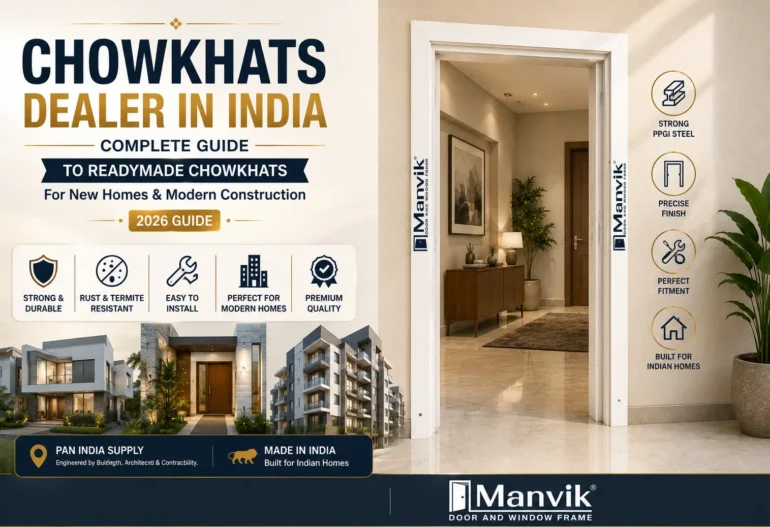
When a new house is nearing the finishing stage, one small mismatch in a door opening can hold up plastering, flooring, and carpentry work for days. This is usually the point at which homeowners and site engineers realise that choosing the right Chowkhats Dealer in India is not a minor decision — it directly affects how smoothly doors fit, how walls finish around the frame, and how the room looks once the project is complete.
Many buyers only start researching Readymade Chowkhats after running into a problem: a frame that doesn’t match the wall thickness, a door shutter that doesn’t align with the chowkhat, or a supplier who can’t confirm specifications clearly. This guide is written to help you avoid that situation — whether you are a homeowner building your first house, a contractor managing multiple openings, or an architect specifying materials for a residential or commercial project.
We’ll cover what chowkhats actually are, how readymade options differ from traditional site-made frames, how PPGI Door Frames fit into this picture, what to check before you buy, common mistakes to avoid, and how to evaluate a dealer or manufacturer before placing an order.
What Is a Chowkhat or Door Frame?
“Chowkhat” is the name widely used throughout India to refer to what’s technically known as a door frame. It’s a rectangular component of the structural structure that sits inside an opening in the wall that keeps the shutter of the door in place. It is utilized different across trades and regions Some places it only refers to the frame and elsewhere it’s broadly used to refer to the frame and the fittings that go with it — therefore it is important to confirm with the contractor or your supplier the exact terms used in the term “chowkhat.”
The door frame is able to perform three major functions:
- It is a support for the shutters for doors and carries its weight via hinges attached on the frame’s vertical members (jambs).
- It is fixed to the wall’s opening it transfers load while maintaining its location throughout its years of closing and opening.
- It’s the name used to define the final design of the entranceway because the frame remains visible once the painting, plastering and flooring is completed.
In light of this dimension and alignment are crucial significantly more than it initially appear to. Frames that are a little out of square or is sized improperly to the wall’s thickness could cause the door to close, and gaps to form on the sides or top and the shutter to move in a wrong direction. That’s why the frame construction is usually designed in conjunction with the wall’s thickness, plaster thickness, flooring levels — and not a separate work in carpentry. japani chaukhat
What Are Readymade Chowkhats?
readymade Chowkhats (also known as ready-made chowkhats or ready-made door frames doors that are made in a factory according to specified dimensions and specifications. They are they are then delivered at the construction site, ready to install. This differs from a custom or site-built frame that is usually made or assembled by a builder or carpenter on or near the location the site.
Certain things differentiate ready-made chowkhats and frames from those made by site:
- Production method: Readymade frames are manufactured using industrial equipment and methods, which allows for more consistent dimensions over several units. This is useful in projects with several alike openings.
- Finalization: Depending on the materials, ready-made chowkhats typically come with the finishing (paint coating, paint, or a surface treatment) already in place and do not require the finishing process after the installation.
- Plan of installation: Because dimensions are set at the time of construction, the wall opening the wall’s thickness and the door shutter must be established in advance instead of being adjusted when work is progressing.
- Applications typical: Readymade chowkhats are utilized in private housing, apartments, building-floor construction, commercial and industrial fitting-outs – wherever with a certain number of openings require consistent factory-made frames.
Builders might consider pre-made chopkhats to cut down on fabrication work on site or standardize dimensions throughout projects, or plan the door frame as an independent and trackable element of the building schedule, as opposed to an ongoing carpentry work.
Why Are Readymade Chowkhats Popular for New Houses?
There’s not a single reason why consumers choose to purchase ready-made Chowkhats. It all is based on how the project being designed and implemented. There are a few reasons for this that come frequently:
- Planning for projects: Ordering frames as an item with a specific line helps you organize and keep track of the construction timetable.
- Dimensions that are consistent: When a house or structure has multiple doors that are the same size factories manufacturing can help maintain the same dimensions across frames to the following.
- Better coordination Because the frame comes mostly finished and ready for painting, coordination with the floor layerers, and installers of door shutters may be more precisely planned.
- A factory-finished look: Depending on the quality of the material and finishing frame designs can be made ready to go. an appearance that is more consistent to the frames that are made on site.
- The availability of standard sizes: Many manufacturers maintain sizes that are standard for most door openings. This can facilitate ordering simple tasks.
- Options for customization: For non-standard openings Some manufacturers offer the option of customizing sizing, which is you should inquire directly with your vendor.
- Improved construction workflows: The reduction in fabrication on site can be a good thing. It means less dust on the site, and less trades working within the same place at the same time.
Be wary about any claims that claim readymade Chowkhats can be used to cut down the time of installation or provide cost savings. The final result will depend on the project size, conditions on the location, as well as how specifications are verified prior to the project’s start.
How to Choose a Reliable Chowkhats Dealer in India
It is usually the most crucial decision made in the whole procedure, since even the most well-crafted frame may create problems for dealers if they does not have the specifications, quantity and coordination in order. If you are considering an Chowkhats Dealer from India (or the Chowkhat provider within India in generalconsider looking at more than price, and think about these aspects:
- Material for the frame What exactly is the actual material of the frame? Is that material well-documented?
- High-quality manufacturing is the frame manufactured using uniform process, with quality control or is it assembled informally?
- frame specifications Do you have the specifications for profiles, thickness and tolerances for dimensional dimensions clearly defined?
- Sizes available Are they available? Does the seller have standard sizes to match doors in India?
- Personalization -Does the dealer have to accommodate special openings that are not standard or meet specific needs for a project?
- Finish What kind of finish alternatives are there and how do they get used?
- door compatibility Does it work in conjunction with the type of door shutter and the thickness you intend to utilize?
- The installation requirements Do the seller provide clear directions regarding how the frame must be aligned and fixed?
- Quantity available Does the supplier provide the quantity of frames you require for your project in the timeframe you require?
- Quote transparency is pricing clearly broken down or is it ambiguous and mixed?
- Coordination of projects Does the supplier responsive to project-specific concerns and modifications?
- Technical assistance • Can they help with questions regarding wall thickness, fixing techniques and frame profiles?
- Coordination of delivery — If appropriate Is the delivery timetable clear?
- Support after-sales (where applicable) Is there a designated person to contact in case issues occur following installation?
The most common mistake and one that can be costly is choosing an Chowkhat retailer who has already been made solely because they offer the most expensive cost. Price that is lower but comes with ambiguous specifications, inconsistency quality, or no assistance could cost more for rework, delays and a wrong results. It’s usually better to evaluate dealers based on specifications clarity and communications first consider price as a element among many and not as the most important one.
What Should You Check Before Buying Readymade Chowkhats?
When placing an order it is helpful to go through an organized checklist instead of using the assumption that you have made. Specifications must always be checked by comparing your site’s requirements and the drawings of your projectrather than against a general model.
- Size of the door opening (the real size and width of the planned or constructed opening.
- Frame dimension include the exterior and internal dimensions of the Chhowkhat.
- Wall thickness is the determining factor for the required frame thickness for an flush fitting.
- The thickness of the shutter on your door The frame’s rebate or groove has to coincide with the shutter that you want to mount.
- Wall level that is finished The wall floor level following plastering and how the frame is placed.
- Floor level that is finished — that is the flooring level that is created after tile or flooring. It alters the frame’s clearance at its bottom.
- Frame’s depth — the extent to which the frame extends beyond the wall’s depth.
- Profile of the frame The outline and cross-sectional design of the frame.
- Finish The surface covering or the paint finish that is used to finish the frame.
- Fixing technique the way in which the frame will be fixed to the wall (this is different for each type of frame and the wall material).
- Quantity -The total amount of frames required, and whether the sizes differ across open spaces.
- Personalization — any other non-standard specifications specific to your project.
- Requirements for installation — Any necessary preparation of the website or sequence prior to the frame being repaired.
It is important to confirm these information with the supplier or manufacturer prior to when placing the order (ideally, by writing down the details — decreases chances of mismatches being that is discovered after the frame has arrived on site.
PPGI Door Frames as a Readymade Chowkhat Option
PPGI refers to Pre-painted Galvanized Iron. Practically speaking, it refers to the base material being galvanized iron – iron treated with a zinc-coated coatingand then completed with a pre-applied painting coating during the process of manufacturing and not coated after the installation.
In the case of the PPGI door Frames This production method has several real-world implications:
- Galvanized base Zinc coating put on during the production process before frames ever reach the location.
- Finish that is pre-painted: Since the paint is placed in a controlled manufacturing location, the finished product generally more consistent as compared to frames that are painted on site.
- Consistency in manufacturing: Producing frames from PPGI coils ensures consistent dimensions and profiles throughout batches.
- applications: PPGI door frames are utilized in residential constructions (independent housing or apartments) and commercial buildings (offices or retail areas and institutional structures) dependent on the particular product and finishing that is selected.
- Finish and design considerations: Colour and finish choices vary from manufacturer to manufactureryou should look at examples or specifications sheets prior to making a final decision.
- Planning for installation: As with any prepared chowkhat PPGI frames require the thickness of walls as well as door shutter dimensions as well as opening measurements confirmed prior to placing an order.
Manvik Door Frames works specifically using PPGI as the primary product, and offers the PPGI door frames, Weld-Free Door Frames and Rivet Technology Door frames that are built on the manufacturing process. Be aware of this that no material for a door frame has no issues with maintenance over the course of its life as well as claims that they are totally maintenance-free, or having an unconditional guarantee for life should be viewed with caution regardless of who manufactures the frames. The truth is that PPGI is manufactured in factory pre-finished form can be designed to cut down on the number of finishing processes on site as compared to other methods The application for your specific project should be discussed directly with a company that can address the specific type of wall temperature, usage, and climate circumstances.
Readymade Chowkhats vs Traditional Door Frames
Both readymade and traditional (site-made) door frames remain valid choices in Indian construction — the right one depends on your project’s scale, timeline, and specific requirements. Here’s a balanced comparison:
| Factor | Readymade Chowkhats | Traditional/Site-Made Frames |
|---|---|---|
| Manufacturing | Produced in a factory to set specifications | Fabricated or assembled on-site or by a local carpenter/fabricator |
| Dimension consistency | Generally consistent across units from the same batch | Can vary depending on the individual fabricator’s process |
| Finish | Often factory-applied, ready or near-ready for installation | Usually finished after installation, on-site |
| Customization | Available with many manufacturers, though may involve lead time | Often adjusted directly on-site during fabrication |
| Installation planning | Requires confirmed dimensions before manufacturing | Allows some adjustment during the fabrication process itself |
| Project coordination | Easier to plan as a distinct supply item with a schedule | Often integrated into ongoing carpentry/masonry work |
| Maintenance considerations | Depends on material and finish selected | Depends on material, workmanship, and finish applied |
| Typical applications | Projects with multiple similar openings, planned schedules | Projects with highly custom openings or flexible timelines |
Neither approach is inherently better in every situation — a small renovation with one unusual opening may be well suited to a traditional, site-adjusted frame, while a multi-unit residential project with dozens of similar openings may benefit more from the consistency of readymade chowkhats.
PPGI Chowkhats vs Wood, WPC and Other Options
Door frame material selection depends on the project’s budget, aesthetic goals, and performance requirements. Here’s how PPGI compares with other commonly used materials in India:
| Factor | PPGI | Wood | WPC | uPVC | Aluminium |
|---|---|---|---|---|---|
| Material | Pre-painted galvanized iron | Natural or engineered timber | Wood-plastic composite | Polymer-based | Metal (lightweight) |
| Appearance | Uniform, factory-finish colours | Natural grain, warm appearance | Can mimic wood grain | Smooth, uniform finish | Sleek, modern look |
| Maintenance | Depends on coating and usage conditions | Requires periodic polishing/treatment, especially in humid areas | Generally lower maintenance than solid wood | Low maintenance in most conditions | Low maintenance, but can show wear at joints |
| Installation | Factory-made, defined fixing method | Often adjusted on-site | Factory-made, similar to PPGI in planning | Factory-made | Factory-made |
| Customization | Available depending on manufacturer | Highly customizable on-site | Available depending on manufacturer | Available depending on manufacturer | Available depending on manufacturer |
| Applications | Residential and commercial | Traditional residential, heritage-style projects | Residential, especially where wood look is desired | Residential and light commercial | Commercial and modern residential |
| Cost factors | Varies by specification and finish | Can range widely by wood type and quality | Generally mid-range | Varies by profile and brand | Generally higher for equivalent specification |
| Project suitability | Projects wanting consistency and factory finish | Projects prioritising a natural material aesthetic | Projects wanting a wood-like look with different maintenance profile | Projects prioritising moisture resistance | Projects with a modern design brief |
No single material is universally the “best” choice — a heritage home renovation may call for solid wood, while a large residential development may lean toward PPGI or WPC for consistency across many units. The right choice depends on your project’s specific priorities.
How Much Do Readymade Chowkhats Cost in India?
This is among the most frequently asked questions that buyers are looking for. It’s crucial to make clear about the fact that there’s no one-time, universally agreed price for ready-made chowkhats because pricing is contingent on many factors that vary from one product to the following.
Factors that impact the price of readymade chowkhats and the cost of a chowkhat usually comprise:
- Material utilized in the manufacture of
- Frame dimensions (height, width, depth)
- Profile and the design’s complex
- Thickness/specification of the base material
- Finish chosen (standard in comparison to top coatings or colors)
- Design personalization
- Quantity placed (bulk orders are usually priced differently from single-unit purchases)
- Manufacturer/Brand as well as their manufacturing process
- Installation specifications, if they are included within the range
- Transportation distances from the production unit up to your site
- The project’s location is a factor that can impact logistics expenses
This is why the dealer who offers an unassailable, fixed price without knowing your specific needs must be handled with care. A more secure option is to ask for a Chowkhat quote as well as door frame quotes, which are based upon your specific dimensions for openings as well as wall thickness, materials you like, and the amount, which will give you the exact number you need to reflect the scope of your work, not an average estimate. chowkhats dealer in india
What Factors Affect PPGI Door Frame Price?
In particular, focusing to PPGI The cost of the PPGI doorframe is affected by a similar but different set of variables:
- Frame size—larger frames require more material per unit.
- Profile: More complex profiles may require many processing stages.
- Materials specification The gauge or thickness of the PPGI sheet that is used.
- Finish – standard colors, compared to specialized or high-end finish.
- Customization of sizes that are not standard or design requirements.
- Quantity Large orders for developers and builders typically are priced differently from smaller residential orders.
- Specific requirements for projects Specific technical specifications relating to the type of building.
- Packaging—the way frames are packaged for transport, particularly for delivery over long distances.
- Transportation distance and the method of delivery to the website.
- Installation specifications depending on whether installation instructions or assistance is included in the purchase.
If you’re considering comparing several suppliers for your door frame, you should request the PPGI door frame estimate that has the same specifications for all of them: similar dimensions, the identical finish, and the same amount in order to make sure you can truly compare apples to apples rather than looking at different specs at different rates.
Readymade Chowkhats for New House Construction
The chowkhats can be made from scratch and are utilized in various residential construction styles in India, each one with various practical implications:
- Independent homes: Typically involve a small number of entrances, typically with a variety in door dimensions (main door, bedrooms, doors to the bedroom, bathroom doors), so it is important to confirm each door’s specifications individually can be crucial.
- Villas: Most often, they include a mixture of bigger and standard or more design-oriented openings that may require the use of both regular and customized-sized frames.
- apartments: Multi-unit buildings often feature floor plans that are repeated, which means that they have many openings with the same design, which is a situation that makes the uniformity of prepared chowkhats particularly helpful.
- Floors for builders: Similar to apartments; however, they have the added benefit of managing supply across many floors or units.
- Residential development: Larger developments benefit by planning frames with their own flow of work that is tracked against the project’s overall schedule.
- Renovations: Existing openings may not meet modern standard sizes and measurements and require special attention, and sizing custom might be more pertinent over standard dimensions.
Prior to ordering any type of project It is important to decide on the type of shutter and dimensions, then verify the wall’s thickness for each particular opening (this may vary even within the same residence) before deciding on the color and finish to match your design plan for the interior. chowkhats dealer in india
Readymade Chowkhats for Builders and Contractors
Contractors and builders who manage many openings over multiple sites: ready-made chowkhats provide a new set of planning issues in comparison to the single homeowner’s plan:
- Bulk specifications: Larger projects need vendors who can provide realistic timelines and quantities prior to the start of work instead of per-unit prices.
- Dimensions that are standard: Where floor plans are repeated, standardizing upon a few frames can make it easier for placing orders and putting them in place.
- Scheduling of projects: Frame delivery needs to be scheduled in conjunction with the completion of walls, plastering, and flooring. Choosing prematurely or late could cause delays or storage difficulties.
- Multiple openings Specifications tracking across hundreds or even dozens of opportunities benefits from having clear documents that are shared by the team on-site as well as the vendor.
- Quantity planning Quantities of buffer for the possibility of harm on the site or for measurement corrections should be discussed with the company prior to the time of purchase.
- Consistency of specification: Ensuring every batch conforms to the same specifications prevents apparent inconsistencies between units within the identical building.
- The coordination with shutters for doors: Shutter dimensions and requirements for hardware should be determined prior to frames being placed on order, because the frame’s rebate will be designed to fit.
- Coordination with plastering and flooring: Floor level when finished and thickness of plaster influence frame fixing and must be discussed with relevant team members prior to installation beginning.
Developers and contractors who deal with massive door frame needs typically are best served by companies that offer consistent technical assistance as well as clear and concise documentation throughout all phases of the project as opposed to a single quotation for a transaction.
How to Measure for a Readymade Chowkhat
An accurate measurement is among the most crucial steps of the whole buying process; it is also among the easiest places for errors to be made. These steps will outline how measurements is required to be verified; however, the actual measurement will depend on your specific door’s system and specifications. Therefore, you should use this guideline as a method of operation, not a source of certain numbers.
- The width of the opening The measurement of the planned or constructed wall opening’s size at different points (top, middle, bottom) as openings are not always completely uniform.
- Opening height (measured starting from the floor’s finished level (or subfloor depending upon the project’s stage) towards the top of the opening).
- Wall thickness Take a measurement of how thick of a wall that the frame will be placed within. This will be the determining factor for the depth of the frame.
- Wall level that is finished • Confirm the level of the wall’s surface level once it has been plastered in addition to the surface level of the wall.
- Level of floor that has been finished Check the level following tiling, flooring, or any other flooring finishing because it will affect the bottom edge of the frame.
- Door shutter dimension Make sure you know the exact dimensions of your shutter and the thickness that you are planning to mount, because the frame’s rebate needs to coincide with your shutter’s dimensions.
- Frame thickness Based on the wall’s thickness Determine the length the frame must span.
- Clear opening required • Calculate the opening’s usable size once the frame has been installed to ensure that it will still be able to accommodate the door shutter you want to use as well as any accessibility requirements.
As the finished floor and wall levels often aren’t set in place when frames are put in place, the norm is to use architectural plans and closely work with the engineer for the site or architect in order to confirm the levels prior to submitting the order.
Common Mistakes When Buying Readymade Chowkhats
Even the most experienced builders sometimes have to deal with these issues. Knowing about them ahead of time can help save substantial costs and time:
- The only criteria to buy is the price; the lowest price doesn’t necessarily reflect the specifications or services or the actual requirements.
- Untrue measurements—either rushed or unreliable measurements—are among the leading reasons for frames being unresolved.
- Do not take into account wall thickness and request the standard depth of a frame without verifying your actual wall thickness.
- Door shutters are not checked for compatibility—making frames available for purchase prior to finalizing shutter thickness and type.
- Insisting on the finished floor height—measuring from the floor’s current level but not accounting for the end floor length.
- Inadvertently ignoring the thickness of the plaster and not considering the thickness of the plaster to be reapplied after the frame has been fixed.
- Insufficiently confirming the frame specification and allowing an offer without a clearly documented set of specifications.
- No need to ask about customization—using standard sizes to function without confirming if the openings are actually in line with them.
- not confirming the quantity that was ordered and having to rush a subsequent batch. This could not correspond to the first exactly.
- not checking the installation requirements and not defining the method of fixing or preparing the site prior to the frame being delivered.
Questions to Ask a Chowkhats Dealer Before Ordering
Before deciding on an order, it is important to get precise responses to these questions by any manufacturer or dealer that you’re contemplating:
- What is the material used to construct the frame?
- Which PPGI specifications are there (thickness or the type of coating)?
- What sizes of standards are there?
- Can custom sizes be made, and what’s the expected lead time?
- What colors and finishes are offered?
- What sizes of door shutters and thicknesses can be used?
- Which fixing method is best for various wall types?
- What are the essential details in order to create an accurate quote?
- Are bulk requirements for projects listed on a timeline for the project?
- What instructions for installation or assistance are provided?
- What is the best way to ensure that frames are kept on site before being installed?
Giving clear, concise answers to these queries—and ideally, in writing—is among the easiest ways to stay clear of unexpected surprises later on in the process.
Why Manvik Door Frames?
Manvik Door Frames focuses specifically on the PPGI door frame solutions that are suitable for residential as well as commercial buildings in India. The range of products comprises the following:
- Door frames made of PPGI manufactured by factories constructed from pre-painted galvanized steel.
- Ready-made chowkhats are available according to the standard size for typical needs of projects.
- The weld-free doors are produced by a method of construction that does not require traditional welding joints.
- Rivet Technology Doorframes: Frames that are joined with rivet-based joinery instead of welding.
- Customized PPGI door frames sized and dimensioned to meet the requirements of particular project sketches.
The choice between them should boil down to your particular project specifications—such as the measurements of your windows and the kind of door shutters you are planning to use, your wall’s design, construction specifications, as well as the desired final. Manvik’s job is to find the best configuration of a product with your specific requirements and not suggest that a particular type of product is suitable for all projects.
This is a good opportunity to say it’s important to note that we don’t claim to be “India’s number 1” or “the most reliable supplier of India,” and we do not offer any guarantees for low prices, 100 percent maintenance-free service, or a lifelong warranty—promises that aren’t something that any manufacturer is able to prove universally. We’d rather be able to earn your trust through precise specifications and honest responses to any questions you have regarding your project. chowkhats dealer in india
How to Buy Readymade Chowkhats in India
If you’re looking to go from research to purchasing, this is a helpful order to be following:
- Define the kind of project that you are looking for: renovating, new construction, commercial, or residential.
- Take measurements of doors’ openings in each site, in accordance with the measurements guide linked above.
- Check wall thickness at every entry point, as it can be different within the same construction.
- Verify the dimensions of your door shutter—determine the shutter’s type prior to ordering the frame.
- Choose the frame material—either wood, PPGI, or WPC, or a different option according to your priorities for the project.
- Frame specifications to choose, including the thickness, profile, and the appropriate depth for the walls you have.
- Verify the finish color and coatings that match your design concept.
- Confirm the number (total number of frames). any buffers for changes to the site.
- Request a quote—a full quotation based on specifications from your preferred dealer.
- Check that you have met the requirements for installation Fixing procedures and site prep are required.
- Revision of specifications Review specifications—verify the specification sheet that you have finalized against the drawings of your project before verifying.
- You can place the order when all the details have been verified in writing.
If you’re a homeowner wanting to purchase pre-made chowkhats for one home or an architect sourcing frames for larger projects, working through this process in conjunction with a chowkhats dealer from India who’s open to discussing every step individually and not rushing to make a sale in a hurry will result in a smoother experience. chowkhats dealer in india
Final Buyer Checklist for Readymade Chowkhats
Print or save this checklist before you place your order
- Door opening is measured
- Wall thickness verified
- Door shutter size confirmed
- Frame dimension verified
- Frame depth confirmed
- Material is confirmed
- Finish confirmed
- Confirmation of customization
- Quantity and amount confirmed
- The method of fixing is verified
- Flooring level considered
- Consideration of thickness of plaster
- A quote was received
- The installation requirements are understood
FAQs
Q1. What is a chowkhat?
A. A chowkhat is the commonly used Indian term for a door frame — the structural component fixed within a wall opening that supports the door shutter. Terminology can vary slightly by region and construction practice, so it’s worth confirming exactly what your contractor or supplier means by the term in your specific context.
Q2. What are readymade chowkhats?
A. Readymade chowkhats are factory-manufactured door frames produced to specified dimensions and supplied for installation at the construction site. Their suitability depends on the door opening, wall thickness, door shutter and installation requirements, which should all be confirmed before ordering.
Q3. Which type of chowkhat is best for a new house?
A. There’s no single “best” type for every house — it depends on your budget, design preference, and how many similar openings your project has. Readymade options like PPGI door frames suit projects wanting consistency and factory finishing, while traditional wood frames may suit projects prioritising a natural material look.
Q4. How do I choose a chowkhats dealer in India?
A. Evaluate the dealer on material transparency, manufacturing quality, available sizes, customization options, quotation clarity, and technical support — not on price alone. A reliable dealer should be able to answer detailed questions about specifications and installation without hesitation.
Q5. What is the price of readymade chowkhats?
A. There is no single fixed price, since cost depends on material, dimensions, finish, quantity, and project location. It’s best to request a project-specific quotation based on your actual openings rather than relying on a generic figure.
Q6. What factors affect chowkhat price?
A. Price is influenced by material type, frame size and profile, thickness specification, finish, customization, order quantity, and transportation to your site. Bulk orders for builders are typically quoted differently than single-unit residential purchases.
Q7. Are readymade chowkhats suitable for new house construction?
A. Yes, readymade chowkhats are commonly used in new house construction, particularly where multiple similar openings need consistent dimensions and finish. Suitability for your specific project should be confirmed against your wall thickness, door shutter plans, and design requirements.
Q8. Are PPGI door frames available as readymade chowkhats?
A. Yes, PPGI (Pre-Painted Galvanized Iron) door frames are manufactured as readymade chowkhats, available in standard sizes as well as custom specifications depending on the manufacturer. Manvik Door Frames offers PPGI door frames including weld-free and rivet technology options.
Q9. What is the difference between PPGI and wooden chowkhats?
A. PPGI frames are made from pre-painted galvanized iron and are factory-finished with consistent dimensions, while wooden frames use natural or engineered timber and are often finished on-site. Each has different maintenance considerations, and the right choice depends on your project’s design and performance priorities.
Q10. What should I check before buying a readymade chowkhat?
A. Confirm door opening size, wall thickness, door shutter thickness, finished wall and floor levels, frame depth and profile, finish, fixing method, and required quantity. Reviewing these details with your supplier before ordering helps avoid mismatches after delivery.
Q11. Can readymade chowkhats be made in custom sizes?
A. Many manufacturers offer custom sizing for non-standard openings, though this typically involves confirming exact measurements and may affect lead time. It’s best to check custom sizing availability directly with your chosen dealer.
Q12. Are PPGI door frames suitable for residential projects?
A. Yes, PPGI door frames are used in residential projects including independent houses, villas, and apartments, generally selected for their factory-finished consistency. Suitability for your specific home should be discussed with the manufacturer based on your wall construction and design plans.
Q13. Are readymade chowkhats suitable for commercial projects?
A. Yes, readymade chowkhats including PPGI options are used in commercial projects such as offices and retail spaces, often where multiple identical openings need to be fitted efficiently. Project-specific specifications should still be confirmed with the supplier.
Q14. Where can I buy readymade chowkhats in India?
A. Readymade chowkhats can be purchased through door frame manufacturers and dealers who specialise in materials like PPGI, wood, or WPC. Manvik Door Frames supplies PPGI door frames and readymade chowkhats for residential and commercial requirements across India.
Q15. What information is needed to get a chowkhat quotation?
A. A dealer typically needs your door opening dimensions, wall thickness, door shutter size, preferred material and finish, and required quantity to prepare an accurate quotation. Providing this information upfront helps avoid revised quotes later in the process.
Conclusion: Choosing the Right Chowkhats Dealer in India
Finding the ideal Chowkhats dealer in India does not just mean seeking the cheapest quote It’s about choosing a dealer who will take the time to check the dimensions of your door’s opening and wall thickness as well as the finished level of the floor and walls as well as the compatibility of your shutters before production commences. These parameters determine whether the frame will fit correctly at first glance or cause delays and need rework at a later stage of the process.
Custom-made Chowkhats could provide real advantages to new construction as well as for larger commercial and residential projects, particularly in terms of the consistency across many openings as well as the ability to predict construction processes However, their use is dependent on the specific project and not on a universal idea. The comparison of materials and dealers by examining the specifications of their suppliers instead of price alone will result in the best long-term results. chowkhats dealer in india
The PPGI door frames are well worth considering for projects in which consistent manufacturing and factory specifications are essential. Other options like wood or WPC might be appropriate for projects with distinct design preferences. Whichever material you decide to use, however, the basic principles remain the same. Measure meticulously, make sure you have specifications written down by writing them down, and then work with a professional who can provide detailed answers to technical queries.
For builders, homeowners, and contractors The main takeaway from this is that the door frame can be a durable and largely unreplaceable component of the construction process, and therefore it should be given the same examination as any other structural choice. Manvik Door Frames, as an industry leader in PPGI door frame options, can help in determining these requirements specifically for your design.
Looking for Readymade Chowkhats or PPGI Door Frames?
If you’re considering building a brand-new residence, coordinating the development of a residential area, or looking for materials to build commercial construction, Manvik Door Frames can aid you with the necessary specifications for you to purchase chowkhats that are compatible with the requirements of your location. chowkhats dealer in india
We invite you to contact us regarding the following:
- PPGI Door Frames
- Readymade Chowkhats
- Custom PPGI Door Frames
- Weld-Free Door Frames
- Rivet Technology Door Frames
- The requirements for residential construction
- Commercial requirements for projects
- The bulk requirements of builders as well as developers
- Specifications for the product in detail
- Project-specific quotations
Please share your door’s opening dimensions along with wall thickness as well as project information We’ll assist you in determining the most suitable door frame PPGI specification to meet your needs, no matter if it’s one home or a multi-unit project.
Also Read:-
Door Frames Manufacturer in Gujarat
Protect Your Home from Extreme Heat


