

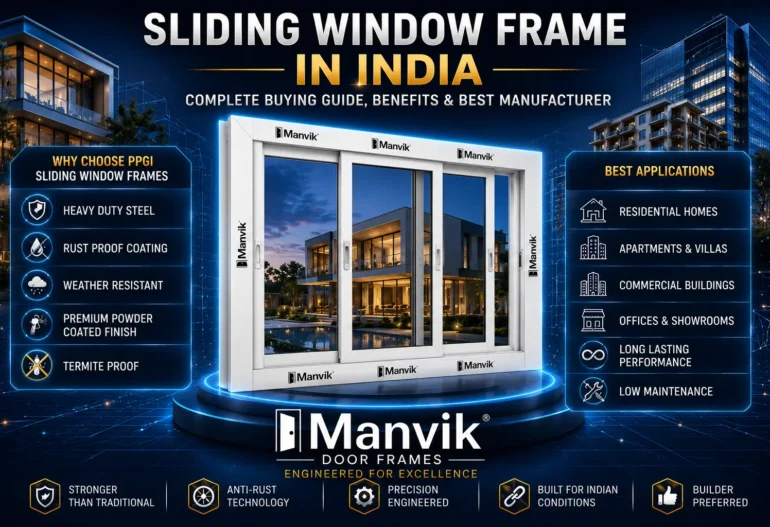
Sliding Window Frame in India: Everything You Need to Know
Sliding Window Frame in India: Visit any brand new commercial or residential complex that is being built in India this day. You’ll see some differences in the windows. These heavy, bulky frames that controlled construction a decade ago are now being substituted by slimmer, cleaner, and more precise designs. Much of the change is due to a single product: the windows that slide. India market. It has been one of the fastest-growing sectors in the field of fenestration. ppgi chaukhat in India
There are many reasons for this. Indian cities are undergoing more modern high-rises, modern commercial facades that are glass, and homeowners seeking sunlight without losing safety or durability. In the same way construction companies are being pressured to speed up project completion times and decrease maintenance calls in the long run. A properly-constructed sliding window frame is a good choice for both It’s easier to set up than conventional hinged frames, and if constructed using the best materials, it will not require any maintenance over the course of time.
This book explains all an architect, homeowner, contractor or bulk purchaser must know prior to deciding on the sliding frame for a window in India What is it, and how is it different from earlier systems? Which are the most common mistakes to avoid, as well as the best way to choose a company that you can and trust. Also, we’ll explain where Manvik Door Frames is a good fit in this scenario in relation to how they approach material selection and manufacture.
A sliding window frame operates horizontally, a window structure where the panels slide across a track instead of opening. In India the steel PPGI sliding frames are more popular than wooden and aluminum frames due to their toughness, durability against corrosion, and need for less long-term maintenance.
What Is a Sliding Window Frame?
A sliding window frame is the frame that is designed to support windows that slide in a horizontal direction along a track instead of swinging inwards or outwards like an ordinary casement window. The frame is the main structural part that stays fixed—mostly made of steel, PPGI (Pre-Painted Galvanized Iron), aluminum, or uPVC—that is home to the tracks and rollers as well as locking mechanisms that permit the sash to move easily.
What is a Sliding Window Frame?
A sliding window frame an unmovable structural component which supports the window panel or frames that move horizontally along tracks. The frame typically has rolling mechanisms, locking mechanisms and seals for weatherproofing. In India the steel and PPGI sliding frames for windows are popular because they can withstand corrosion and require little maintenance compared to wooden or the basic aluminum frames.
As opposed to traditional hinged windows, one that slides requires no clearance space for opening, which allows it to be used in areas like kitchens, hallways, balconies, or any other space in which grills or furniture would hinder a sash from swinging. The job of the frame is to be firm and solid throughout many years of usage. Should the frame become flexed or expand, the movement is stiff, and the seal will break.
Modern sliding window frames used within India make use of the double-track or three-track style that allows for up to three or two sashes to overlap. This is what makes sliding windows have a smaller footprint.
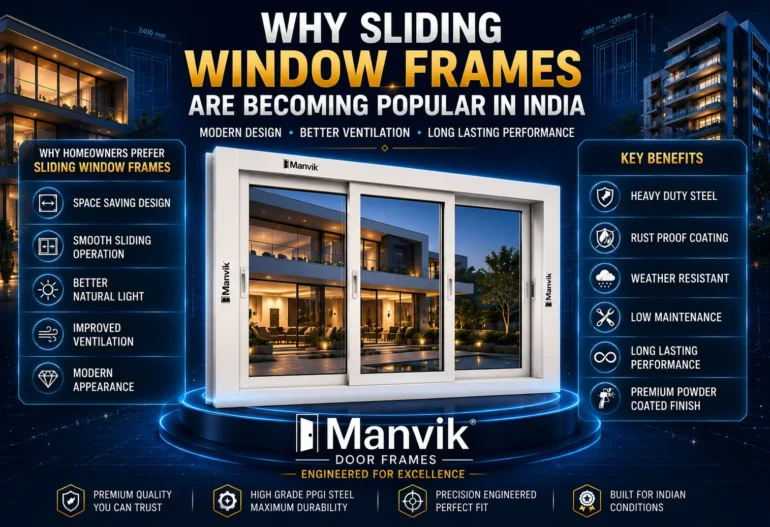
Some converging trends are the reason for the growing demand for the sliding window frame India sector:
- The efficiency of spaces in the urban environment The apartments have been shrinking, and sliding windows aren’t eating the usable balcony or floor spaces the same way as the windows that swing outwards do.
- Speedier construction times Construction companies with tight timelines for handovers favor factory-built, ready-to-install frames over hinged site-fabricated frames.
- A growing awareness of the expenses for maintenance: homeowners who’ve had to deal with wood that is rusting or damaged aluminum frames are clamoring for rust-proof window frames as well as powder-coated window frames in the beginning.
- Improved weather sealing technology Modern sliding systems come with interlocks and brush seals, which can handle rain and dust much better than the older models.
- An aesthetic shift towards minimalist windows and glass-forward facades: Architects who design buildings for commercial as well as residential structures prefer the sleek lines that steel or PPGI sliding frames permit.
From my experience at websites across states, the biggest reason is the maintenance fatigue. Construction companies that were using ordinary MS (mild steel) frames 10 years back are now using PPGI sliding window frames, or powder-coated ones, particularly to avoid hearing the same complaints regarding the appearance of rust spots on exteriors 2 monsoons after.
Types of Sliding Window Frames Available in India
There are many different sliding window frames that have the same construction. Below is a list of the most common types of frames that buyers come across:
By Material
- Steel sliding window frames are known for strong and sturdy construction and are ideal for large openings for commercial and residential use.
- Sliding window frames with PPGI pre-painted galvanized steel that has a factory-applied coat to ensure superior corrosion resistance. becoming the preferred choice for home improvement projects.
- Aluminum sliding window frames are lightweight and easily available; generally, they are less sturdy over long lengths than steel.
- Sliding window frames made of uPVC are excellent insulation for sound and thermal, although less sturdy to be used in industrial and heavy-duty projects.
By Manufacturing Method
- Window Frames that Weld for Free They are assembled using mechanical joinery rather than welding, which reduces joint corrosion points while improving consistency of finish.
- Rivet Technology Window Frames: Frames that are joined by precision riveting that ensures structural integrity, without any distortion in heat caused by welding that could cause it.
- Classic welded frames are still common for local fabricators; however, welding points are typically the initial points where rust starts.
By Track Configuration
- Two track (single sliding sash)
- 3-track (two sliding sashes, each with a mesh or fixed one)
Weld-free and rivet technology technologies are worthy of paying close attention to because the point where welds are made on the frame of a traditional model is the place where corrosion usually begins initially. This is because the heating from welding can damage any coating of protection right there on the junction.
Benefits of Choosing Steel & PPGI Sliding Window Frames
Key Takeaways
- The PPGI coating blends an aluminum layer with the paint finish. It provides two layers of protection against corrosion.
- Steel frames provide greater load-bearing capacity than aluminum for larger openings.
- Powder coating is a third layer that provides UV and scratch resistance.
- The use of rivet and welding-free joinery eliminates the weaknesses that are typical of the frames that are welded.
Galvanized steel begins with the zinc coating, which safeguards the metal underneath Even if it is scratched on the surface and the zinc surrounding it keeps protecting the exposed steel. PPGI goes one step further by putting a factory-cured coating on top that increases both the resistance to corrosion and the appearance. This is the reason PPGI sliding windows are now the most popular alternative for people who need the convenience of a non-maintenance window frame and avoid changing to costly uPVC or high-end aluminum frames. ppgi chaukhat
The application of powder coating on PPGI and steel gives the appearance of a tough, UV-resistant finish that is resistant to chipping and fading common coated surfaces are unable to resist in India’s scorching summer sun.
From a structural perspective, steel performs much better when under stress than aluminum with the same amount of profile. It is a factor in terms of the thermal efficiency as well. A sturdy frame ensures seals are tight as time passes, reducing the leakage of air and consequently contributing to more efficient energy use in rooms that are air-conditioned.
Sliding Window Frame vs Traditional Window Frames
| Factor | Sliding Window Frame (Steel/PPGI) | Traditional Hinged Window Frame |
|---|---|---|
| Space Required | Minimal — no swing clearance needed | Requires open swing space inside/outside |
| Installation Speed | Faster with factory-made frames | Slower, often site-fabricated |
| Corrosion Resistance | High (PPGI/galvanized + powder coating) | Depends heavily on paint quality |
| Maintenance | Low | Moderate to high |
| Weatherproofing | Good with brush seals & interlocks | Variable, gaps common over time |
| Best Suited For | Apartments, balconies, offices, commercial facades | Bathrooms, small ventilators, heritage-style builds |
| Cost (Initial) | Moderate | Often lower upfront, higher lifetime cost |
| Structural Load Capacity | High (steel-based systems) | Moderate |
Myth vs Fact
- Myth: Sliding windows are less secure than hinged windows.
- Fact: Modern sliding window frames use multi-point locking systems that are just as secure, if not more, especially in steel construction.
- Myth: All steel window frames rust quickly.
- Fact: Rusting is largely a coating issue — PPGI and powder-coated steel frames are specifically engineered to resist corrosion for years.
Residential Applications of Sliding Window Frames
In homes, sliding window frames are most commonly used for:
- Balconies and utility areas where swing clearance isn’t practical
- Kitchen windows above counters, where an outward swing would be awkward
- Bedroom and living room windows in apartments with limited floor space
- Staircase and corridor windows in multi-storey residential buildings
Homeowners increasingly ask for residential sliding windows with mesh integration for mosquito protection and toughened glass for safety — both of which pair well with a rigid steel or PPGI frame that won’t flex under the added weight.
Commercial & Industrial Applications
Commercial and industrial buyers have different priorities: durability under heavier use, consistency across large order volumes, and compliance with building specifications.
- Office buildings — Slim-profile steel frames for a modern glass facade look
- Retail and showroom fronts — Wide sliding systems for maximum glass visibility
- Warehouses and factories — Heavy-duty window frames prioritizing strength over aesthetics
- Educational institutions and hospitals — Low-maintenance, corrosion-resistant frames that hold up under years of continuous use
For commercial sliding windows, buyers should specifically evaluate a manufacturer’s ability to deliver bulk sliding window frames with consistent dimensional accuracy — inconsistent batches cause installation delays on large projects.
Another factor commercial buyers often overlook is acoustic performance. Offices near main roads or industrial zones benefit from a rigid steel frame paired with thicker glass, since a frame that flexes even slightly under vibration will eventually loosen its seals and let in both noise and dust. Architectural window frames used on office facades also need to account for repeated daily operation — a sliding sash in a busy reception area or shared corridor may be opened and closed dozens of times a day, which is exactly where roller quality and track gauge start to matter more than they do in a quiet residential bedroom.
For industrial buildings specifically, buyers should also ask whether the manufacturer tests frames for wind load and structural deflection, particularly for wide spans. A heavy-duty window frame that hasn’t been tested for the specific span and floor height of a warehouse or factory can develop play in the track over time, which shows up first as a sticking sash and eventually as a seal failure. door frame manufacturer in India
Residential Applications of Sliding Window Frames
In homes, sliding window frames are most commonly used for:
- Balconies and utility areas where swing clearance isn’t practical
- Kitchen windows above counters, where an outward swing would be awkward
- Bedroom and living room windows in apartments with limited floor space
- Staircase and corridor windows in multi-storey residential buildings
Homeowners increasingly ask for residential sliding windows with mesh integration for mosquito protection and toughened glass for safety — both of which pair well with a rigid steel or PPGI frame that won’t flex under the added weight.
Commercial & Industrial Applications
Industrial and commercial buyers differ in the importance of the durability of their buildings under more intense demand, uniformity across huge orders, and conformity with the building’s specifications.
- Office buildings — Slim-profile steel frames for a modern glass facade look
- Retail and showroom fronts — Wide sliding systems for maximum glass visibility
- Warehouses and factories — Heavy-duty window frames prioritizing strength over aesthetics
- Educational institutions and hospitals — Low-maintenance, corrosion-resistant frames that hold up under years of continuous use
For commercial sliding windows, buyers should specifically evaluate a manufacturer’s ability to deliver bulk sliding window frames with consistent dimensional accuracy — inconsistent batches cause installation delays on large projects.
Another factor commercial buyers often overlook is acoustic performance. Offices near main roads or industrial zones benefit from a rigid steel frame paired with thicker glass, since a frame that flexes even slightly under vibration will eventually loosen its seals and let in both noise and dust. Architectural window frames used on office facades also need to account for repeated daily operation — a sliding sash in a busy reception area or shared corridor may be opened and closed dozens of times a day, which is exactly where roller quality and track gauge start to matter more than they do in a quiet residential bedroom.
For industrial buildings specifically, buyers should also ask whether the manufacturer tests frames for wind load and structural deflection, particularly for wide spans. A heavy-duty window frame that hasn’t been tested for the specific span and floor height of a warehouse or factory can develop play in the track over time, which shows up first as a sticking sash and eventually as a seal failure. door window frame
How to Choose the Best Sliding Window Frame in India
Buying Checklist
- ✅ Confirm the base material — steel, PPGI, aluminium, or uPVC
- ✅ Check coating type — galvanized, powder-coated, or painted
- ✅ Ask about joinery method — welded, weld-free, or riveted
- ✅ Verify frame thickness and gauge for your opening size
- ✅ Request warranty terms in writing
- ✅ Ask for sample frames or site references before bulk ordering
- ✅ Compare pricing against material specification, not just per-square-foot cost
- ✅ Confirm delivery timelines for your project schedule
Which Sliding Window Frame is Best in India?
For most Indian climates, a PPGI or powder-coated steel sliding window frame offers the best balance of durability, corrosion resistance, and cost. Coastal regions with high humidity especially benefit from galvanized or PPGI systems over standard painted steel.
It is also helpful to consider regional differences instead of believing that a single specification is suitable for all the nation. Cities with salty air can put more stress on the frame’s coating than a dry climate in the inland will, and that’s why those who purchase frames in cities such as Mumbai, Chennai, or Kochi generally prefer selecting PPGI or galvanized frames over painted steel that is standard, even though it will cost some more initially. Contrarily, those who purchase located in areas that are dry, like North India, may find that heat resistance and UV resistance have more significance than just corrosion resistance. This is because extreme summer temperatures could cause frames made of cheaper materials to warp a little over multiple cold and hot cycles.
You should also ask prospective suppliers what their policies are regarding after-sales concerns. An organization that has clear warranties and an attentive technical support team will generally be the safer option over one that offers the cheapest price and offers vague assurances, particularly for large as well as PAN India orders where a problem in a single batch could cause a delay to the project’s timeline.
Common Mistakes Buyers Make
- Aiming at price by itself This is the most expensive frame, which will usually be the cheapest due to the steel being thinner gauge or coatings that are skipped.
- Not paying attention to the joining method The frames that have been joined that do not have corrosion treatments at the joints tend to rust in the first place at these points.
- Incorrectly determining the thickness of the coating The thin coat of powder wears off quicker than a properly curing normal-thickness, thick layer.
- Skipping measurements of the site frames that are not properly fitted cause gaps, weak sealing, and seepage of water.
- Incorrectly judging the track record of the manufacturer buying from a manufacturer without a known project history can be an issue that is frequently resisted by the bulk purchasers.
- Do not ask regarding lead time Custom-designed sliding frame frames for windows can be more time-consuming; ordering last minute frequently results in sacrifices of the quality.
Installation Tips from industry experts
- Be sure that the opening has been taken into account before the plastering process, not prior to it is done. It’s a common fault that leads to frame problems.
- Make use of a spirit level for both sides of the axes. A slight tilt can affect how easily the sash slides.
- Secure the junction between wall and frame with weatherproof sealant in order to stop flooding during monsoons.
- In the case of higher floors, ensure that frame anchoring points are able to handle the wind loads—it is more important than most people think in the case of high-rise constructions.
- Don’t force a sash that is sliding onto a track that is not alignedThis is the quickest method to cause damage to the rollers before they are damaged.
In site visits throughout time Most often, the complaints about the installation aren’t related to the frame but the poor seals at the junction of frame and wall. This is later revealed in the form of water spots or draft issues.
Maintenance Tips for Long-Term Performance
- Make sure to clean the tracks each few months to avoid dust accumulation that can cause stiff sliding.
- Regularly lubricate the rollers by using the silicone-based (not oil-based) lubricant
- Examine seals for cracks and damage every year. Replace them if they are damaged or broken.
- Remove the powder coating from surfaces using moderate soap and water. stay clear of abrasive cleaners
- Verify the lock’s mechanism at least every six months, in particular when you live in areas with high humidity or coastal regions.
AEO Answer Block — Which Sliding Window Frame Requires the Least Maintenance?
Steel sliding frames need the minimum maintenance due to the multi-layer coating protects against the effects of UV and rust. The routine maintenance is restricted to periodic track cleaning and lubrication of rollers — none of repainting, rust treatment or painting will be required for a long time.
Why Choose Manvik Door Frames
Manvik Door Frames manufactures sliding window frames, PPGI window frames, steel window frames, and door frames made of weld-free rivet technology, which is free of the corrosion-prone welding points in standard frames.
What does this mean for purchasers in terms of practicality:
- High-quality material PPGI to provide long-term resistance to corrosion
- High-quality manufacturing to ensure frame dimensions are consistent throughout large order
- Technology for rivets and welding construction. It reduces joint weaknesses
- Coated with powder for UV and scratch resistance
- Custom dimensions for residential as well as commercial construction projects
- Ability to supply bulk quantities to contractors, builders, and dealers
- Pan-India Supply with defined timelines for delivery
- Professional technical assistance to select the right material and specifications questions
If you are planning a project that requires doors, the Manvik range is extended to PPGI frame doors and steel frames that are weld-free as well as the latest in rivet technology for door frames as well as fire-rated door frames that are ideal if you’re speculating on windows and doors with a specific manufacturer to provide uniformity across projects.
For commercial construction projects, Manvik also supplies commercial door frames in addition to residential door frames for housing construction projects, which gives contractors an all-in-one point of coordination instead of managing several suppliers.
Buying Guide
First step: Determine the requirements you want to meet, whether commercial or residential, the amount of units, and sizes for openings.
Second step: Pick the right material—either steel or PPGI is advised for all Indian conditions; coastal regions are advised to choose galvanized or PPGI over the standard steel.
Third step: Choose the type of joinery that is weld-free, or frames with rivet technology typically surpass basic welded frames in resistance to corrosion.
Step 4. Request a sample as well as pricing and specs side-by-side and not only the price per unit.
Phase 5: Verify delivery as well as assistance with installation, which is especially crucial in large or PAN-India purchases.
6. Finish by writing an estimate that includes the materials grade, coating type, and warranty conditions.
Cost Factors & Long-Term ROI
A variety of factors affect the cost of sliding windows in India:
- The base material—steel and PPGI—usually will cost you more than aluminum but last for a long time.
- Type of coatings, galvanized as well as powder-coated finishes, cost more; however, they reduce the long-term cost of maintenance
- Frame thickness and gauge A steel with thicker gauges is priced higher but can withstand bigger openings and winds more effectively.
- A joinery technique that is free of welding and rivet technologies can provide an extra cost over standard frames that are welded, which is offset by less replacement cycles
- Volume of orders includes bulk and wholesale window frames for sliding, generally bring costs per unit down
Although a simple welded aluminum frame might appear cheaper at first, the repeated repainting or rust treatments, as well as an infrequent replacement of 8-10 years, typically results in a PPGI or a steel sliding frame being the most economical option over the life of the structure. That’s an ROI argument that should be put to any budget-conscious purchaser or construction company.
Frequently Asked Questions
Q. What is a sliding window frame
A sliding window frame is a fixed structure that holds window panels which move horizontally along a track, instead of swinging open like traditional windows.
Q. Which is the best sliding window frame in India?
PPGI and powder-coated steel sliding window frames are generally considered the best choice for Indian conditions due to their corrosion resistance and low maintenance needs.
Q. Are steel sliding window frames better than aluminium?
Steel frames typically offer higher structural strength and better load-bearing capacity for larger openings, while aluminium is lighter but less rigid over long spans.
Q. Why choose PPGI sliding window frames?
PPGI combines a zinc coating with a factory-cured paint layer, giving double protection against rust and weather damage compared to standard painted steel.
Q. Which window frame lasts the longest?
Properly coated steel or PPGI sliding window frames with weld-free or rivet technology construction tend to last the longest, often outperforming basic welded or painted frames by many years.
Q. Are sliding window frames rust proof?
No frame is fully “rust proof,” but PPGI, galvanized, and powder-coated steel frames offer very high corrosion resistance when manufactured and installed correctly.
Q. How much does a sliding window frame cost?
Cost varies by material, size, coating, and order volume. PPGI and steel frames cost more upfront than basic aluminium but usually offer better long-term value.
Q. Which window frame is best for homes?
For most homes, a PPGI or powder-coated steel sliding window frame offers the right balance of appearance, durability, and cost.
Q. Which window frame is best for commercial buildings?
Commercial buildings often benefit from heavy-duty steel sliding window frames due to higher usage frequency and larger opening sizes.
Q. Where can I buy sliding window frames in India?
Sliding window frames are available through manufacturers like Manvik Door Frames, which supplies PAN India for both residential and commercial projects.
Q. Which sliding window frame requires less maintenance?
PPGI and powder-coated steel frames require the least maintenance, needing only occasional cleaning and roller lubrication.
Q. Is a steel sliding window frame better than aluminium?
For structural strength and long-term durability, steel is generally considered better, though aluminium remains popular for lighter applications.
Q. How do I choose the right sliding window frame?
Consider your climate, opening size, budget, and maintenance expectations, and prioritize manufacturers offering PPGI or powder-coated steel with weld-free or rivet construction.
Q. What is the difference between weld-free and welded window frames?
Weld-free frames use mechanical joinery instead of heat-based welding, avoiding the coating damage and corrosion risk that welded joints often develop.
Q. Do sliding window frames come with mesh options?
Yes, most manufacturers, including Manvik Door Frames, offer mesh-integrated sliding window frames for mosquito and insect protection.
Q. Can sliding window frames be customized in size?
Yes, reputable manufacturers offer custom sliding window frames tailored to specific opening dimensions for both residential and commercial projects.
Q. Are sliding window frames suitable for high-rise buildings?
Yes, provided the frame gauge and anchoring are specified correctly to handle wind load at higher floors.
Q. What is the typical warranty on sliding window frames?
Warranty terms vary by manufacturer and material; it’s advisable to request warranty details in writing before placing a bulk order.
19. How long does installation of a sliding window frame take?
Factory-made sliding window frames are generally faster to install than site-fabricated hinged frames, often within a day per unit depending on scope.
Q. Does Manvik Door Frames supply in bulk for builders?
Yes, Manvik Door Frames offers bulk and wholesale supply of sliding window frames and door frames with PAN India delivery for builders, contractors, and dealers.
Final Conclusion
The best sliding window frame in India depends on being aware of what you’re spending on—the raw material and coating, as well as the technique of joining, as well as the manufacturing capability of the company to provide consistent high quality at a large scale. A powder-coated or PPGI steel frame made with welding-free or rivet technologies provides the best combination of toughness, low maintenance, and lasting worth for Indian conditions, no matter if it’s in a single residence or for a commercial building of a significant size
Manvik Door Frames manufactures sliding window frames and door frames using exactly this approach — premium PPGI material, precision manufacturing, and weld-free construction — with PAN India supply for both bulk and custom orders.
Ready to move forward?
- 📩 Request a Free Quote for your project requirements
- 📞 Contact Manvik Door Frames Today to speak with our technical team
- 🏗️ Get Bulk Pricing for builder and dealer orders
- 🤝 Become Our Dealer and partner with a manufacturer built on quality
- 💬 Talk to Our Experts about the right frame for your climate and application
Read more:-
weld free door frame manufacturer in India
Weld Free Door Frames vs Welded Frames


