

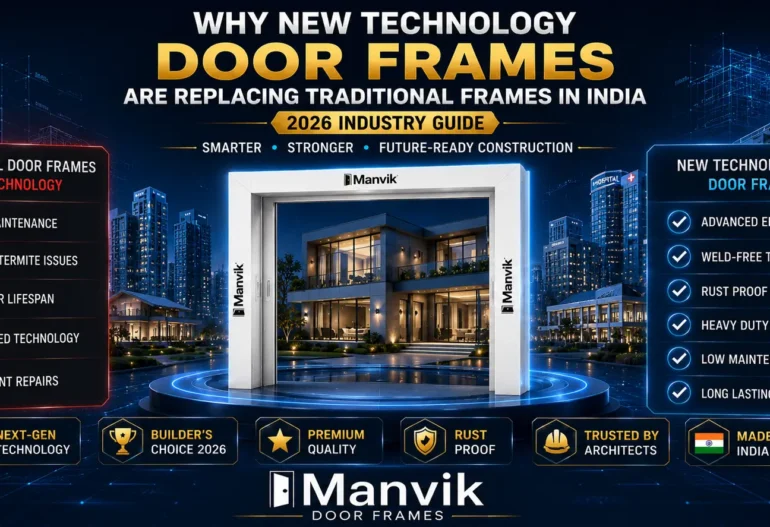
What is this change?
The Evolution of Door Frames in India
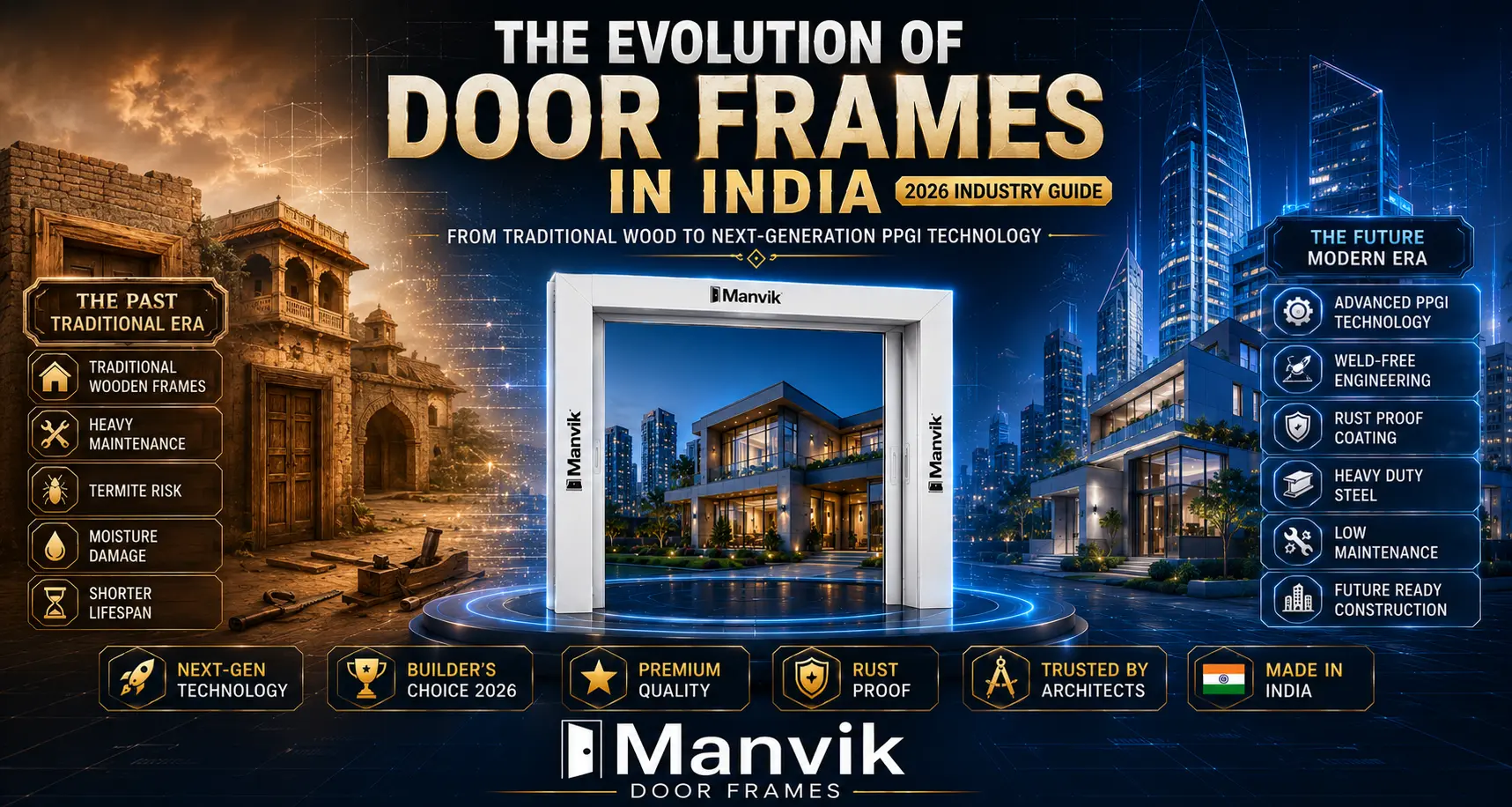
Door frame construction in India has moved through roughly three eras.
The wooden era: For most of the twentieth century, door frames made of wood were the standard. After all, they were easy to obtain locally and familiar to carpenters. However, as anyone familiar with Indian climatic conditions knows, wood comes with its own set of disadvantages.
The monsoons make it swell, and then it twists when the atmosphere dries out it is prone to white ants; and the quality varies considerably from timber to timber, and also based on the treatment of wood.
A door frame that is set perfectly one day, might warp after two monsoons. The generic steel era: During the building boom of the nineteen nineties and two thousands, welded mild steel frames began to be widely adopted, mostly for commercial and industrial buildings.
It offered resistance to white ants, but introduced other problems such as uneven welds, joints where moisture could collect and cause rusting and, of course, the standard paint finish that soon chipped off to reveal rusty metal underneath. The new technology era: In the past few years, however, there has been a significant shift in manufacturers towards factory-controlled processes, using factory finished roll-formed steel frames that are made from coil.
They are precisely manufactured and assembled without any on-site welding, and are what is referred to today as new technology door frames.
This segment has been the fastest growing in India’s door frame market in recent years for the obvious reason that it takes away variables such as the skill level of the workforce and the ability to deliver a product that can be used with complete confidence, irrespective of whether a project involves a single villa or a large hotel of 300 rooms. Architects, builders, consultants, and homeowners alike have started to specify these systems by their brand name due to the consistent quality that they provide.
What Are New Technology Door Frames?
New technology door frames are manufactured at a factory in frame systems formed by pre-painted (e.g. PPGI) metal and riveted (instead of welded) together without joining on site. This makes them precise in shape and resistant to corrosion and allows for rapid onsite installation.
“New technology” really just means that the new frame systems: have their paint, primer, and galvanizing done at the factory (so none of these processes need to be done at the site); are machine-cut and formed so every part of the frame is to the same exact dimensions, consistently; and are riveted together rather than welded, eliminating any heat distortion or potential weak spots created by welds.
New technology frames arrive at your door ready to be installed, and need no on-site painting or welding. Given how critical these elements are in project completions and the constant crunch of project schedules, for designers and builders looking to turn over buildings as quickly as possible, new technology frames alone can justify a change in specification.
How PPGI Door Frames Represent Modern Door Frame Technology
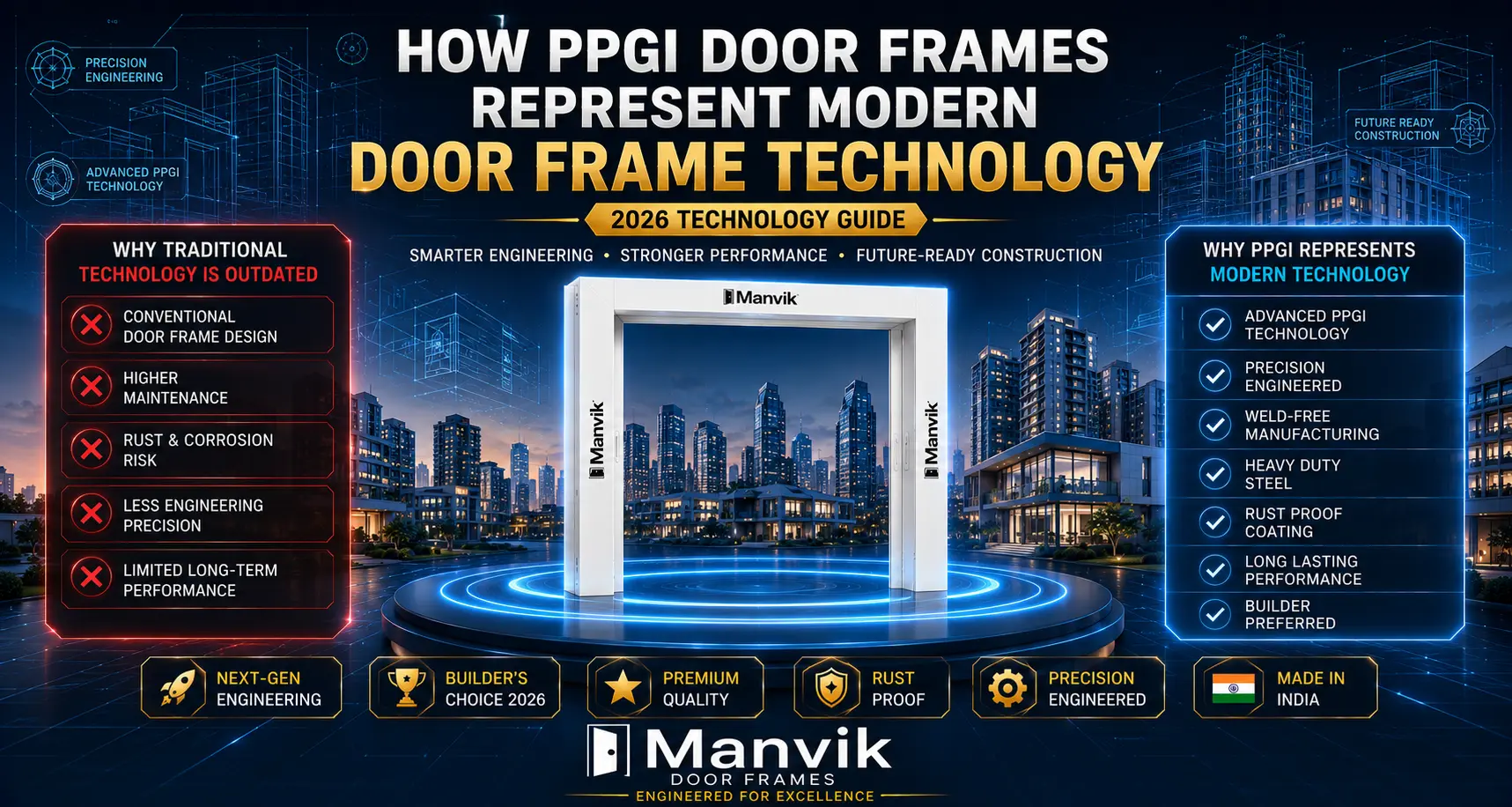
Fast Answer PPGI stands for Pre-Painted Galvanized Iron. A PPGI door frame is created from steel coils that are first galvanized (zinc-coated) to resist rust and then have a layer of factory-baked paint applied before the steel is actually bent and formed into a door frame. The base is the foundation for Manvik Door Frames and we need to know why the term “pre-painted” is just as crucial as “galvanized”.
The galvanization layer is what will provide protection using the principles of galvanic (sacrificial) protection-the zinc is sacrificially consumed to preserve the underlying steel, regardless of scratches. Weld-Free Door Frames
This method is widely utilized in building construction and appliances to fight oxidation. Paint coating system is laid over the galvanizing coating at the factory where heat curing allows the paint system to form more properly. A superior, better-adherent layer than what could be expected from paint brushed or sprayed at a site after the frame is cut and welded where moisture and contaminants are prevalent in the atmosphere can be produced. The combined advantages a PPGI door frame can offer to your construction project are; An aesthetically pleasing and consistent finish due to factory application rather than site application.
Increased durability of coating due to uniform factory application.
Protection of the metal even if the paint coating system is damaged during shipping and handling as the galvanizing will sacrifice itself. Dimensional accuracy since steel sheet is painted prior to forming. Ready to install directly to the opening.
A Note on Specification Corrosion resistance and longevity of coating is directly related to coating type-that is the coating grade (zinc coating amount and paint thickness), also dependent upon environmental exposure-coastal and industrial environments may require coating to a much higher grade specification to prevent corrosion. This is why the PPGI terminology should not be used synonymously with metal frames or steel door frames-there is a tangible difference to our product.
Understanding Weld-Free Door Frame Technology
- HIGHLY SECURE CORNERS – The corners are the most stressed parts of a door frame during installation, door usage, and settlement of a building.
- The joints made with rivet technology offer maximum structural integrity.
- NO heat damage – since the material is connected mechanically with no heat generation.
- HIGHLY CONSISTENT quality – since mechanical joints made by riveting can be standardized.
- EASY quality check – a visual check is enough to confirm the structural integrity of a rivet joint.
Traditional Door Frames vs New Technology Door Frames
The table below compares traditional wooden and hand-welded steel frames against new technology door frames (PPGI, weld-free, rivet-based) across the factors that matter most to builders and project owners.
| Factor | Traditional Wooden Frames | Traditional Welded Steel Frames | New Technology Door Frames (PPGI + Weld-Free + Rivet) |
|---|---|---|---|
| Manufacturing | Site or workshop carpentry, variable skill dependency | On-site or workshop welding | Factory roll-forming from pre-coated PPGI coil |
| Finish application | Site-applied polish/paint | Site-applied primer and paint after welding | Factory pre-painted before forming |
| Installation time | Moderate, depends on carpenter availability | Slower — welding, grinding, touch-up painting on site | Faster — arrives ready to fix in place |
| Corrosion resistance | Not applicable (susceptible to rot, not rust) | Depends on weld-joint touch-up quality | Continuous zinc + paint coating, including joints |
| Moisture/termite resistance | Vulnerable to warping, termites, fungal decay | Not vulnerable to termites; rust risk in humid zones | Not vulnerable to termites; corrosion-protected by design |
| Dimensional consistency | Varies with wood grade and craftsmanship | Varies with fabricator skill | Machine-precision, batch-consistent |
| Maintenance needs | Periodic polishing, termite treatment, repainting | Periodic repainting, rust checks at joints | Minimal — mainly routine cleaning; verify with supplier for specific coating warranty terms |
| On-site labor & mess | Sawdust, carpentry tools on-site | Welding fumes, grinding dust, paint odor | Minimal — largely a fix-and-install process |
| Suitability for bulk/large projects | Difficult to standardize at scale | Possible but quality varies by fabricator | Designed for consistent bulk supply |
| Typical applications | Low-rise residential, heritage-style interiors | Older commercial and industrial stock | Residential, commercial, institutional, industrial |
A note on lifecycle value: Upfront cost comparisons between these categories can be misleading if they don’t account for maintenance and replacement cycles. A lower-cost frame that needs repainting every two to three years, or termite treatment annually, carries an ongoing cost that a factory-finished, corrosion-protected frame typically avoids. That said, actual lifecycle costs depend on local climate, installation quality, and usage — project teams should evaluate this against their own site conditions rather than a generic industry claim.
Benefits of New Technology Door Frames for Residential Projects
Benefits for Commercial, Institutional & Industrial Projects
There are many requirements for high traffic and large-scale projects, and the new tech door frames help tick a few of those boxes. Hospitals & Healthcare: Frames in a hospital or health facility endure relentless wear, constant disinfecting (often with aggressive chemicals) and are required to meet the highest of hygiene standards. Factory finished frames have a smooth continuous surface (without the hidden dirt trap of visible weld seams) making cleaning easier to adhere to.
Hotels: Hotels require hundreds of the same frames to the highest standard and on strict deadlines. It’s exactly this type of production consistency that comes as standard when working with a factory manufacturer.
Warehouses & Industry: A high number of daily door uses, potential exposure to dust and chemicals requires frames that will withstand these demanding environments. This is where PPGI door frames with a rivet joint offer durability against corrosion compared to welded seams.
Government & Public Projects: Publicly funded infrastructure and government tenders often specify standards for door frames and this demand for consistent quality can be easier to manage with large quantities produced at a controlled factory facility.
Education: School, university and college building budgets are almost certainly too tight to support a regular repainting or replacement schedule.
These new door frames offer a more maintenance free option.
How to Choose the Best New Technology Door Frames in India
Buyer’s Checklist
- Confirm the coating specification — ask for the zinc coating weight (GSM) and paint film thickness, and match it to your site’s environmental exposure.
- Verify manufacturing process — ask specifically whether the frames are weld-free and rivet-jointed, or whether welding is used at any stage.
- Check gauge/thickness — thicker gauge generally means more structural rigidity, especially important for heavy commercial doors.
- Ask about custom sizing — confirm whether the manufacturer supports project-specific dimensions, not just standard sizes.
- Request sample or site references — ask for examples of similar projects (residential, commercial, institutional) the manufacturer has supplied.
- Clarify lead times for bulk orders — critical for project scheduling on large tenders.
- Understand warranty terms — specifically what’s covered (coating, structural integrity) and for how long.
- Confirm PAN-India delivery capability if your project spans multiple locations.
- Ask about technical support — will the manufacturer assist with installation guidance or troubleshooting?
Decision Matrix
| Project Type | Priority Factors | Recommended Frame Specification |
|---|---|---|
| Residential (individual home) | Aesthetics, low maintenance, moderate budget | Standard PPGI door frame, mid-range coating grade |
| Multi-unit residential/apartments | Consistency across units, fast installation | Bulk-order PPGI frames, standardized sizing |
| Coastal/high-humidity sites | Corrosion resistance | Higher-grade zinc coating, verified with supplier |
| Commercial/hospitality | Volume consistency, aesthetics, durability | Custom PPGI door frames, premium finish options |
| Industrial/warehouse | Structural strength, heavy daily use | Heavier gauge PPGI, reinforced rivet joints |
| Institutional/government | Documented specs, compliance, bulk supply | Certified specification sheets, PAN-India logistics |
Common Buying Mistakes and How to Avoid Them
Expert Installation & Maintenance Tips
Installation
- Ensure the rough opening is accurately measured and squared before frame placement — even a precision-manufactured frame will underperform in an out-of-tolerance opening.
- Use appropriate anchoring methods recommended by the manufacturer; avoid excessive force that could distort the frame during fixing.
- Seal gaps between the frame and the wall properly to prevent moisture ingress at the frame-wall junction, which is a common source of long-term issues regardless of frame material.
- Avoid scratching the factory finish during handling and installation — protect corners and edges with manufacturer-supplied covering until final handover.
Maintenance
- Clean with a soft cloth and mild detergent; avoid abrasive cleaners that can degrade the paint finish over time.
- Periodically inspect hinges, locks, and hardware attachment points, since hardware wear is independent of frame material.
- In coastal or high-pollution areas, rinse accumulated salt or particulate residue periodically to protect the coating’s long-term appearance.
- Report any coating damage (deep scratches exposing bare metal) early, so it can be touched up before corrosion has a chance to start.
Myth vs Fact
| Myth | Fact |
|---|---|
| “All metal door frames rust eventually, so material doesn’t matter.” | Coating quality and application method matter significantly — a factory-applied zinc and paint system performs very differently from bare or site-painted steel. |
| “Weld-free frames are structurally weaker than welded ones.” | Properly engineered rivet joints are designed to meet structural performance requirements; the key factor is joint design and placement quality, not the absence of welding. |
| “PPGI is just painted steel.” | PPGI involves a galvanizing (zinc) layer for corrosion protection in addition to the paint coating — the zinc layer is what continues protecting the steel even if the paint surface is scratched. |
| “New technology frames cost more overall.” | Upfront pricing can be comparable to or higher than basic traditional frames, but lifecycle cost (maintenance, repainting, replacement) often favors factory-finished systems — actual savings depend on project specifics. |
Why Builders, Architects & Contractors Prefer Modern PPGI Door Frames
Professionals managing project timelines and budgets tend to gravitate toward new technology door frames for a consistent set of reasons:
- Predictability. Factory-manufactured frames behave the same way across an entire project, which simplifies planning and reduces on-site troubleshooting.
- Speed. Removing on-site welding and painting from the critical path shortens overall project timelines.
- Fewer callbacks. Coating and structural issues that show up months after handover are a real cost — in rework, reputation, and client relationships. Reducing that risk matters to any contractor managing multiple simultaneous projects.
- Specification clarity. It’s easier to write a clear technical specification for a factory-manufactured product than for site-fabricated work, which helps at both the tender and quality-control stages.
- Sustainability considerations. Factory manufacturing generally produces less on-site waste (no sawdust, no leftover welding rod, less overspray) compared to traditional site fabrication — a factor increasingly relevant to green building certifications.
Sustainability & Building Lifecycle Cost Considerations
New technology door frames shift more of the cost to the manufacturing stage and less to the maintenance stage. Because the corrosion protection is embedded in the material itself — zinc coating plus a factory-cured paint system — rather than dependent on periodic site maintenance, the ongoing cost burden on facility managers and homeowners tends to be lower. This is particularly relevant for institutional and government projects, where maintenance budgets are often fixed and unpredictable repair costs can strain multi-year facility plans.
Steel is also fully recyclable at end of life, and factory manufacturing typically generates less on-site construction waste than fabrication done on-site — relevant considerations for projects pursuing green building certifications such as IGBC or GRIHA ratings, though specific certification credit depends on the rating system’s documentation requirements.
None of this means new technology door frames are the right choice for every single project — heritage restoration work, for instance, may have design requirements that call for traditional materials regardless of maintenance cost. But for the large majority of new residential, commercial, institutional, and industrial construction in India today, the lifecycle cost argument is one of the strongest reasons project teams are moving toward factory-manufactured PPGI systems. Sliding Window Frames
Why Choose Manvik Door Frames
Manvik Door Frames manufactures new technology door frames built specifically around the three pillars covered in this guide:
- Premium PPGI material — zinc-coated, factory-painted steel engineered for corrosion resistance and a consistent finish
- Weld-free manufacturing — no heat-affected joints, no compromised coating at the corners
- Rivet technology — mechanically strong, consistently placed joints designed for long-term structural performance
- Precision engineering — machine-formed for dimensional accuracy across every unit in a bulk order
- Custom sizing — frames manufactured to project-specific dimensions, not limited to standard sizes only
- Bulk supply capability — built for residential developments, commercial projects, and institutional tenders alike
- PAN-India supply — logistics support for projects across multiple states
- Technical support — guidance on specification selection and installation best practices
Whether you’re sourcing frames for a single residential project or managing procurement for a multi-site commercial rollout, Manvik Door Frames is built to support the shift toward new technology door frames in India — with the manufacturing discipline to back it up.
Ready to move forward?
- Request a Free Quote
- Contact Manvik Door Frames Today
- Get Bulk Pricing
- Talk to Our Experts
- Order Direct from Manufacturer
- Become Our Dealer
- Enquire Now
Frequently Asked Questions
1. What are new technology door frames? New technology door frames are factory-manufactured frames made from pre-coated PPGI material, assembled using weld-free, rivet-based jointing instead of on-site welding, offering more consistent finish and corrosion resistance than traditional frames.
2. Why are new technology door frames replacing traditional frames in India? They address the recurring problems of traditional frames — warping, termite damage, rust at weld joints, and inconsistent site-applied finishes — while also offering faster installation for time-sensitive projects.
3. What does PPGI mean? PPGI stands for Pre-Painted Galvanized Iron — steel that is zinc-coated for corrosion resistance and then coated with a factory-applied, baked-on paint finish before being formed into a frame.
4. Are PPGI door frames better than wooden frames? PPGI door frames are not vulnerable to termites or moisture-driven warping the way wood is, and they typically require less ongoing maintenance. Wooden frames may still be preferred for certain heritage or aesthetic requirements — the right choice depends on project priorities.
5. Are PPGI door frames better than regular welded steel frames? PPGI door frames avoid the heat-damaged, coating-compromised joints that welding can introduce, giving more consistent corrosion protection across the entire frame, including corners.
6. What is weld-free door frame technology? It’s a manufacturing method that joins frame components mechanically — typically through rivets or interlocking folds — instead of welding, preserving the factory coating at every joint.
7. What is rivet technology in door frames? Rivet technology uses precision-placed mechanical fasteners to join frame sections, creating strong, stable joints without the heat exposure that welding involves.
8. Do weld-free rivet joints compromise structural strength? Properly engineered rivet joints are designed to meet structural requirements. Joint strength depends on rivet spacing, placement, and gauge — all defined by the manufacturer’s engineering specification.
9. Which door frame material lasts the longest? Longevity depends on material, coating specification, installation quality, and environmental exposure. In general, PPGI frames with an appropriate coating grade for the site conditions tend to require less maintenance and show fewer premature failures than untreated or site-painted alternatives.
10. Which door frame requires the least maintenance? Factory-finished PPGI door frames generally need only routine cleaning, since there’s no on-site paint to touch up and no termite vulnerability, though hardware components still need periodic inspection.
11. Are new technology door frames suitable for coastal areas? They can be, provided the coating specification (zinc coating weight and paint system) is matched to the site’s humidity and salt exposure — this should be confirmed with the manufacturer for coastal projects specifically.
12. Can PPGI door frames be custom sized? Yes, most manufacturers, including Manvik Door Frames, offer custom sizing for project-specific openings in addition to standard sizes.
13. Are new technology door frames more expensive than traditional frames? Upfront costs can be comparable to or slightly higher than basic traditional frames, but lifecycle costs — accounting for maintenance, repainting, and replacement — often favor factory-finished systems, depending on the project.
14. How long does installation take compared to traditional frames? Because PPGI door frames arrive pre-finished and don’t require on-site welding or painting, installation is generally faster than traditional welded steel or site-fabricated wooden frames.
15. Are these frames suitable for commercial and industrial buildings? Yes — their dimensional consistency, corrosion resistance, and bulk-supply capability make them well suited to hotels, hospitals, warehouses, and institutional projects with large frame quantities.
16. What should I check before ordering door frames in bulk? Verify the coating specification, gauge, jointing method, sample quality, lead times, and warranty terms before placing a bulk order.
17. Do new technology door frames need repainting? Generally no, under normal conditions, since the paint is factory-applied and cured. Deep scratches exposing bare metal should be addressed promptly to prevent localized corrosion.
18. What warranty should I expect on PPGI door frames? Warranty terms vary by manufacturer and typically cover coating and structural integrity for a specified period — always confirm exact terms in writing before purchase.
19. Does Manvik Door Frames supply across India? Yes, Manvik Door Frames offers PAN-India supply capability to support projects across multiple locations and states.
20. How do I get a quote for a project? You can request a free quote directly from Manvik Door Frames by contacting their team with your project specifications, quantities, and timeline.
Final Conclusion
The shift toward new technology door frames in India isn’t a passing trend — it’s a response to decades of recurring, well-understood problems with traditional wooden and welded steel frames. PPGI material addresses the corrosion and finish-consistency problem. Weld-free manufacturing addresses the coating-damage-at-joints problem. Rivet technology addresses the structural-reliability problem, without reintroducing the weaknesses that welding brings.
Together, these three elements are why builders, architects, and project owners across residential, commercial, institutional, and industrial segments are increasingly specifying new technology door frames by name rather than settling for generic “steel” or “metal” frames. PPGI Door Frame Manufacturer in Chandigarh
If you’re planning a project — from a single home to a multi-site commercial rollout — Manvik Door Frames manufactures PPGI door frames built on weld-free, rivet-based technology, with the custom sizing, bulk supply, and technical support to back a specification-driven purchase decision.
Request a Free Quote or Talk to Our Experts today to discuss which specification is right for your project.


