

Introduction
CNC Japani Chokhat: -Most people buying a japani chokhat never see how it’s actually made — they only see the finished frame at their door. But the manufacturing process is exactly what determines whether a frame lasts 25 years or starts rusting within five. Today, the better manufacturers use CNC (Computer Numerical Control) roll forming instead of manual fabrication, and the difference in precision is significant.
This guide walks through how a CNC computerised japani chokhat is actually manufactured, from raw sheet to finished frame — and why this process matters for anyone buying one.
What Does “CNC Computerised” Mean for a Chokhat?
CNC roll forming means the steel sheet is shaped into a frame profile by a computer-controlled machine rather than by hand. The machine follows an exact digital specification — every bend, every dimension, every cut is programmed in advance. This removes the human error that’s common in manually hammered or hand-bent frames, which is where most inconsistencies in cheap chokhats come from.
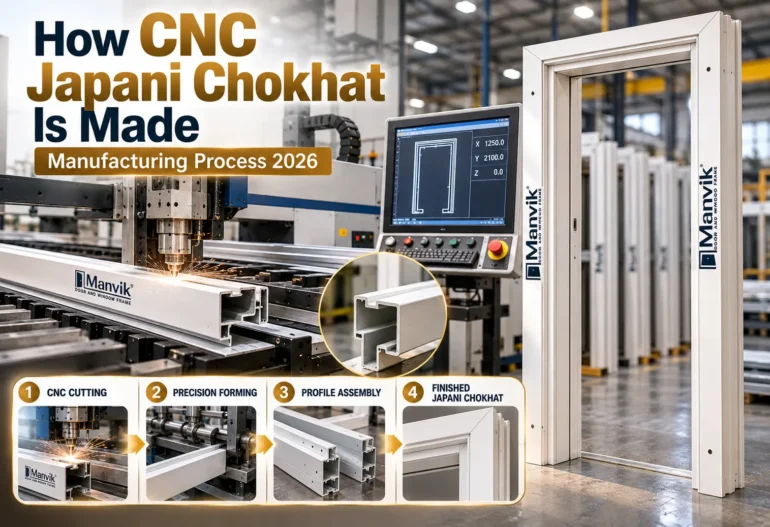
The Manufacturing Process, Step by Step
1. Raw Material Selection
The process starts with galvanized or PPGI (Pre-Painted Galvanized Iron) steel coils. The gauge (thickness) of the sheet is chosen based on the frame type — heavier gauges for main doors, lighter for interior doors.
2. Sheet Feeding into the CNC Roll Former
The coil is fed into the CNC roll forming machine, which unwinds it at a controlled, consistent speed. This is where computerisation matters most — the feed rate stays exact across the entire production run, so the 500th frame comes out identical to the 1st.
3. Progressive Roll Forming
The flat sheet passes through a series of rollers, each one bending the metal a little further until it reaches the final chokhat profile — the characteristic folded, rebated edge that holds the door shutter. Because this is computer-controlled, the bend angles and rebate depth stay precise across the full length of the frame.
4. Precision Cutting to Length
Once formed, the profile is cut to the exact frame dimensions using CNC-guided cutting. This is where custom sizing becomes possible — since it’s programmed rather than manually measured and cut, adjusting for a non-standard door opening doesn’t compromise accuracy.
5. Corner Jointing and Welding
The cut lengths are joined at the corners — typically welded or crimped depending on the frame design — to form the complete rectangular chokhat shape.
6. Coating and Finishing
The frame then receives its protective finish. For PPGI frames, the coating is already applied to the coil before forming. For additional protection, some frames go through a secondary powder-coating stage, which adds scratch resistance and a smoother finish.
7. Quality Inspection
Before dispatch, frames are checked for squareness, rebate depth, coating consistency, and overall dimensional accuracy against the original specification.
Why CNC Manufacturing Matters for Buyers
- Consistency — every frame in a batch matches the same dimensions, which matters when you’re ordering multiple frames for an apartment project or a large home
- Fewer on-site fitting issues — precise rebate depth means the shutter sits correctly without extra adjustment
- Custom sizing without quality loss — non-standard openings can be manufactured to exact size without manual guesswork
- Better long-term durability — consistent coating application reduces weak points where rust typically starts
CNC vs Manually Fabricated Chokhats
| Factor | CNC Computerised | Manual Fabrication |
|---|---|---|
| Dimensional accuracy | Consistent across all units | Varies frame to frame |
| Production speed | Fast, high volume | Slower, labour-intensive |
| Custom sizing | Precise, programmable | Depends on worker skill |
| Coating consistency | Even, controlled | Can be uneven |
| Best suited for | Bulk orders, projects | Small one-off jobs |
How Manvik Manufactures CNC Japani Chokhats in Sirsa
With over 40 years of manufacturing experience in Sirsa, Manvik Door Frames combines long-standing craftsmanship with modern CNC precision. We use CNC computerised roll forming for our japani chokhat range, working with PPGI and galvanized steel sheets sourced for consistent gauge and coating quality. Every batch undergoes dimensional and coating quality checks before dispatch, and both standard and custom sizes are manufactured on the same production line — so custom orders don’t come with a quality trade-off. chowkhats dealer in india
Want to see the exact specifications for your project? Request a Free Quote or WhatsApp us at +91-74969 97603.
FAQs
1. What is a CNC computerised japani chokhat?
It’s a steel door frame manufactured using computer-controlled roll forming machines, which shape the metal into the chokhat profile with precise, repeatable accuracy rather than manual bending.
2. Is CNC-made japani chokhat better than handmade frames?
For consistency and durability, yes. CNC manufacturing removes variation between frames, which matters especially for multi-unit projects like apartments or commercial buildings.
3. Can CNC machines make custom-size chokhats?
Yes. Since the process is programmed rather than manually measured, custom dimensions can be manufactured with the same precision as standard sizes.
4. What is the price of japani chokhat per square foot?
CNC-manufactured japani chokhat typically costs between ₹180 to ₹450 per square foot in India, depending on steel gauge, coating quality, and finish. Heavier gauges and premium PPGI coatings sit at the higher end of this range.
5. Which chokhat is best for a door?
For most residential and commercial doors in India, a CNC-manufactured PPGI or galvanized steel chokhat is the best choice — it resists rust, termites, and warping far better than wood or basic iron, while CNC manufacturing ensures the frame fits precisely without on-site adjustment.
6. What is the price of GI chokhat per square foot?
GI (galvanized iron) chokhat typically ranges from ₹150 to ₹400 per square foot, depending on the zinc coating thickness (GSM) and steel gauge. PPGI variants, which add a painted protective layer, usually cost slightly more due to better long-term corrosion resistance.
7. How much does an iron chokhat cost?
A standard iron (steel) chokhat costs between ₹800 to ₹2,500 per frame in India, depending on size, gauge thickness, and whether it’s galvanized, PPGI-coated, or CNC-manufactured to custom dimensions.
8. What material is used in CNC japani chokhat manufacturing?
Typically galvanized steel or PPGI (Pre-Painted Galvanized Iron) sheet, chosen for rust resistance and durability.
9. How long does a CNC-manufactured japani chokhat last?
With proper coating and maintenance, 20 to 30 years is typical for steel-based chokhats manufactured to consistent quality standards.
10. Does CNC manufacturing affect the price of a japani chokhat?
CNC production is often more cost-effective at scale due to speed and reduced material waste, though pricing also depends on gauge thickness and coating type.
Conclusion
The manufacturing method behind a japani chokhat has a direct impact on how well it performs over its lifetime. CNC computerised roll forming brings a level of dimensional accuracy and coating consistency that manual fabrication struggles to match — which is why it’s become the standard for serious manufacturers. door window frame
Also Read:-
sliding window frame for balcony
right windows for indian homes


