

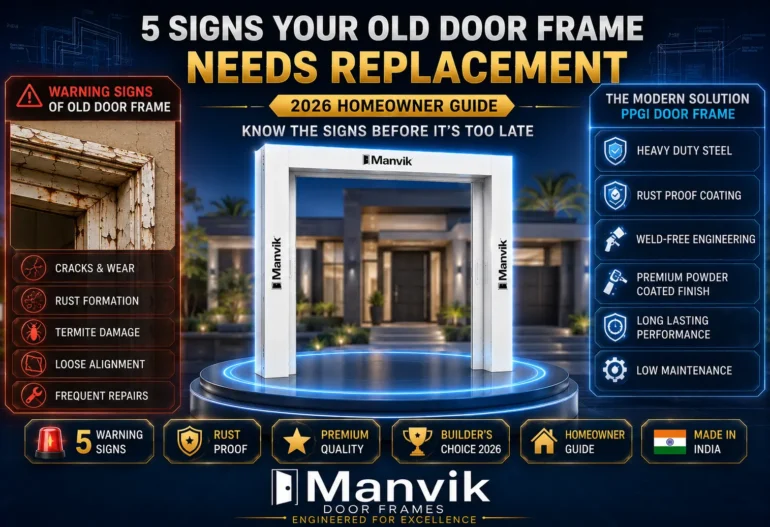
5 Signs Your Old Door Frame Needs Replacement: A door’s frame is in need of replacement—not simply repairing it when it exhibits structural cracks and swelling caused by moisture or rot, a persistent distortion or corrosion, or repair costs that continue to rise each year. If your frame displays at least two of these indicators, replacing it is the most sensible longer-term choice.
Many homeowners don’t think about the door’s frames until there’s a problem, for example, a door that doesn’t latch or close, drafts that weren’t there this winter, or a swath of wood that is soft and discolored close to the threshold. These are easy things to ignore problems as minor issues. However, a door’s frame plays a security and structural part in your home. When the issues are apparent, frames have often been in silent decline for a long time, or even years. door frame for new houses
This guide outlines the five most obvious signs that your old door frame requires replacement. It will also explain how to recognize the difference between a problem that can be fixed and one that is beyond salvaging and what to think about—such as modern door frames made of PPGI in the event that it’s time for a change. 5 Signs Your Old Door Frame Needs Replacement
Key Takeaways
- Warping, cracks, or structural delamination are some of the evident signs that a frame requires replacement.
- The effects of moisture and rot usually are more extensive than what they appear at first glance.
- A door that doesn’t fit properly could be a sign of the frame being bent or twisting or even a damaged door.
- Rust and failure of coatings on frames made of metal cause structural weakness to increase.
- If the repair costs continue to increase each year, replacing the item is usually more affordable over time.
- Doors made of PPGI provide a durable, corrosion-proof, low-maintenance option to traditional wooden as well as painted steel frames.
Why Recognizing Door Frame Problems Early Matters
The door frame is more responsible than many homeowners are aware. It supports the weight of the door and keeps the open square in place, blocks off weather, and is an integral part of your home’s security. When a frame begins failing, results tend to be limited to the frame.
A frame that has moved from its square shape can cause uneven pressure on locks and hinges and doors, making it more difficult to open. A frame that is absorbing moisture may let that moisture in to the wall framing, drywall, or masonry, transforming the small fix into a larger improvement. Frames that are worn out can ruin the aesthetics of a clean office or home. 5 Signs Your Old Door Frame Needs Replacement
The earlier you spot the warning signs that your old door frame is in need of replacement, the greater alternatives you’ll have—and the less likely it is to cost. The time to wait until a frame breaks completely can lead to water damage to flooring, ruined wall studs, or doors that have become a security threat. This is among the main reasons that experienced contractors suggest an inspection walk-around of each exterior frame of the door at least once each year, and especially prior to the monsoon or winter seasons.
In the following sections we’ll review the five most trustworthy warning signs, then explain what’s going on structurally in each instance and assist you in deciding with certainty whether repair or complete door frame replacement will be the correct option. 5 Signs Your Old Door Frame Needs Replacement
5 Signs Your Old Door Frame Needs Replacement
1. Visible Cracks, Warping or Structural Damage
Cracks that are visible, splits, or warping of the door frame typically indicate that the frame is losing structural strength. Small surface cracks may be filled, but large cracks, jambs that are twisted, or joints that are separated indicate that the frame cannot keep its shape and needs to be replaced.
Warping and cracks are among the most obvious indications that your old door frame requires replacement, yet they’re typically the ones that homeowners overlook for the longest time. A small crack in a wooden jamb that is painted may appear to be cosmetic, but cracks typically begin at the point of stressing screws or joints that are weak or an area where the wood has started to dry and shrink in a different way.
Warping is an entirely similar issue. It is a fact that wood contracts and expands in response to humidity. During the course of seasonal cycles frames may be twisted to the point of becoming a rectangle. It’s evident when you see the door was once flush shut but now has one corner catching the other or daylight glaring along one side of the frame after the door is closed.
What to look out for in an inspection:
- Cracks that run vertically across the jamb, particularly close to hinges
- The frame has visible gaps where it faces the wall or where the leaf of the door.
- A frame that appears “bowed” when viewed from the side
- The corners are split where the head jamb joins the side jambs
When the fracture is minor or cosmetic and separated, a woodworker may be able to fill it and repair the area. However, once the crack becomes structural—that is, it alters the way in which the door’s frame stays in place—fixing is only a temporary solution at best; replacing it is the most durable solution.
2. Moisture Damage, Swelling or Surface Deterioration
Swelling, soft or soft wood peeling paint, and an unpleasant smell around the frame are all signs of water damage. When wood absorbs water and begins to break down inside, repairs are not always lasting, and replacement is typically required to stop the damage from further spreading.
Moisture is among the most frequently cited—yet under-appreciated—factors that cause frame failure in doors, especially for doors that are exterior, ground-floor entryways, and frames in kitchens or bathrooms. Wood is porous, and frequent exposure to moisture, humidity, or plumbing leaks causes it to absorb water more quickly than it is able to dry. new technology door frames in india
The first signs are not obvious, such as paint that bubbles up or peels at the frame’s base and a slight swell when you push a finger across the jamb or a door that is difficult to shut during hot conditions. If left untreated, it will lead to soft and spongy wood that swells under pressure. This is a sure sign that rot is setting in.
Common moisture damage indicators:
- Dark staining or discoloration at to the base of the frame
- A damp or musty smell near the entrance
- Laminated or painted paints that are bubbling or cracking or peeling
- Wood that is soft breaks up a little when pressured
- There is visible mold or mildew at the bottom of the jamb
The problem with the effects of moisture can be that the visible damage from the outside is usually only a small part of what’s going on within the frame. When rot becomes evident, the internal fibers of the wood may have been damaged far beyond the repair that a patch or filler could solve. This is precisely the type of damage that drives homeowners towards moisture- and corrosion-resistant alternatives such as doors made of PPGI that don’t soak up water in the same way that traditional wood does. 5 Signs Your Old Door Frame Needs Replacement
3. Door No Longer Closes or Aligns Properly
The door, which does not latch or has apparent gaps upon closing, is usually an indication that the frame is warped or shifted; it’s not just a hinge issue or door issue. In the event of constant alignment issues, after adjustment, they typically indicate that the frame is in need of replacement.
Sometimes, it’s easy to attribute a stuck door to the frame, but sometimes it’s not. Hinges can loosen up, and doors may expand a little with humidity. However, if a door consistently does not latch, sways along the flooring, or creates an unbalanced gap on one side, even after adjustments, it most likely could be framing that’s not anymore square. sliding window frame in india
It happens slowly. The wall surrounding it and over the years of constant humidity fluctuations or a frame that was not installed properly could cause the door to move slightly out of its shape. After that there is no way that hinge adjustment can make the door fit properly since the frame—not only the door itself—is not in alignment.
The frame but not the door. is the issue:
- The door runs down the floor, but just on one side.
- The gaps are uneven around the door after it is closed, being wider on the top than the bottom, or vice versa.
- The latch does not line up with the strike plate even after adjustments.
- The door can swing open or shuts on its own due to a sloping frame
A slanted door frame isn’t just a nuisance—it has a direct impact on the security of your home. Locks and latches are designed to operate with a correctly aligned strike plate. If the frame moves, that alignment can be compromised, and an intruder with a ferocious plan may force a poorly placed door to be seated with very little effort. This is among the more obvious instances where replacing is not repairing but can restore both security and function. 5 Signs Your Old Door Frame Needs Replacement
4. Rust, Corrosion or Damage (where appropriate)
Metal door frame flaking or rusty paint, or edges that are corroded, suggest how the protection coating has gone down. If corrosion begins to penetrate the metal base, the structural strength decreases, and replacement with a stronger corrosion-resistant frame is the most recommended solution.
For commercial and residential buildings with metal door frames, corrosion is similar to wood rot—it’s a gradual, slow problem that begins small but expands. Commonly painted mild-steel frames depend solely on their coatings to shield moisture from the steel underneath. When the coating chips or scratches or wears thin—typically close to the threshold, which is the point where moisture and feet make the most contact—corrosion can start to develop within a matter of weeks in humid conditions.
How do rust and coating damage generally advance:
- Small spots of orange-brown appear at joints or scratches
- Paint starts flaking or bubbling as rust builds up beneath
- Pitting occurs on the metal’s surface, which weakens it structurally
- In more advanced cases, the edges of the frame thin or form holes
Surface rust is sometimes removed and sanded back in the event of being it is detected early. However, once the corrosion has eroded the metal or spewed along the structural edge, the frame is permanently deficient in strength in that region and painting over it just hides the issue, instead of solving it. This is the exact risk which Door frame made from PPGI are engineered to protect against because the galvanized pre-painted coating is permanently bonded to the metal during production which gives it longer-lasting, consistent protection against corrosion compared to a frame that is painted at the site following installation. 5 Signs Your Old Door Frame Needs Replacement
5. Frequent Repairs and Rising Maintenance Costs
When you notice yourself painting, refilling or re-adjusting the door frame each year, the overall repair costs are likely to be close to or even exceedingthe replacement cost. Regular, frequent repairs are a sign that it’s time to replace, rather than patch.
Sometimes, the most obvious sign isn’t necessarily a single, dramatic loss, but the pattern. Frames that require paint every year to cover new spots of rust. Hinges that require tightening every couple of months since that the timber around screws is worn. A jamb that has had to be filled with sandpaper three times in the past three years.
Each repair may appear to be small and cost-effective However, when they are accumulated over time, the cost of repairs often surpasses what an all-in replacement could cost. Unlike repair, repeated repairs do not reset the clock of the frame’s original state. The cost of maintaining frames that continue to degrade and age.
Questions to consider:
- Have I had to repair or paint the frame at least two times in the past three years?
- Do you see the same issue (rust or sticking gaps) persisting after fixing it?
- Do I spend more money in upkeep than I do for a new frame?
- Does the frame appear aged or worn-out despite frequent repairs?
If you’re saying “yes” to most of these questions, you’re probably experiencing a decline in returns. This is when the switch to a long-lasting and low-maintenance alternative—like a door frame that is PPGI-free and weld-free made using an innovative rivet system—is likely to yield a much better financial return in the next 10 years rather than patching an old frame.
Door Frame Repair vs Replacement: Which Is the Better Choice?
Not every damaged frame needs full replacement, and not every replacement is strictly necessary. The right decision depends on how deep the damage goes, how old the frame already is, and how much you’re likely to spend maintaining it going forward.
Repair vs Replacement Decision Matrix
| Condition | Repair Usually Works | Replacement Recommended |
|---|---|---|
| Damage extent | Surface-level, isolated | Structural, widespread, or recurring |
| Frame age | Under 10 years, otherwise sound | Over 15–20 years, or already repaired multiple times |
| Moisture/rot | Minor surface staining only | Soft, spongy, or crumbling wood |
| Alignment | Minor sticking, fixable with hinge adjustment | Persistent misalignment after adjustment |
| Corrosion (metal frames) | Light surface rust, coating intact elsewhere | Pitting, flaking, or spreading rust |
| Repair history | First or second repair | Third or more repeat repair |
| Cost comparison | Repair costs a fraction of replacement | Repair costs approaching 40–50% of replacement |
| Security concern | Locks and latches function normally | Locks don’t seat properly due to frame shift |
Pros & Cons
Repairing an Old Door Frame
- ✅ Lower upfront cost for isolated, minor damage
- ✅ Less disruption, often completed in a few hours
- ❌ Doesn’t address underlying causes (moisture source, coating failure)
- ❌ Repairs tend to recur once a frame has started deteriorating
- ❌ Doesn’t improve energy efficiency, security, or appearance
Replacing an Old Door Frame
- ✅ Resets the frame’s condition and lifespan entirely
- ✅ Opportunity to upgrade to a more durable material like PPGI
- ✅ Improves door alignment, sealing, and security
- ✅ Often improves the visual appeal and resale value of the property
- ❌ Higher upfront cost than a single repair
- ❌ Requires a short installation period
Myth vs Fact
Myth: “If the door still closes, the frame is fine.” Truth: A door can still shut even if the frame is weak beneath—cracks or rotting typically begin internally before they affect the way the door functions.
Myth: “Repainting a metal frame fixes rust permanently.” The truth: Repainting covers existing rust but does not remove the corrosion in the metal, and it usually will continue to grow under the new coating.
Myth: “Replacing a door frame is always a major, expensive renovation.” The truth: With modern weld-free installation techniques, a lot of door frame replacements can be accomplished within one day, causing little disruption to the walls.
In general, repairs make sense if the damage is recent and isolated as well as the structure is solid and sturdy. Repair is the better option when the damage is structural, repeated, or affects more than one area of the frame, and that’s the reason why the five indicators listed above should be taken seriously instead of patching the damage repeatedly. 5 Signs Your Old Door Frame Needs Replacement
Why PPGI Door Frames Are a Smart Replacement Option
If homeowners decide to replace a worn-out or damaged frame, the material they select is as important as the choice of replacing the frame. This is why the PPGI door frames are a standout as a contemporary, practical alternative to wood and painted steel.
PPGI is a shorthand for pre-painted galvanized iron, which is a production procedure in which steel is galvanized (coated with zinc to improve resistance to corrosion) followed by an applied paint layer that is manufactured, and this is done before the frame is formed. This is distinct from a wooden structure that is painted following installation or a steel frame, which is painted on-site, and both rely on the application of a coating in a less controlled environment. weld free door frames vs welded frames
Why is this important to door frame replacement
- Resistance to corrosion: The galvanized layer protects the base metal in the event that the paint is scratched, in contrast to the paint applied on-site, which leaves exposed metal after it has been damaged.
- Resistance to moisture: Unlike wood, PPGI does not absorb water, expand, or rot—solving the exact problem of moisture damage that was previously discussed in this guide.
- Structural stability The frame is manufactured with precision to keep it square and reduce door alignment issues that can be found in older wooden frames.
- Easy maintenance The paint is not repainted each year. There is no need to sand the rust spots, and there is no need to fill cracks.
- Long-term benefit: A longer effective time frame reduces the total cost of ownership compared to a frame that requires regular maintenance.
Manvik Door Frames builds its PPGI range with welding-free techniques as well as the use of rivets, two different manufacturing options that further enhance the consistency. Weld-free construction prevents thermal distortion or weak areas that welding could create at joints, while rivet technology makes mechanically secure joints, without compromising the protective coating, which means the resistance to corrosion is maintained at joints, as well as on flat surfaces. 5 Signs Your Old Door Frame Needs Replacement
For those who have been through the pain of damaged, cracked, or rusted-out frames, the combination of resistance to corrosion, moisture resistance, stability, and low maintenance provides the best answer to what the best new door frame will actually do.
Benefits of Replacing Your Old Door Frame
Removing a frayed door frame is more than fixing a quick issue. When done properly, it provides an array of benefits that go well beyond the doorway.
- Enhances Security: The properly aligned and structurally sound frame can let locks and latches work in the way they were designed, thereby eliminating the gaps that a shifted or warped frame could create.
- More energy efficient: Gaps around an old frame that is warped let in drafts. A new, well-fitted frame can improve the sealing around the door, which can reduce modestly heating and cooling losses.
- Enhances curb appeal: A faded, shabby, or peeling frame is visible outside, usually more so than people realize—while a fresh, modern replacement dramatically enhances the appearance of the entryway.
- Low maintenance over the long term: Moving away from the materials that are prone to rot and corrosion (like natural wood and coated steel) towards resistant to corrosion PPGI door frames minimize the frequency of maintenance.
- Greater property value: Well-maintained, modern door frames are the type of details that appraisers and buyers take note of, especially on doors that are used for entry.
- Smoother, quieter doors: A square, correctly installed frame allows the door to move, close, and latch easily without the friction or dragging that are common in old frames.
These advantages increase with time. A frame replaced today with a sturdy and low-maintenance material will avoid the pattern of “repair, repaint, repair again” that many homeowners find themselves stuck with old wood or steel frames. 5 Signs Your Old Door Frame Needs Replacement
How to Choose the Right Replacement Door Frame
After you’ve made the best option, selecting the appropriate frame is just as much as making the decision itself. There are a few factors that will guide your decision:
1. Durability of the material. Take into consideration how the material will perform against corrosion, moisture, and everyday wear, not only how it appears on the first day. This is why corrosion-resistant PPGI door frames generally outperform wood that has not been treated or plain painted steel over the course of a 10-year period.
2. Quality of manufacturing. The quality of manufacturing determines how solid and square the frame is throughout its life. Construction using rivet technology and welding is particularly effective in avoiding the joint weaknesses that result from weaker welded frames.
3. Customizing the size and fitting. Door openings don’t always match, particularly in older houses. Find a company that can provide custom sizes, instead of limiting a fit to a set of standard sizes.
4. Ratings for safety and fire are appropriate. For commercial buildings or shared residential buildings or certain rooms, fire-rated door frames could be a requirement in the code—it is worth checking prior to making a final decision.
5. Maintenance expectations. Find out directly How often will this frame require repainting, resealing, or even servicing? A frame that requires only minimal regular maintenance will save you cost and time over the span of its lifetime.
6. Reliability of the supplier. A supplier that has PAN India delivery, technical support, and a history of custom and bulk orders is typically a better alternative to a smaller, local, unreliable supplier, particularly when it comes to bigger construction or renovation projects.
Replacement Checklist:
- Measure the existing door opening accurately (height, width, wall thickness)
- Decide between standard and custom sizing
- Choose a corrosion- and moisture-resistant material
- Confirm fire-rating requirements, if applicable
- Get a written quote covering material, delivery, and installation
- Confirm installation timeline and any wall repair needed
- Ask about warranty and after-installation support
Common Mistakes Homeowners Make During Door Frame Replacement
Even if the decision to replace a component is the correct one, the procedure could be a disaster in a number of predetermined ways:
- Incorrect measurements are a common mistake. An inaccurate opening measurement results in an unfit frame correctly, which causes similar alignment issues to those that the replacement was designed to fix.
- Selecting the least expensive choice without considering the quality of the material. A low-cost frame that isn’t corrosion-resistant or water-resistant could be replaced within a few years, which will erase any savings that were made in the beginning.
- Insisting on the root causes of the original issue. If a leak or a poor drainage airflow issue caused the original frame to turn rotten, putting up an entirely new frame and not fixing the root issue is a risk of harming the replacement as well.
- DIY installation with no proper tools or knowledge. Door frames need to be straight and square. Even a slight sloppiness can lead to gaps, stickiness, or security concerns.
- Do not check for building codes or fire standards. This is particularly pertinent for commercial buildings, shared spaces, or doors to specific rooms in which fire-rated frames are required.
- The final details are not being considered. Gaps between the frame and wall should be sealed and finished for aesthetics as well as to block water from entering.
The best way to avoid these mistakes is to hire an experienced installer and a manufacturer that offers clear and precise technical advice instead of using this frame like a generic universally fitting product.
Professional Installation Tips
- Check that the structure of the opening prior to installation A frame is only as solid as the opening on the wall it is placed in.
- Use a level across all sides and not just at the top to verify that the frame is straight horizontally and vertically prior to final fixing.
- Fill the gaps between the frame and wall by applying a sealant that blocks moisture from infiltrating, particularly on frames facing the outside.
- Verify the door’s swing clearance with respect to flooring in particular in the event that flooring has been installed since the frame was put in place.
- Check the alignment of the latch and lock immediately following installation, prior to completing painting or trimming work, to ensure that any adjustments are possible while it’s still easily accessible.
- Set a proper curing time for any adhesives or fillers that are used on the frame prior to exposing it to daily usage.
- Utilize installers trained by manufacturers whenever it is possible Weld-free or rivet technology frames can be constructed differently than traditional steel frames that are welded. Using the proper procedure preserves both the structural integrity as well as the coating.
Why Choose Manvik Door Frames
Manvik Door Frames manufactures PPGI door frames specially designed to solve the issues discussed in this guide: cracking, water corrosion, damage to the alignment, and the frustration of frequent repairs.
What is it that sets Manvik Door Frames from the rest?
- Premium material made of PPGI that has been applied by a factory, with a anti-corrosion coating
- Weld-Free Technology to ensure consistent structural strength, without heat-distortion weak spots
- Rivet Technology to create precise, secure joints that protect the coating
- Manufacturing precision that ensures frames remain even for long-term, smooth door alignment
- Resistance to corrosion designed for commercial and residential environments
- Custom dimensions to fit openings that aren’t standard, which is often used in renovation projects.
- Capacity for bulk supply for contractors, builders and property developers
- PAN India delivery for projects of all sizes or locations within the country.
- Technical assistance provided by a staff who knows the door frame’s performance and not just sales
- Pricing that is competitive without compromising the quality of the material or manufacturing accuracy
It doesn’t matter if you’re replacing a single damaged frame in your home or searching for frames to be used in an entire commercial or residential task; Manvik Door Frames offers a long-lasting, low-maintenance option to traditional steel frames that often brings homeowners back to the same question: Is now the right time to upgrade my door frame?
Are you ready to take the next step?
- Request an estimate on your project for replacing the doorframes
- Get in touch with Manvik Door Frames Today, I spoke to our technical team.
- Get direct orders from the manufacturer to get the most competitive door frame pricing based on PPGI.
- Request Bulk Pricing for contractor and builder projects
- Join Us as a Dealer and introduce PPGI Frames for door frames into your market
- Contact Our Experts about customizing sizing and options for fire-rated products
Frequently Asked Questions
1. How do I know if my door frame needs replacement? Look for cracks, warping, soft or swollen wood, persistent misalignment, rust or corrosion, and repairs that keep recurring. Two or more of these signs together usually indicate replacement is the better option.
2. Can a damaged door frame be repaired? Minor, isolated damage — small cracks, light surface rust, or slight misalignment — can often be repaired. Once damage is structural, widespread, or recurring, repair becomes a short-term fix rather than a real solution.
3. When should I replace my door frame? Replace your door frame when you notice structural cracking, deep moisture damage, a door that won’t stay aligned after adjustment, spreading corrosion, or when repair costs start approaching the cost of a new frame.
4. What causes door frame damage? Common causes include prolonged moisture exposure, poor installation, natural wood expansion and contraction, coating failure on metal frames, general age-related wear, and structural settling in the surrounding wall.
5. How much does door frame replacement cost? Cost varies based on material, size, and whether custom dimensions are needed. Request a quote from a manufacturer directly for accurate, project-specific pricing rather than relying on general estimates.
6. Which door frame lasts the longest? Corrosion-resistant materials like PPGI generally outlast untreated wood and basic painted steel, since the factory-applied protective coating resists moisture and rust far more consistently over time.
7. Is a PPGI Door Frame better than a traditional wooden frame? For durability and low maintenance, yes — PPGI Door Frames resist moisture, rot, and pest damage in ways wood cannot, though wood may still be preferred for certain traditional aesthetic requirements.
8. What are the signs of a failing door frame? Cracking, warping, swelling, rust, misalignment, sticking doors, and frequent repairs are all signs of a failing door frame.
9. Can a damaged door frame affect home security? Yes. A misaligned or structurally weak frame can prevent locks and latches from seating properly, making forced entry easier.
10. What is the best replacement door frame for modern homes? A corrosion-resistant, precision-manufactured frame like a PPGI Door Frame is generally considered a strong option for modern homes due to its durability and low maintenance needs.
11. How long does a quality door frame last? A well-manufactured, corrosion-resistant frame can last significantly longer than traditional wood or basic steel — often well beyond 15–20 years with minimal maintenance, depending on installation quality and environmental exposure.
12. Do all door frame problems require full replacement? No. Isolated, minor issues can often be repaired. Full replacement is typically needed when damage is structural or recurring.
13. What is weld-free door frame technology? Weld-free technology assembles door frames without welding, avoiding the heat distortion and coating damage that welding can introduce at joints.
14. What is rivet technology in door frames? Rivet technology uses mechanical rivets to join frame components securely, preserving the protective coating and structural consistency at the joints.
15. Can I install a new door frame myself? While possible for those with carpentry experience, professional installation is recommended to ensure the frame is properly plumb, square, and sealed.
16. Does a new door frame improve energy efficiency? Yes. A properly fitted new frame reduces drafts and gaps around the door, which can help with heating and cooling efficiency.
17. Are PPGI Door Frames suitable for commercial buildings? Yes. Their durability, low maintenance, and availability in fire-rated options make them a practical choice for commercial and multi-unit residential projects.
18. How do I maintain a PPGI door frame? PPGI Door Frames require minimal maintenance — occasional cleaning is generally sufficient, without the repainting or sealing that wood or basic steel frames need.
19. What should I check before buying a replacement door frame? Check material durability, manufacturing quality, custom sizing options, fire-rating requirements if applicable, and the supplier’s delivery and support capabilities.
20. How do I get a quote for a PPGI Door Frame replacement? Contact Manvik Door Frames directly with your door opening measurements and project details to receive a free, custom quote.
Final Conclusion
The frame of a door rarely fails in one go. The frame wears down slowly, through tiny gaps, years of moisture and exposure to the elements, smaller misalignments, or slowly advancing corrosion. Being aware of the five signs that your old door frame is in need of replacement before it is too late allows you to take action before the damage extends to the wall and compromises the security of your home or leads to an even more costly repair. best door frame for bathroom
When the frame’s damages are minimal and isolated, repairing is a feasible option and a cost-effective one. However, once the cracks become structural in nature, or rot has established itself in the wood, and alignment cannot be repaired or the corrosion has spread and spread, replacing the frame is the most sensible and economically sound option.
For those who are builders, homeowners and property managers looking for a new door that won’t result in the similar choice within a couple of months, PPGI Door Frames provide a durable and low-maintenance structurally stable alternative to standard wood and steel, with manufacturing methods like weld-free and rivet technologies that increase long-term durability. best door frame manufacturers in india
Manvik Door Frames brings that combination of quality materials and precision manufacturing for commercial and residential projects throughout India. If you’ve seen any of the indicators mentioned in this post, contact Manvik Door Frames now for a free estimate and expert advice on choosing the best new frame to suit your needs.


