

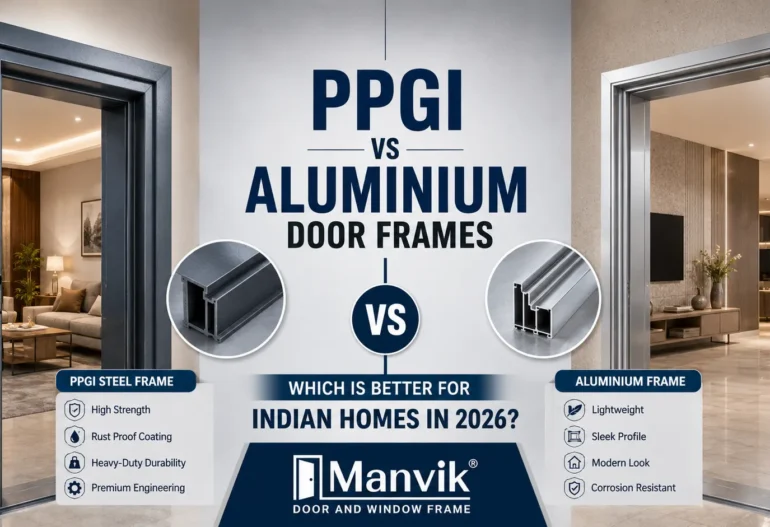
PPGI vs Aluminium Door Frames: If you walk into any of the housing projects within India in the present–whether it’s an average-segment home in Pune or a luxurious home in Hyderabad or a modest city in Tier-2–and you’ll be able to see that home builders and homeowners pay greater at the door’s frame as they did in the past.
It’s logical. The door frame isn’t solely a structure necessity. It’s also the foundation of your entryway and the element that keeps the entire structure together throughout monsoons, humidity in the coastal zone as well as scorching summer heat and the wear and tear of a bustling household. PPGI vs Aluminium Door Frames
In 2026, right now the most tense debate on the subject of building materials is: Aluminum vs. PPGI door frames – which is more suitable for Indian residences?
Both materials are backed by strong arguments. Each has its own advantages. They’re just not identical, and picking the wrong one could result in significant costs for repair, replacement, or regret. This article breaks everything in plain English, so that you are able to take a sound, informed decision. Best Door Frame Manufacturer in Haryana
What Are PPGI Door Frames?
The term PPGI is a reference to pre-painted Galvanized Iron. Its name tells the bulk about the process beginning with a premium steel base, which is then coated with galvanization with zinc to prevent rust. It it is coated with a coat of paint before it is shaped into frame for doors.
It is the result of an entryway frame that blends the strength and rawness of steel with a surface which is factory finished and will not rust right when it comes out of the box.
Material Composition
- Material base: Cold-rolled steel (CR steel)
- Layer of protection: The process of hot-dip galvanization (zinc coating)
- Finish on the surface: Pre-applied paint or powder coating
- Profile Forming rolls into door frame designs with precise measurements
Key Features of PPGI Door Frames
Extraordinary durability: Steel is inherently stronger than aluminum. The door frames of PPGI are able to handle heavy doors with shutters made of metal or wood without warping, breaking or becoming loose over the course of time.
Inbuilt corrosion protection The zinc layer is a kind of sacrificial layer. If the paint surface is scratched, zinc remains in place to safeguard the steel beneath it.
The consistency of a factory Since PPGI frames are produced under strict conditions, the coating dimension, thickness, and finishes are consistent. This is impossible to accomplish with painted frames.
A natural termite repellent: Steel doesn’t attract termites. This is an important benefit when you live in the tropical Indian circumstances in which wooden frames are always in danger of being attacked by termites.
Flexible design: PPGI frames are accessible in various color choices and designs, making the frames ideal for contemporary minimalist designs and classic aesthetics.
What Are Aluminium Door Frames?
Doors made of aluminium are constructed of extruded aluminum alloy profiles. Aluminum is naturally non-ferrous (meaning that it does not contain iron) This gives it the advantage of being able to withstand moisture in humid areas: it is essentially in a position to not corrosion.
Aluminum has been a popular material in India as windows as curtain walls, window frames and partition system for a long time. Recently there has been a rise in usage in door frames as well specifically in commercial space as well as in high-end residential developments.
Common Uses in Indian Homes
- Frames for entrances on coastal properties
- Interior partition door frames
- Commercial and office entrance systems
- Lightweight interior doors in high-rise apartments
- frames for bathroom and utility space that are exposed to moisture.
Key Features of Aluminium Door Frames
Risk of rust-free: Aluminium naturally forms an oxide layer which protects it from rust. It is completely unaffected by rust even in the humid regions of the coast.
The light weight of The aluminum is approximately 1/3 the weight of steel that makes installation and handling much simpler.
Modern design: Aluminium frames carry a modern, clean design that works with modern architecture very perfectly.
Powder coating and anodizing choices: Surface finishing options are numerous Anodized aluminum keeps its appearance for a long time without peeling.
Dimensional stability The aluminum doesn’t grow and contract in the same way like other substances but this is greater in mild conditions.
PPGI vs Aluminium Door Frames – Detailed Comparison
Let’s cut through the marketing language and compare these two materials honestly across every parameter that matters for Indian homeowners.
| Parameter | PPGI Door Frames | Aluminium Door Frames |
|---|---|---|
| Strength & Rigidity | Excellent — steel base handles heavy loads | Moderate — can flex under heavy shutters |
| Corrosion Resistance | Very Good — zinc + paint coating | Excellent — naturally non-rusting |
| Termite Resistance | 100% termite-proof | 100% termite-proof |
| Fire Resistance | Good — steel has higher melting point | Moderate — aluminium melts faster |
| Weight | Heavier — adds stability | Lightweight — easier to handle |
| Maintenance | Very Low — coated surface lasts long | Very Low — minimal upkeep needed |
| Lifespan | 20–30+ years with proper coating | 15–25 years depending on grade |
| Cost (Initial) | Lower to moderate | Moderate to high |
| Long-Term Value | Excellent — strong ROI | Good — but quality varies widely |
| Aesthetics | Multiple colors, modern profiles | Sleek, modern, anodized finishes |
| Installation | Slightly heavier but standard | Easier due to light weight |
| Load Bearing | Superior | Adequate for light to medium doors |
| Dent/Impact Resistance | Excellent — steel resists impacts | Moderate — can dent under heavy impact |
| Availability in India | Widely available | Widely available |
| Eco-Friendliness | Steel is highly recyclable | Aluminium is highly recyclable |
Quick verdict: PPGI wins on strength, fire resistance, cost, and load-bearing. Aluminium wins on natural rust immunity and weight. For most Indian homes, PPGI offers better overall value.
Which Door Frame Performs Better in Indian Weather?
The climate of India isn’t just only one aspect. There are a myriad of factors, and the door frame has to manage them all.
Coastal Regions (Mumbai, Chennai, Kochi, Goa, Visakhapatnam)
Salt particles are carried by the ocean which attack metallic surfaces. That’s why aluminium is traditionally had an advantage as it creates its own oxide layer of protection.
Yet, premium PPGI frames equipped with zinc galvanization and a powder coating work equally well even in the harsh coastal environment. It is important to have a thick coating, at the minimum of at least 275 GSM zinc coating, and an excellent topcoat. door window frame
The winner in coastal conditions: Tie — Both work when the the specification is accurate. PPGI is a quality requirement; aluminum has a greater natural forgiveness.
High Humidity and Monsoon-Heavy Regions (Kerala, Northeast India, West Bengal)
For areas that experience prolonged humid and heavy rain Any door frame material should be able to resist water penetration around corners and joints. PPGI frames that are made with sealed edges and cut edges galvanized, stand up well. Cut edges that are not treated on PPGI can be a risk. That’s the reason why choosing a trusted producer such as Manvik Door Frames is important, as factory sealed ends will eliminate the risk.
The rust-free nature of aluminum is a great choice for this application with no edges-related issues.
Top performer in regions with high humidity: Slight edge to Aluminium to ensure a smooth and safe performance. PPGI closely behind in terms of quality production.
Extreme Summer Heat (Rajasthan, Delhi, UP, MP)
When temperatures exceed 45degC temperature, the expansion rate of the material is a factor. The expansion of aluminium is greater than that of steel at temperatures, about two times as much for each unit of length. The aluminum frames can be caused to swell slightly during the course of time and could affect the alignment of doors.
Frames made of PPGI/steel are more robust in extreme temperatures.
Winner in extreme heat zones: PPGI
Zones of heavy rainfall and Medium Salinity, High Humidity (Most of the peninsular India)
The large number of Indian homeowners who reside in the peninsular or coastal areas, PPGI frames with good galvanization provide a stronger option due to their greater strength and rigidity, as well as adequate protection against corrosion.
All-around Indian winner in the Indian climate: PPGI, especially for frames with structural components. Aluminium is a great choice for special or low-load applications.
Why Builders and Architects Prefer PPGI Door Frames in 2026
If you’re lucky enough to visit construction sites or meet with architects on medium to large residential construction projects there is a noticeable trend that is becoming increasingly evident: PPGI doors are becoming popular as the preferred material.
This is the reason why the business has changed:
Better Structural Performance for Indian Construction Norms
Indian homes typically employ massive solid or engineered shutters for primary doors, which can weigh anywhere from 40 to 80 kgs. Aluminium frames, though great to be used in light designs, may not be an ideal structural fit for shutters that weigh a lot. PPGI frames are made of steel and can support the weight without flex.
Long-Term Cost Economics Work in PPGI’s Favour
In a world where construction decision-making is heavily influenced the lifecycle cost of construction, PPGI makes a compelling argument. Its initial price is less than aluminium of premium quality, and maintenance is low as well as the 20-30-year duration means that you won’t have to replace frames for a 10 years.
Fire Safety Compliance
As building codes in Indian metros get stricter, fire resistance matters. Steel’s melting point is almost twice that of aluminum (1538degC against 666degC). When a fire occurs, PPGI frames hold up longer and provide crucial moments of structural stability.
Sustainability Credentials
Steel is among the materials that is most recycled in the world. It is expected to be recycled by 2026. building rating (GRIHA, IGBC) influencing increasing commercial and residential construction making use of recyclable, durable material scores high marks with designers and architects.
Ease of Standardization
Builders and developers of large scale are in love with PPGI frames due to the fact that they are available with standard sizes and shapes which make it easier to procure as well as quality assurance and the installation of hundreds or even thousand of frames.
Best Door Frame Choice for Different Types of Homes
There isn’t a universal solution, however, there’s an appropriate answer to your particular situation.
Apartments (Mid-Segment to Premium)
Most suitable: PPGI door frames
Apartments with high-rises in India generally use prehung door frames where structural stability is essential. PPGI frames can handle the weight as well, and are compatible with masonry and provide consistent finish in all units. In the case of main entry doors The strength benefit from PPGI is especially important.
Villas and Independent Homes
The best choice is PPGI as main doors; Aluminum for internal utility doors
The main entrance doors to houses are typically large, attractive and valuable. PPGI frames are the structural foundation needed. for bathroom, util rooms or interior partitions that are lightweight and in which moisture concerns are a problem Aluminium frames are the best option.
Coastal Homes and Beach Villas
Most recommended: High-spec either Aluminium or PPGI, contingent on your budget
If you are looking for coastal homes, choose PPGI frames that are at least the 275 GSM galvanization as well as a high-quality powder-coat finish. Alternately, anodized aluminium frames can be used. Cost should be the primary factor to consider as PPGI usually offers better value for price.
Budget Homes and Affordable Housing Projects
Most suitable: PPGI door frames
When it comes to projects with a price tag, PPGI provides the best quality and value. Aluminum frames within the same price range typically are of poor quality and therefore, make PPGI the better long-term option.
Commercial Spaces (Offices, Retail, Hospitality)
Most suitable choice: context-dependent Aluminum for its aesthetics; PPGI is for the load-bearing
Glass facades in commercial spaces and modern design tend to prefer aluminium frames because of their slim design. For entrance doors that have massive shutters, the strength of PPGI’s advantages are a reality.
Luxury Homes
The best choice is High-end PPGI, with designer finishes
The latest high-end PPGI frames are available with glossy, matte, wood-grain and textured frames which can be easily distinguished from costly alternatives. The word “luxury” doesn’t necessarily mean that you require aluminum. It means that you want top quality finish, and that’s what PPGI offers.
Cost Comparison – PPGI vs Aluminium Door Frames in India
Let’s talk numbers. Prices vary by region, supplier, and specification—but here are realistic ballpark figures for 2026:
| Cost Factor | PPGI Door Frames | Aluminium Door Frames |
|---|---|---|
| Material cost (per frame, standard size) | ₹800 – ₹2,000 | ₹1,200 – ₹3,500 |
| Installation cost | Standard masonry — moderate | Light frame — easy but needs precise fitting |
| Maintenance (10-year estimate) | Near zero with quality coating | Near zero — surface wash occasionally |
| Replacement frequency | Every 20–30 years | Every 15–25 years |
| Long-term cost (25-year TCO) | Lower | Moderate to higher |
The bottom line: Over a 25-year period, PPGI door frames typically cost 20–35% less than equivalent aluminium frames when you factor in initial cost, maintenance, and replacement cycles. For a home with 8–10 doors, that difference adds up meaningfully.
Expert Buying Tips Before Choosing a Door Frame
No matter if you’re building new, renovating or providing advice to clients in the role of contractor, architect, or as an architect these guidelines will protect you from costly mistakes
1. Do not compromise on the thickness of your coating. When it comes to PPGI frames, you must insist on the minimum coating thickness that is 120 gsm for indoor applications, and 275 GSM in zones with high humidity or coastal areas. For aluminum, anodized surfaces (15-25 microns) beat standard painted coatings by a few microns.
2. Examine for the measurement (thickness) that the frame is made of. gauge. A thicker gauge means a the frame is stronger. When it comes to main doors, you should use frames made of 1.2mm up to 1.6mm thickness PPGI sheet. A thinner gauge is ideal for doors used in the interior, but not ideal for entrances.
3. Check edge sealing. Cut edges of PPGI frames could be susceptible to rust, if they are left untreated. Good manufacturers will seal the edges. Always ask questions or check for edge treatments prior to purchasing.
4. Make sure you have a warranty. Reputable companies offer warranties of 5-10 years for their frames. If a company doesn’t guarantee their frame with a warrantee isn’t a company that you should trust.
5. Make sure the frame is in line with the weight of your shutter robust teak or engineered wooden shutter requires a sturdy PPGI frame. Hollow-core doors that are lightweight works well with aluminium. Do not over- or under-specify.
6. Take a look at the wall-type PPGI frames, which blend seamlessly into blocks and brick. Aluminium frames require exact openings and typically require fixing hardware. Be aware of the complexity of installing to determine the wall style you prefer.
7. Contact us for post-installation touch-up paint PPGI frames are equipped with painting touch-ups from reputable producers. It is essential to address any scratches that occur during the installation process, particularly when it comes to construction with a lot of plaster Indian construction.
8. Choose a reputable brand not an unbranded supplier. generic frames made by unbranded vendors are often made with poor coating quality as well as non-standard measurements, which means lack of after-sales assistance. A small cost to a reputable brand such as Manvik Door Frames is worth it in terms of reliability. PPGI vs Aluminium Door Frames
Why Choose Manvik Door Frames?
In the field of PPGI doors in India, Manvik Door Frames has built its name in the right manner – through consistency in product quality, current manufacturing techniques and an awareness of the needs Indian home owners require.
Quality Starts at the Material Level
Manvik procures high-quality cold-rolled steel. It also applies galvanizing processes that comply with or surpass IS norms. The zinc coating’s weights aren’t just numbers for marketing purposes, they’re actual specifications that are kept over the production batches.
Modern Roll-Forming Technology
Manvik’s door frame is roll-formed with precise engineering. This ensures that each frame is dimensionally exact, sturdy and ready to install without any adjustments or modifications which frames of inferior quality often need.
Rust-Proof and Ready for India’s Toughest Conditions
From the humid backwaters in Kerala to the saline ocean air of Mumbai’s coast, Manvik frames are built to endure. Galvanization in combination with top-quality coatings on the surface provides these frames with an anti-corrosion profile that is far beyond standard security.
Range That Covers Every Application
It doesn’t matter if you’re building on a project housing 500 units or a homeowner who wants to renovate a single room Manvik’s selection includes regular profiles, customized dimensions, as well as a variety of finish choices. All one supplier. Complete range of products.
Trust Built Over Years
The track record of Manvik’s in dealing with contractors, builders, architects and homeowners is a testimony to the fact that it’s been around for a long time. If professional contractors repeatedly select the same company for several projects, it’s not a habit, it’s a trust that has been earned by performance.
After-Sales Confidence
Manvik offers its products with specific warranty conditions and prompt support for customers. If you’re making a choice regarding your house’s future in the coming 2 to 3 years, this kind of trust is important. PPGI vs Aluminium Door Frames
Frequently Asked Questions (FAQs)
1. Which is better—PPGI or aluminium door frames for Indian homes?
For most Indian homes, PPGI door frames are the better choice because of their superior strength, higher load-bearing capacity, better fire resistance, and lower overall cost. Aluminium frames are excellent for lightweight interior applications and coastal environments where their natural rust immunity is valuable, but for main entrance doors and structural applications, PPGI’s steel core provides advantages that aluminium cannot match.
2. Are PPGI door frames rust-proof?
Yes—quality PPGI door frames are highly corrosion-resistant thanks to their zinc galvanization layer and factory-applied coating. The galvanization acts as a sacrificial layer, meaning even if the surface coating is scratched, the zinc continues to protect the steel beneath. For coastal or high-humidity areas, specify frames with 275 GSM or higher zinc coating for maximum protection.
3. Which door frame lasts longer in Indian weather—PPGI or aluminium?
High-quality PPGI door frames can last 20 to 30+ years in Indian conditions when properly manufactured and installed. Aluminium frames typically last 15 to 25 years, with lifespan heavily dependent on alloy grade and surface treatment quality. In extreme-heat zones like Rajasthan and Delhi, PPGI has an edge due to steel’s lower thermal expansion coefficient.
4. Is aluminium good for main door frames?
Aluminium can work for main door frames, but with caveats. If your main door shutter is lightweight (below 25–30 kg), aluminium is a viable option. However, for heavier solid wood or engineered wood shutters that are common in Indian main entrances, PPGI frames provide better structural support and long-term door alignment.
5. Why are steel door frames becoming popular in India in 2026?
Several factors are driving the rise of PPGI/steel door frames: stricter fire safety codes in urban construction, growing awareness of termite damage to wooden frames, the shift to pre-engineered building systems, and the significantly lower lifecycle cost compared to both wood and premium alternatives. Additionally, modern PPGI frames now offer aesthetic finishes that rival more expensive options, removing the last remaining objection to adoption.
6. Can PPGI door frames be used in bathrooms?
Yes, PPGI door frames can be used in bathrooms, provided the frames have adequate galvanization (minimum 120 GSM for indoor, humid areas) and sealed cut edges. For bathrooms with extremely high moisture exposure, specifying frames with additional polymer coating or using aluminium frames for those specific locations is advisable.
7. How do I know if a PPGI door frame is good quality?
Check four things: (1) the zinc coating weight specification (ask for 120+ GSM for interiors, 275+ GSM for coastal/exterior), (2) the steel gauge or thickness (1.2mm minimum for main doors), (3) whether cut edges are sealed or treated, and (4) whether the manufacturer offers a product warranty. Buying from established brands like Manvik Door Frames gives you verified specifications and accountability.
8. Are PPGI door frames suitable for heavy doors?
Absolutely—this is actually one of PPGI’s standout advantages. Steel-based PPGI frames are designed to bear the weight of heavy shutters, including solid teak doors weighing 60–80 kg or more. The structural rigidity of steel ensures the frame doesn’t flex or warp under sustained load, which maintains door alignment and prevents hinges from loosening over time.
Conclusion: Making the Right Choice for Your Home
Following a comprehensive examination of the two materials, here’s how is the real verdict:
Choose PPGI door frames if:
- Frames that are strong and frame structures that can bear loads for the heavy doorways.
- It’s a building or renovation project with a limited budget but not sacrificing high-end quality.
- It’s a hot, humid area. extreme temperatures or temperature variations
- Safety in the workplace is an absolute requirement
- You’re looking for 20-30 years of dependable, low-maintenance quality
Choose aluminium door frames if:
- The doors are lightweight for interior or utility doors.
- The aesthetic requirements of this particular space call for aluminum’s look
- The coastal area is high in salinity zone, but cost isn’t the only restriction
- This application is commercial in nature that has design restrictions specific to the application.
In the majority of Indian home owners and construction workers by 2026, doors made of PPGI provide the most complete package–strength endurance, toughness, termite and weather-proofing security against fire, and an unbeatable cost efficiency over time.
In picking a name that you trust to make your PPGI doors, Manvik Door Frames offers high-quality manufacturing, proven performance as well as the type of customer service that can make a significant difference in the lifespan of your home. door window frame in sirsa
Door frames aren’t an item you’ll want to be thinking about once you have installed them. Pick the best option first-time– choose the best quality, select reliability and choose Manvik.
Ready to explore Manvik Door Frames’ full range of PPGI door frames for your project? Contact us for specifications, pricing, and installation guidance tailored to your needs.


