

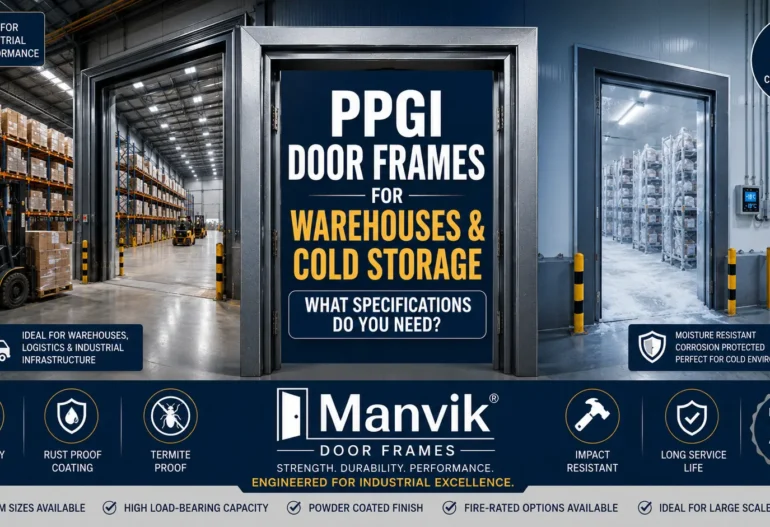
PPGI Door Frames for Warehouses & Cold Storage – Complete Specification Guide
If you are the manager of an industrial warehouse, cold storage facility, or any other large-scale industrial structure, then you recognize how hard these areas are for infrastructure. Continuous humidity, extreme temperature changes as forklifts crash into walls, hygiene checks as well as round-the-clock operationall of these can be seen in the daily reality that the most common construction materials can’t withstand for long. door frame manufacturer in India
Door frames are among the components that are often overlooked in industrial infrastructure. They’re designed to withstand the weight of high-end doors, protect against the effects of splashes and condensation, endure low temperatures in cold rooms yet look clean over time. Many facility managers choose the wrong materials when building, but only to have frayed frames, rust staining and costly replacements after five or seven years. PPGI Door Frames for Warehouses & Cold Storage
PPGI door frames made of Pre-Painted Galvanized Steelare now the most popular option for cold and warehouse storage structures in India as well as across global industrial markets. This guide will walk you through the entire picture, including what requirements to be looking for and what PPGI stands out from other alternatives and common mistakes in procurement and an easy buying guide for project managers as well as procurement managers who wish to make sure they get perfect in the very first attempt.
Why PPGI Door Frames for Warehouses & Cold Storage Are Becoming the Preferred Choice
PPGI (Pre-Painted Galvanized Iron) door frames are iron frames that are coated with zinc galvanizing layers with a pre-applied finish on the paint which provides superior resistance to corrosion as well as moisture resistance as well as structural toughness. for cold storage and warehouse establishments, PPGI door frames outperform conventional materials in resisting rust and temperature variations, and needing minimal care in a twenty-year period.
The trend towards industrial PPGI door frames isn’t just a trend but due to lessons that were learned from the ground.
Traditional door frames made of wood used in cold storage and warehouse facilities usually last between up to 5-8 years prior to the time that moisture damage begins to take hold. They expand, shrink, and even crack. When temperatures in cold areas range from -18degC to the -25degC range, wood shrinks and expands continuously, breaking seals and damaging their thermal insulation. Mold, insects, and rot cause the issue to get even more dangerous, particularly when it comes to food storage or pharmacy warehouses where cleanliness is an absolute requirement. doors and window frames
Simple steel frames are better than wood frames. However, in the absence of a coating, surfaces begin to rust within 2 years in humid environments. Rooms with cold temperatures are especially harsh as condensation develops across all metal surfaces when the frame is not coated with enough corrosion protection, corrosion accelerates.
PPGI frames address these issues at an technical levels. The steel base is hot-dip galvanized, this means that zinc is then bonded metallurgically onto the steel’s surface after which a primer as well as polyester paint coat is put on in a controlled manufacturing setting. The protection layer is the barrier to resist water, chemical and extreme temperatures at the same time. PPGI Door Frames for Warehouses & Cold Storage
Warehouse owners as well as cold storage builders throughout India seeking durable doors for warehouses, this product combination offers the lowest price for total ownership throughout the lifetime of the building.
Key Specifications Required in PPGI Door Frames for Warehouses & Cold Storage
Industrial PPGI doors for warehouses must comply with the minimum standards that include 1.2-2.0 millimeters steel thickness, 120 to 275 GSM zinc coating (galvanization) powder-coated, polyester-painted surfaces and a minimum yield to 250 MPa in compliance to IS 4351 or similar norms. Cold storage door frames need more thermal break designs and greater galvanization, ranging from 180 to 275 GSM.
If you are looking at PPGI door frames used for industrial construction, managers of procurement need to evaluate the specifications in five important aspects:
1. Steel Grade and Base Material Quality
The steel used for the base should be hot- or cold-rolled mild steel that meets IS 513 and IS 1079 standard. In the case of heavy-duty warehouse door frames the minimum tensile strength of between 270 and 410 MPa is advised. Lower base steel impacts the adherence to the coating of galvanizing and compromises the structural integrity of the door frame when it is subjected to heavy loading conditions.
2. Galvanization Coating Weight
The zinc coating acts as the main defense against corrosion. Galvanization is expressed as GSM (grams in square meters). In standard warehouses, the minimum is 120 GSM is sufficient. For door frames used for cold storage and food processing establishments with regular exposure to moisture, a range of 180 to 275 GSM is the standard industry advice. It is not a matter of negotiation for establishments located in areas with high humidity or coastal zones.
3. Paint System and Finish
The painted finish applied to PPGI frames is best done with two-coat systems which includes primer to convert chromates and a polyester or PVDF topcoat. The minimum thickness of dry film (DFT) between 20-25 microns in the primer, and 20-25 microns for the topcoat are standard in industrial uses. The paint system must be able to pass the minimum 500 hours salt spray test as per ASTM B117.
4. Frame Profile and Section Design
The majority of warehouse door frames use double rebate profiles for doors that range from 90mm up to 120mm overall frame thickness. In cold storage doors, the insulated panels tend to be thicker — typically 100-150mm. Therefore, frames should be designed in accordance with. Frames must also have the same thermal break materials (typically polyurethane gaskets or foam) to avoid condensation on the frame’s junctions when in cold areas.
5. Compliance and Standards
Seek out frames made that conform to IS 4351 (specification for door frames made of steel) in the minimum. For door frames for food processing facilities, such as frames as well as pharmaceutical warehouse door frames an additional conformity to FSSAI guidelines for facilities and GMP requirements is necessary. ppgi chaukhat
Ideal Thickness, Strength & Load-Bearing Capacity
The most commonly inquired about questions from procurement professionals is this: What is the thickness that the frames of warehouse doors be?
The answer is contingent on the type of application.
for standard warehouse applications that have doors with one leaf that weigh up to 90kg:
- The thickness of the frame sheet: 1.2-1.6 mm
- Frame section: 100mm x 60mm minimum
Doors for warehouses that are heavy-duty and sliding doors. double-leaf designs that weigh up to 200 kilograms:
- Thickness of frame sheet: 1.6-2.0 mm
- Frame section 120mm x 60mm, or specially designed profile with heavy section.
For industrial cold storage door frames supporting insulated slab doors (often 150-250 kg):
- The thickness of the frame sheet: 2.0-3.0 mm
- Section of frame: 150mm by 80mm with reinforcement of anchor tabs
The capacity for carrying loads of the frame should be able to account for not only the door’s weight, but also for stresses in operation such as repeated slamming forklift vibrations that are transferred to the floor and also the wind load in dock-level bays. The heavy-duty PPGI door frames specifically designed for use in warehouses are made with corner welds reinforced along with anchor bolts in addition to withstand these stresses throughout their long-term service. PPGI Door Frames for Warehouses & Cold Storage
One of the most common mistakes made during design is to select the frame’s thickness only on the cost, not the intended use. A 1.2mm frame mounted on a cold storage unit weighing 180kg door can flex and cause problems with hinges and may scratch the wall within 3 to 5 years. Moving to a correctly specified 2.0mm frames is less upfront, but will eliminate regular maintenance costs and the expense of replacing. Japani chokhat door frame in India
Corrosion Resistance and Moisture Protection in Cold Storage Facilities
PPGI door frames are resistant to corrosion and moisture with a three-layer system of protection consisting of hot-dip galvanized zinc basecoat (120-275 GSM) as well as primer for conversion to chromate, as well as polyester topcoat. For cold storage they can withstand the every day condensation cycles, temperatures ranging of -25°C to ambient and water jet cleaning or chemical sanitizers that do not cause damage to the surface.
Cold storage structures are among the most harmful environments found in construction. It is simple: When cold metal surfaces come into contact with the warm air in the surrounding condensate forms continuously. In addition, regular washing down routines using chemical sanitizers to create conditions that can destroy metal surfaces within the winter months.
Here’s what door frames that resist corrosion that are used for cold storage should be capable of handling:
Condensation Cycling If you live in a cold -20 degree space, the frame’s area temperature close to the door edge may be just a bit over zero because of breaking the heat. Cool, humid air that comes from outside condenses on the frames on a daily basis. The zinc layer in PPGI frames functions like a sacrificial sacrificial anodeand even when the scratches it continues to safeguard the steel by electrochemical actions.
Chemical Resistance Food storage and cold processes are cleaned using the quaternary ammonium compound, bleach solutions, as well as acidic and alkaline cleaners. It is important to note that the polyester, or PVDF topcoat used on high-quality PPGI frames acts as a chemical inert in standard concentrations of dilution.
The resistance to freezing and freezing The temperature ranges between -25degC to ambient and back can cause significant expansion and contraction of the thermal structure. PPGI steel is a material with the ability to expand its thermal coefficient that is easily understood and manageable. The paint system is elastic in this range, and does not delaminate or crack when it is the proper paint specification employed.
In coastal areas or regions with excessive humidity, moving to 275 GSM galvanization together with an PVDF topcoat over ordinary polyester is an investment worth it. The specification will add about 8 to 12 years of expected frame’s lifespan in these situations.
Heavy-Duty PPGI Door Frames for High-Traffic Warehouse Operations
Warehouses for logistics, distribution centers and manufacturing facilities function differently than standard commercial structures. Doors could open and close hundreds of times throughout the each day. Forklifts are operating in the doorways all day long. Docks that are loaded with docks suffer a substantial impact from the equipment as well as automobiles.
For these environments that are prone to high traffic the strength and structural integrity of the door frame is just as crucial as the strength of its corrosion resistance. For heavy-duty doors, PPGI door frames designed for warehouses should be identified by:
Reinforced Mitre Joints The edges that horizontal and vertical frame members intersect must be joined by welding, not mechanically secured. Mitre joints that are welded resist racking force that results from repeating door movements as well as lateral loads much more effectively than screws-fastened joints.
Anchor Tab Frequency The industrial warehouse door frames must have anchor tabs with a the minimum of 600mm, along with additional tabs that are within 150mm from the upper and lower edges of the frame. It ensures a strong bond to the wall’s structure during the time that the wall is subject to any vibrations from vehicles or machinery.
Head Reinforcement Frame headhorizontal component at the top takes the load of the door leaf via hinges. If doors are heavy, over 80kg, the head must be constructed from a heavier gauge materials (2.0mm or more) or incorporate an welded steel reinforcement plate on the hinges’ connection points.
Floor Channel Optional: For external warehouse doors or dock-level systems, the floor channel or sill plate that’s integrated within the frame system will help to ensure alignment throughout time specifically in places that have floor-level load loads as important.
Temperature Resistance and Performance in Cold Rooms
PPGI door frames function reliably when temperatures in cold rooms range between -30°C and +60°C, without damage to the structure, failure of paint or the acceleration of corrosion. Galvanized steel bases maintain its mechanical properties far lower than the operating limits of conventional cold storage facilities. Likewise, their polyester, or PVDF topcoat stays robust and flexible over the temperature range.
The material steel can actually become more durable (though less brittle) in very low temperatures. It’s not a problem when it comes to door frames that operate in cold -20°C – -25°C storage temperatures. However, this is the reason the reasons why steel is better suitable for colder climates than plastic and wood alternatives.
The most important design aspect of cold room door frames isn’t its ability to withstand low temperaturesthe issue is preventing heat from passing via the frame, which might compromise the efficiency of the cold room. This is the reason why frames that are thermally or electrically broken PPGI frame designs are used for the construction of cold storage.
A frame that is thermally broken incorporates an insulating substance which is typically polyurethane foam, or a neoprene thermal break strip between the interior (cold space) and the outer (ambient) segments of the frame’s design. It blocks the conduction pathway, decreases condensation that occurs on the warm part of the frame and aids in maintaining the building’s thermal envelope.
for blast freezer rooms and ultra-low temperature facilities for storage of pharmaceuticals that operate below -30 degrees Celsius, an further thermal break depths and sealant systems that are specialized for the purpose are needed. Make sure you specify the temperature to the door frame supplier and get confirmation that the frame has been validated or tested to be suitable for the purpose. PPGI Door Frames for Warehouses & Cold Storage
Fire-Rated PPGI Door Frames for Industrial Safety Compliance
Safety codes for industrial buildings in India as well as around the world require doors that are fire-resistant in certain places: the boundaries of fire compartments and emergency exit routes staircases, as well as areas that house dangerous materials or electrical equipment.
PPGI door frames are designed to work with fire-rated doors assemblies. It’s crucial to realize that the fire rating is only applicable to the entire door including the frame as well as the leaf for the doorbut not to each component separately. A Fire-rated PPGI frame has been checked and approved as a component of an assembly comprising the specific fire-rated leaf on the door.
For cold storage and warehouse establishments, the most frequently needed safety ratings for fire are:
- FD30 (30-minute resistant to fire): Suitable for general compartmentation lines within warehouses
- FD60 (60-minute fire-resistant): Required in bigger warehouses, with greater load of fire, especially ones that store flammable items
- FD90/FD120 (90/120-minute protection against fire): Required for staircases, plant rooms and other high-risk areas such as the storage of chemicals or pharmaceuticals.
If you are purchasing fire-rated PPGI door frames Make sure you request the certification documents, including the number for the test report as well as the size of the test assembly. This will protect your investment from concerns about compliance when you inspect it.
Hygiene Requirements for Food Processing & Pharmaceutical Storage Facilities
Facilities that handle food items such as pharmaceuticals and food products, as well as medical equipment, are subject to strict hygiene standards. The regulations in India, FSSAI guidelines, and GMP requirements require the surfaces of facilities (including doors and frames) to be impervious to dirt, washable, and impervious to chemical sanitizers. A lot of international customers and certification organizations add their own specifications. door or window frame
PPGI door frames are suitable for environments that require hygiene; however, the specifications needs to be evaluated carefully
Surface Profile The most hygienic solutions for door frames are designed with a smooth, continuous profile without visible fasteners, gaps, or horizontal ledges that collect dirt and hold bacteria. The internal corner radius ought to be wide (minimum 25 mm diameter) for an effective cleaning.
Paint System Polyester with a gloss or semi-gloss finish is recommended for use in pharma and food industries due to its ease of wash and is less susceptible to attracting contaminants. Matte finishes are visually preferable in office settings and are not suggested for door frames that are in controlled areas.
Sealant Compatibility The joints between frame members and wall must be sealed using high-quality silicone or polyurethane sealant. The standard sealants for construction may include biocides and plasticizers, which are not suitable for use in food-contact zones.
Color Coding The majority of processing doors use certain shades to define the zones of cleanliness. Door frames for pharmaceutical warehouses typically come in light grey or white so that contamination is visible. The frames of PPGI can be made in any RAL color, which makes the color code for specific zones easy.
PPGI Door Frames vs Traditional Wooden Door Frames for Warehouses
This comparison is frequently requested by project managers evaluating materials for new warehouse construction or facility upgrades.
| Parameter | PPGI Door Frames | Traditional Wooden Door Frames |
|---|---|---|
| Expected Service Life | 25–35 years | 5–10 years |
| Corrosion Resistance | Excellent (zinc + paint coating) | Poor (no corrosion protection) |
| Moisture Resistance | Excellent | Poor (swells, warps, rots) |
| Cold Room Suitability | Excellent | Poor (temperature cycling damage) |
| Termite/Pest Resistance | Complete immunity | Highly susceptible |
| Fire Performance | Can be fire-rated | Limited fire resistance |
| Hygiene Compliance | Fully compliant (smooth, cleanable) | Difficult (porous surface) |
| Structural Strength | High (steel construction) | Moderate (degrades with moisture) |
| Maintenance Requirement | Minimal | High (regular treatment, repainting) |
| Customization Options | High (sizes, profiles, colors) | Moderate |
| Environmental Impact | Recyclable at end of life | Depletes timber resources |
| Total Cost of Ownership (10 yr) | Lower (less maintenance + replacement) | Higher (multiple replacements + maintenance) |
| Compliance with IS Standards | IS 4351 | IS 4021 |
The contrast makes an obvious point: for every commercial, industrial, or cold storage use that requires durability, cleanliness, as well as low maintenance, important doors made of steel PPGI surpass wooden doors on almost all the metrics that matter for facility managers.
One area in which wood traditionally has advantages is in the initial cost in tiny quantities. But, when the all costs of ownership are estimated over a 10 year building lifespan – taking into account treatments, maintenance and repair and treatment PPGI door frames offer considerably lower prices for each year of use.
Common Mistakes Buyers Make While Selecting Warehouse Door Frames
In the past, after years of providing industrial door frames to cold storage and warehouse projects all over India The team at Manvik Door Frames has seen similar procurement mistakes repeated. The most expensive mistakes:
1. Specifying Thickness Without Reference to Door Weight
The most frequently-repeated error in specifications is selecting a the frame gauge on basis of general catalog descriptions or appearance instead of the actual door leaf weight or operational frequency. Make sure you specify the door’s weight and duration of operations (cycles daily) as well as any automated door openers before determining the frame’s the thickness.
2. Ignoring Galvanization GSM
Buyers typically compare PPGI frames solely on the basis of price without considering galvanization’s weight. Two frames that are similar and cost different prices often differ with regard to their zinc coatings’ weights; the 80 GSM is different from the 180 GSM, as an example. In an office that is dry, it might not matter. In cold rooms or warehouses with humidity, the difference will determine the longevity of your frame, whether it lasts for 8 to 25 years.
3. Selecting Frames Without Thermal Break for Cold Rooms
Standard PPGI frames aren’t intended for installation in cold rooms. In the absence of a thermal break the frame’s steel conducts cold through the room and onto the exterior which creates the condensation line, which stain walls and damages insulation panels and can cause energy loss. Be sure to choose thermally broken frame frames for door frames that are cold-storage.
4. Not Verifying Fire Rating Compliance Documentation
Making an order for “fire-rated frames” without requesting an official test certificate could pose a compliance risk. The rating for fire is applicable to the assembled unit testedmake sure that the frame and door combination you’re ordering is compatible with an approved and tested assembly.
5. Ordering Standard Sizes for Non-Standard Openings
The industrial buildings are not always equipped with doors that are standard. Making a frame that is standard into an opening that is too large or insufficient will require packing components and modifications to the site that could weaken the frame’s structural strength and look. Make sure to provide the exact dimensions of your opening and make sure you order the correct size.
6. Neglecting Anchor Design in Lightweight or Sandwich Panel Walls
Modern warehouses often use walls made of sandwich panels that are insulated. Anchor tabs made of concrete cannot be utilized in panels. Frames designed for wall panel installations need specialized brackets and fixing system. Check the construction of your wall before you purchase frames.
Buying Guide – How to Choose the Best PPGI Door Frames for Warehouses & Cold Storage
If you’re in the planning process for your cold storage or warehouse project, this step by step guide will assist you in defining the specifications accurately.
Step 1: Define the Application Environment
Be sure to answer these questions prior to approaching any supplier:
- Does the building function as an open, dry warehouse, chill storage (+2degC up to +8degC) or blast freezer (-20degC to 30degC)?
- Are you situated in a beach area or a high-humidity region, or an inland standard environment?
- Does the facility deal with the food industry, pharmaceuticals or chemical substances (hygiene regulations)?
- What’s the door’s approximate frequency (light use, moderate and heavy-duty industrial)?
Step 2: Determine Door Leaf Specifications
Find out the leaf style of your door size, weight and width prior to deciding on frames. The frame should be constructed to safely carry the door and to fit into the door’s profile. In the case of insulated cold rooms the thickness of the door (often between 80 and 150mm) will determine the frame’s thickness.
Step 3: Confirm Wall Construction Type
Indicate whether the walls include RCC (reinforced concrete) solid masonry block, hollow or solid and insulated sandwich panels. The anchor tab will be determined by the layout and the method of installation.
Step 4: Establish Regulatory Requirements
Find out if fire-rated structures are required by local construction code or by insurance regulations. Take note of any hygiene requirements applicable to your particular facility.
Step 5: Prepare a Detailed Quantity and Drawing Schedule
Contact your framer with a schedule of the door openings for each opening’s dimensions, the door’s kind, as well as any specific specifications. This will prevent costly mistakes and permits accurate price pricing.
Step 6: Evaluate Suppliers on Quality Credentials, Not Just Price
Request test certificates for steel and galvanization test results and specific specifications of the paint system from the suppliers you have shortlisted. If a supplier is unable to provide the required documents will be supplying uncertified products. The difference in price between a frame that is well-specified and an inferior substitute can be minor, however the difference in performance is significant.
Cost vs Long-Term ROI of Industrial PPGI Door Frames
If budgets for projects are under pressure, procurement departments typically consider door frames as a place that can be cut in cost. Knowing the real economics behind the decision is crucial.
Think about the typical cold storage space with 20 doors. The most well-crafted PPGI cold storage door frame could run between Rs8,000 and Rs15,000 depending on its size and the specifications. The cheapest option that has a thinner gauge, less galvanization and with no thermal break could cost between Rs4000 and R6500 per opening. This savings is between Rs2,000 and Rs9,000 per open, or around Rs40,000-180,000 per project.
But, take into account the costs of maintenance and replacement:
- The frames that cost less used in cold storage facilities usually require replacement in 8-10 years.
- Each replacement of a frame in the operation of a cold storage facility requires labor and downtime, as well as the temporary management of doors, as well as the reinstallation of wall insulation as well as wall finishesbetween Rs15,000 and Rs25,000 for the total cost of replacement
- Maintenance on a regular basis (rust removal, painting or sealing agent replacement) can cost between Rs2,000 and Rs5,000 each year, per opening. This is for frames with inadequate frame
If you have a facility that lasts for 20 years and a 20-year facility life, the cost of the less expensive option could be anywhere from three to four times that of the top quality. The ROI argument for putting money into top-quality manufacturing PPGI frame doors can be easy to understand.
Large project warehouse construction and large frames for doors, Manvik Door Frames offers competitive price for bulk purchases that can reduce the cost per unit of correctly designed frames significantly, thereby increasing the ROI calculation. PPGI Door Frames for Warehouses & Cold Storage
Why Choose Manvik Door Frames for Warehouse & Cold Storage Projects
Manvik Door Frames is a expert manufacturer and distributor of PPGI door frames, steel doors as well as industrial door frames made specifically for use in demanding environments such as cold storage facilities, warehouses facilities, food processing plant Pharmaceutical warehouses, as well as logistic distribution centers.
What differentiates Manvik Door Frames different from other door frames?
High-Quality PPGI: Every frame is made from ISI-marked steel base that has been galvanized and painted by factory systems that comply with IS 4351 specifications. We supply complete material documents which includes steel mill certifications and galvanization test report.
Industrial-Grade Strength Our robust PPGI door frames have been designed to withstand the harsh warehouse environment Welds reinforced with mitre and rated anchor tab systems and the specifications for gauges are matched to real doors’ weights and operating demands.
The Cold Storage Expert Design Manvik Door Frames manufactures the thermally broken cold room door frame systems that are specifically designed to be used in cold storage that have been tested for performance up to -30degC.
Moisture and corrosion protection: Multiple galvanization options between 120 GSM up to 272 GSM and a the option of PVDF or polyester topcoats, you can be sure of the best corrosion protection to your particular area.
Custom sizes for every project: No two industrial construction sites are the same. Manvik Door Frames manufactures to specifications for projects, allowing special openings that are not standard, insulated door profiles and custom frame design.
Bulk Project Supply We can support massive Cold storage and warehouse construction projects that have regular batch production, coordinated timelines for delivery, as well as dedicated Project Account Management.
Rapid Delivery All Over India — PAN India Supply: Manufacturing capabilities and a logistics networks that cover large industrial zones throughout India, Manvik Door Frames can deliver its products to construction sites in schedule, regardless of whether they are in metro cities or industrial sites in Tier 2.
Competitive Price: Direct manufacturer pricing without middleman costs, and discounts in bulk for huge order construction of warehouses.
Expert Technical Support Our staff is comprised of engineers who have extensive experience working in industrial construction. We can assist you to determine the best specifications for your building, look over your door’s schedule and address any technical issues on site.
Contact Manvik Door Frames
If you’re thinking of building a brand building a new Cold Storage facility, or upgrading the existing one or you require a massive frame for industrial doors for a ongoing construction project, Manvik Door Frames has the products, specifications experience, and the ability to assist the project right from design until the installation.
Request for a free quote Make a call or message our sales representatives from industrial to discuss your requirements for the project and get a full quote.
contact Manvik door frames today • Send us your plans and door schedule to receive a technical analysis and pricing competitive.
Find Bulk Price Contact us to inquire about our pricing on projects over 50 doors. We also offer commitment to delivery times for big warehouse projects.
Speak to our Industrial Experts Not sure of the specifications of your warehouse or cold room? Our engineering experts are available for a free technical consult.
Get in touch now Complete our enquiry form online with the details of your project and one of our team members will get back to you within 24 hours.
Buy Directly from the Manufacturer Get rid of the margins of distributors and receive factory direct prices in PPGI door frames to suit your cold storage or warehouse project.
Frequently Asked Questions
Q1. Which door frame is best for warehouses?
For most warehouse applications, PPGI (Pre-Painted Galvanized Iron) steel door frames are the best choice. They combine structural strength, corrosion resistance, low maintenance, and competitive total cost of ownership. Steel door frames outperform wood in moisture resistance, structural stability, pest immunity, and compliance with industrial building standards.
Q2. Are PPGI door frames suitable for cold storage?
Yes. PPGI door frames are an excellent choice for cold storage facilities, provided they are specified with thermal break design to prevent condensation and energy loss. For cold rooms operating below -18°C, select frames with 180–275 GSM galvanization and thermally broken profiles.
Q3. What thickness should warehouse door frames have?
For standard warehouse doors up to 90 kg, 1.2–1.6mm frame thickness is adequate. For heavy-duty warehouse doors or double-leaf configurations up to 200 kg, use 1.6–2.0mm frames. Cold storage insulated door frames typically require 2.0–3.0mm thickness to handle the weight of insulated slab doors.
Q4. Are steel door frames better than wooden door frames?
For industrial applications, yes — significantly. Steel PPGI door frames last 25–35 years versus 5–10 years for wood in comparable conditions. They resist moisture, pests, rot, and temperature cycling that destroy wooden frames in warehouse and cold storage environments. They are also fully compliant with industrial hygiene standards where wood is not.
Q5. How long do PPGI door frames last?
Properly specified and installed PPGI door frames in industrial environments typically last 25–35 years. In controlled indoor environments, service life can exceed 40 years. Lower-specification frames in high-humidity or coastal environments may need replacement in 12–15 years, which is why galvanization grade (GSM) selection matters.
Q6. Can PPGI door frames resist moisture?
Yes. The hot-dip galvanized zinc base coat provides both a barrier protection and electrochemical protection against moisture-driven corrosion. The pre-painted polyester or PVDF topcoat adds further resistance to water penetration. PPGI frames are moisture-resistant door frames suitable for high-humidity warehouses, cold rooms, food processing plants, and outdoor applications.
Q7. What are the specifications of cold storage door frames?
Cold storage door frames should specify: frame thickness 2.0–3.0mm; galvanization 180–275 GSM; thermal break incorporated in frame profile; polyester or PVDF topcoat; smooth hygienic profile; frame depth matched to insulated door panel thickness (typically 80–150mm); food-grade sealant at wall interface.
Q8. Which door frame material is best for industrial buildings?
PPGI (Pre-Painted Galvanized Iron) steel is the preferred material for industrial building door frames. It meets the structural, corrosion resistance, hygiene, and fire safety requirements of modern industrial construction more comprehensively than wood, plain mild steel, or aluminum alternatives.
Q9. Are PPGI door frames rust-proof?
PPGI door frames are highly corrosion-resistant but technically not “rust-proof” in all conditions forever. The hot-dip galvanized zinc coating provides 25–35+ years of rust resistance in standard industrial environments. In extreme coastal or chemical environments, specifying 275 GSM galvanization with PVDF topcoat provides the highest available corrosion resistance for steel-based frames.
Q10. How to choose industrial door frames?
Choose industrial door frames by: (1) defining your environment — humidity, temperature, chemical exposure; (2) confirming door leaf weight and frequency of use; (3) identifying regulatory requirements — fire rating, hygiene standards; (4) specifying the correct galvanization grade and paint system; (5) verifying compliance with IS 4351; and (6) sourcing from a manufacturer who can provide material test documentation.
Q11. What is the price of PPGI door frames for warehouses?
PPGI door frame pricing depends on frame dimensions, steel gauge, galvanization specification, and order quantity. Typical range in India is ₹6,000–₹20,000 per frame for standard warehouse sizes. Bulk orders for large warehouse projects attract significant discounts. Contact Manvik Door Frames for project-specific pricing with full material specification details.
Q12. Do food processing facilities require special door frames?
Yes. Food processing facility door frames must meet hygiene requirements including smooth, non-porous cleanable surfaces; no crevices that harbor bacteria; resistance to chemical sanitizers; and food-grade sealants at wall joints. PPGI frames with gloss polyester finish and hygienic profile design are the correct specification for food storage and processing environments.
Q13. What is the minimum galvanization required for cold room door frames?
For cold storage door frames, a minimum of 180 GSM galvanization is recommended. For blast freezer environments, high-humidity cold rooms, or coastal locations, 275 GSM is the preferred specification to ensure the 25+ year service life expected from a quality industrial installation.
Q14. Can PPGI door frames be custom-sized for non-standard openings?
Yes. PPGI door frames can be manufactured to any specified dimension. Industrial buildings frequently have non-standard opening sizes, particularly where oversized forklift doors, insulated cold room panels, or architectural constraints require custom frame dimensions. Provide your opening dimensions and door leaf specifications to your frame manufacturer for custom fabrication.
Q15. What certifications should I look for when buying industrial door frames in India?
Look for frames manufactured in compliance with IS 4351 (steel door frames standard). Request steel mill certificates for the base material, galvanization test reports confirming coating weight (GSM), and paint adhesion test documentation. For fire-rated assemblies, request the test certification from an accredited test laboratory confirming the rated assembly specifications.
Conclusion
The right door frame to fit a cold or warehouse storage facility is an important option that will have long-lasting effects. There is a difference between a properly defined PPGI door frame versus a less than ideal alternative that will not be apparent on the first date of installation and is revealed in the cost of maintenance, early replacements, compliance issues, and disruptions to operations over the course of 10 years. double rebate door frame in India
The basic principles are simple. The basic idea is to match the galvanization grade to your specific environment’s exposure to corrosion, to match your frame’s thickness to the weight of your door and frequency of use, to indicate thermal breaks to be used in cold room applications, and to confirm the material quality of your provider.
PPGI door frames designed for cold storage and warehouses are the most current standard of industrial construction both in India and around the world. They offer durability against corrosion and structural strength, as well as the hygiene and long-lasting service life modern industrial facilities require—and all for a price of maintenance that is worth it each time.
Manvik Door Frames manufactures and offers high-quality industrial PPGI door frames in India and offers full technical assistance as well as project-specific custom sizes, as well as bulk supply capabilities for huge-scale cold and warehouse storage projects.
Do you want to design PPGI door frames to your future project? Call Manvik Door Frames today for no-cost technical advice and price for bulk projects.


