

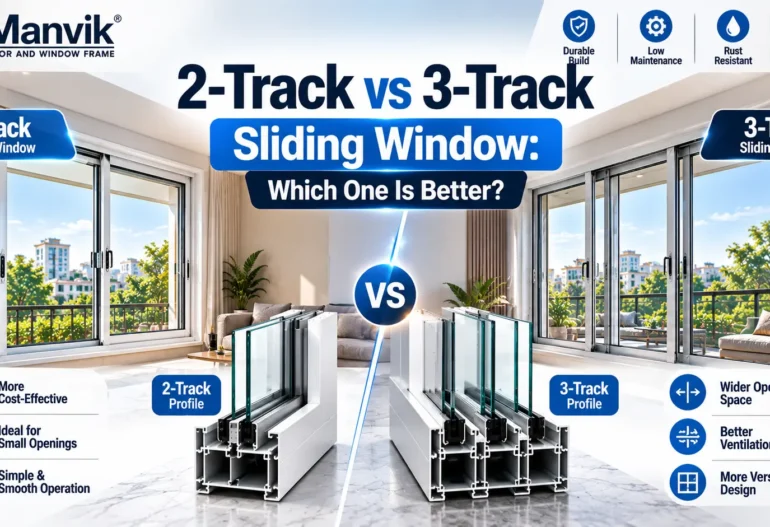
If you’ve started shortlisting window options for a new home or a renovation, you’ve probably come across the 2 track vs 3 track sliding window question more than once — usually right after a dealer or contractor asks “kitne track chahiye?” and you realize you don’t actually know what that changes. The number of tracks isn’t a minor spec. It decides how the panels move, how much of the opening you can actually use, and how much ventilation or access you get at any given time. Manvik Door Frames use both so often that the reality is that, honestly, one answer doesn’t really hold any more weight than the other. It really depends on where the window is going and what it needs to do.
This handy guide explains the practical differences so you can make that call for your particular room, balcony, or project.
2 Track vs 3 Track Sliding Window
The 2-track sliding window has two tracks, so usually two sliding panels (doors) sliding along two parallel lines. Usually only one sliding panel (door) can be open at a time, thereby opening approximately half of the window space. A 3-track sliding window is installed with an additional track for more sliding panels or combinations (e.g., a fixed or screened panel).
It really comes down to which one fits your window size, the ventilation you require, room or balcony, number of panels you want, design preferences, price range, and maintenance needs. Neither system is better in all applications.
What Is a 2-Track Sliding Window?
A 2-track sliding window provides a pair of parallel channels built into the window frame. The panels slide along those tracks, overlapping each other as they slide open. A standard design involves either a fixed panel with one sliding or two sliding panels that meet in the middle or stack to the side when the window opens.
The fact there are only two tracks means the maximum opening at any given time is generally around half the total width of the window – one panel has to hide behind or in front of the other. Two-tracks windows are thus generally simpler to manufacture, often easier to clean (there is less to clean in the tracks) and are a common option when the opening needn’t be very wide.
2-track sliding windows are frequently used in:
Bedrooms, where full-width ventilation isn’t usually required
- Smaller living rooms
- Kitchens with limited wall space
- Small balconies or utility areas
Any residential room where a simple, space-saver style of window is appropriate
What Is a 3-Track Sliding Window?
3-Track Sliding Window The addition of a 3-track sliding window provides you with an additional track for the frame. This gives you more configuration options for the application, there are several options based on the type of design you want, either 3 sliding panels or 2 sliding panels with a fixed glass or mesh/screen panel.
The additional track results in more of a panel exposed opening, because the panels can be set up to reveal a greater amount of window width. For this reason, 3 track windows are often used when additional ventilation, natural light, or accessibility is desired-especially on larger openings such as balcony doors and living room windows that serve as views and / or entry points.
3-track configurations tend to show up in:
Balconies, where access and ventilation are both important, might include a broader opening.
Living rooms with larger window openings
New style houses where you require a mesh/screen panel in addition to the glass panels
Rooms that focus on additional sunlight
Precise panel layout can differ depending on manufacturer and project, so it’s beneficial to verify this prior to purchasing.
2 Track vs 3 Track Sliding Window — Main Comparison
| Feature | 2-Track Sliding Window | 3-Track Sliding Window |
|---|---|---|
| Number of tracks | Two parallel tracks | Three parallel tracks |
| Panel configuration | Typically two panels | Often three panels, or two sliding + one fixed/mesh |
| Opening flexibility | Moderate — limited by two-track movement | Generally higher, more arrangement options |
| Ventilation | Adequate for smaller openings | Can offer more airflow for larger openings |
| Natural light | Good, depending on panel size | Can be higher with larger effective opening |
| Balcony suitability | Works for smaller balconies | Often preferred for wider balcony openings |
| Large openings | Less suited to very wide spans | Better suited to wider spans |
| Space usage | Compact, simple mechanism | Slightly more complex, more usable opening |
| Cleaning | Fewer tracks, generally simpler | More tracks, slightly more maintenance |
| Maintenance | Lower | Marginally higher due to extra track |
| Design flexibility | Simpler designs | More room for mesh/screen integration |
| Cost considerations | Usually lower base cost | Can be higher due to extra track and panel |
| Best suited for | Bedrooms, small rooms, budget projects | Balconies, living rooms, larger openings |
How Much Opening Does a 2 Track vs 3 Track Sliding Window Provide?
The actual clear opening in any sliding window is determined by them all – not just the number of tracks. It is determined by the number of panels, the width of each panel, the total window size and the installer’s track configuration.
2 Track vs 3 Track Sliding Window 3-tracks windows can typically open a little wider in a panel’s maximum open position because the panels can slide behind each other a little better. Often two panels will slide all the way open while one remains stationary. 2-tracks windows will be half as wide in a panel open position in most cases because the panels only have two channels to occupy.
However, it’s not necessarily going to apply to everything. Depending on the width of the panel, the style of frame and the way the window was constructed, the overall opening size will be different. Rather than assuming the same percentage, it’s a good idea to get the precise measurements for the window you’re ordering.
Choose Between 2 Track and 3 Track Sliding Window for Better Ventilation.
The 3-tracks sliding window will have the most ventilation due to the fact that a larger percentage of the window opens at any given time but there are so many other factors such as window locations which impact ventilation.
Any room you’re in, you’re basically just talking about volume of opening and how that opening is positioned (against another window or door for cross-ventilation). You’re never going to get a 3-track window to open as wide a section as a 2-track window can, but when you need the air to circulate in your home as much as you’re able to, that’s not a bad thing.
A 3-track may be a good idea if a room has just a single window and you rely on the air flow for most of the room’s air circulation. For a room with more than one window, or if you don’t require the air flow, a 2 track window typically suffice.
2-Track or 3 Track Sliding Window for Balcony?
The correct configuration for balcony usage relies on the size of the opening and your intent of use.
If the balcony is relatively small opening and the window is largely just for light and some fresh air, a 2-track sliding window should be appropriate. It’s much easier, cheaper, and suitable for a small space.
Larger balcony openings – particularly those designed as a “walk-through” or “view” opening – generally work best with a 3-track design, as you’ll typically want to open up a larger portion of the opening for circulation and/or visibility. Third track doors are also ideal if you want a screen panel for insect protection with a wider opening for ventilation.
Other balcony related things to keep in mind: Degree of exposure to the elements – Whether the window is easy to access for cleaning from inside, and whether safety sliding considerations (such as ensuring small kids don’t have easy access to the broad open space) are important for your family. These points of related concern people look up for are sliding window for balcony, balcony sliding window design, and modern balcony sliding window options for Indian homes – wherein the answer is largely based on the dimension of the actual opening and purpose of the balcony.
2-Track vs 3 Track Sliding Window for Different Rooms
Bedroom
Bedrooms usually need to be relatively quiet and ventilated rather than an opening with maximum capacity, so a 2-tracked sliding window is often perfect as it can be opened to let fresh air in without having to have the entire opening back.
Living Room
Room For a 3-Track 3-Track Window Systems Living room openings tend to be wider, which allows for an abundance of light and can even be used as a connection to the outdoors. For wide openings, a 3-track may work well.
Kitchen
Ventilation The best kitchen ventilation has both: high-exhaust airflow and the ability to clear smoke and heat from the area. Easy to clean Also, because of the grease and moisture (kitchen) environment, choose a 2-track window rather than a 3-track. The 2-track window is better for smaller openings – less hardware and easier to clean.
Balcony
As discussed above the size and use of the balcony will determine the guide used – small balconies will more than likely need a 2 track while a larger one may need a 3 track.
Study Room
Concentrate room – Has direct sunlight and noise Comfortable light and noise can be controlled. A window with a small opening along two tracks can control both without affecting basic cross-ventilation.
Utility Area
Utility spaces mostly require practical ventilation and are easy to maintain. Perhaps a 2-track window is a more functional solution here as it would be easier to clean and to maintain.
2-Track vs 3 Track Sliding Window Size
Currently, there is no one size fits all size for either arrangement – sliding window sizes are dependent on wall opening, the structural needs of the room, the number of panels, the track configuration, and the ventilation requirements of the room. That’s why a 2-track sliding window size and a 3-track sliding window will be different from project to project.
Always measure the actual wall opening before selecting the size of a sliding window frame, rather than choosing a size to fit a standard opening. This is true whether you’re ordering a small bedroom window or a large balcony unit.
What Are the Dimensions of a 3-Track Sliding Window?
Short answer: No, a 3 track sliding window doesn’t have a standard size. Size varies on the number of panels needed, wall opening, and project specifications, so it’s best to speak to the manufacturer for the correct 3 sliding window sizes.
Frame Width, Height, and Panel Dimensions for a 3 Track Window In general, width, height, panel size, and overall frame size for a 3-track sliding window will be based on the opening that needs to be filled. For example, a balcony opening will likely have a different width than a bedroom window, and panels will be sized to suit. 3-tracks come in all configurations, so it’s safer to provide your supplier with your opening dimensions than to assume a standard.
Which Type of Sliding Window Is Best?
Short answer: There isn’t a “best” sliding window – what is best varies by the room, opening size, ventilation requirements, balcony requirements, budget, maintenance requirements, frame material, and glass requirements.
A 2-track sliding window is ideal for smaller openings, a tight budget, or spaces where a little less airflow is acceptable. A 3-track sliding window is ideal for larger openings, balconies, and spaces where a little more airflow, light, or a mesh panel option is desirable. In addition to the above options, some projects also use fixed-plus-sliding combinations where part of the window remains fixed while just part slides – great if a wide window doesn’t need to open across the entire length.
To buyers who specifically focused on PPGI base options, Manvik PPGI Sliding Window Frames offer both 2-track and 3- track options so you can select based on your real requirement and not the limits of the frame material options you have available.
What Is the Difference Between 2.5-Track and 3-Track uPVC Windows?
Quick answer: “2.5-track” terminology is a handle that is occasionally used in the uPVC window business to refer to a track that is out of line with a typical 3-track in the sense that you may get a more narrow frame profile and still keep the mesh or extra panel option.
Note: The real definition can differ by manufacturer, because this is not a normally standardized term as “2-track” and “3-track” are generally.
The precise meaning does vary by manufacturer, since 2.5-track isn’t a standardized, universally defined designation in the same way that 2- and 3-track do tend to be. Most often, a 2.5-track profile is used as a sort of compromise option that offers some of the benefits (such as the ability to accommodate a mesh panel) of a 3-track profile, but maintains a narrower frame than a standard 3-track. Do note that the designation “2.5-track” is used almost exclusively in uPVC Window systems; since the current Manvik product range is PPGI Sliding Window Frames, a comparison of 2.5-track in uPVC against PPGI should be checked with each supplier.
How Much Is the Cost of 33 Sliding Window?
Quick Answer: The price for a 33 sliding window varies based on the material of the frame, specific dimensions, number of panels, track type, glass style, hardware, finish, customization options, installation, and how many you order.
What is a 33? What does it mean? 33 can either relate to a window measuring roughly 3′ X 3′ or a particular panel or track layout based on the window manufacturer’s system. When comparing 33 sliding window quotes, double-check exactly what the size measurement means to avoid comparing apples to oranges- and make sure the estimates you’re comparing are for the same material, glass, hardware, and finish. 2 track vs 3 track sliding window
Sliding Window Price / Cost Guide
Pricing for any sliding window — 2-track, 3-track, or otherwise — is shaped by multiple factors rather than a single number. Here’s what typically influences the final cost:
| Price Factor | Effect on Final Cost |
|---|---|
| Frame material | PPGI, uPVC, and aluminium carry different base costs |
| Window size | Larger dimensions require more material |
| Number of tracks | More tracks can mean more hardware and complexity |
| Number of panels | More panels generally increase cost |
| Glass type | Thickness, tinting, or safety glass affect pricing |
| Hardware quality | Rollers, locks, and handles vary in cost and durability |
| Finish | Coating type and color options can shift price |
| Customization | Non-standard sizes or configurations add cost |
| Installation | Labor and site conditions affect the total |
| Quantity | Bulk orders often come with better per-unit pricing |
Rather than comparing a single “sliding window price” figure across suppliers, it helps to request itemized quotations that break down each of these factors — that’s the only reliable way to compare like with like.
PPGI Sliding Window Frames manufactured by Manvik Door Frames
Manvik Door Frames presents PPGI Sliding Window Frames manufactured for residential as well as commercial purposes using prepainted galvanized iron construction. Customers comparing a 2-track or 3 track sliding window should consider the track, and some may also need to keep in mind the material of the frame, as this will influence how long the window lasts.
PPGI Frames are Coated in the Factory with Anti-Corrosion Coating, which is especially useful for the sliding window that gets used daily, and if installed on a balcony, is also exposed to the elements. At Manvik, we have a few options of sliding window frames which can be decided based on your needs of – 2 track for bedroom or 3 track for balcony/living room opening.
Not that this is a blanket statement that PPGI is the best option in all circumstances, with all aluminium or uPVC items – just that it’s a sensible choice to research among the options below, all of which depend on the frame material. 2 track vs 3 track sliding window
PPGI vs uPVC vs Aluminium Sliding Windows
| Factor | PPGI | uPVC | Aluminium |
|---|---|---|---|
| Basic material | Pre-painted galvanized iron (steel core) | Rigid PVC plastic | Lightweight metal alloy |
| Appearance | Factory-finished, multiple colors | Smooth, typically white or woodgrain finishes | Sleek, modern metallic look |
| Maintenance considerations | Low, factory coating reduces upkeep | Low, no painting needed | Low to moderate, depending on coating |
| Durability considerations | Strong due to steel core with protective coating | Durable, resistant to warping | Durable but can be prone to denting |
| Design flexibility | Moderate, depends on manufacturer options | High, many profile and color options | High, slim frame profiles possible |
| Sliding applications | Common for residential and commercial sliding frames | Common, especially for insulated designs | Common, especially in commercial settings |
| Residential use | Widely used | Widely used | Widely used |
| Commercial use | Used in various commercial projects | Used, particularly where insulation matters | Frequently used in commercial facades |
Each material has genuine trade-offs, and the right choice depends on your project’s priorities — whether that’s cost, appearance, insulation, or long-term maintenance. door window frame
How to Choose Between 2-Track and 3-Track
Step 1: Measure the opening. Get the precise measurements of the wall opening before trying out any configuration.
STEP 2: Estimate the necessary open area. Determine how large an opening you need in your window to get the ventilation or access you require.
Step 3: Ventilation. If you want more air in the room, go with 3-track; secondary rooms will probably be 2-track.
Step 4: Think about the room/balcony usage. Adapt the arrangement to the way you normally live.
Step 5: Deciding how many panels. This impacts flexibility of opening as well as price.
Step 6: Choose frame material Each type of frame material has advantages and disadvantages when it comes to durability and maintenance. PPGI uPVC aluminium
Step 7: Select the Glass based on Requirements Think Safety, Insulation or Privacy needs of the room while choosing the Glass.
Step 8: Inspect hardware and track. Rollers and locks influence window functionality over time.
Step 9: Ask for the workquotes to be compared on the same specifications As mentioned above. Make sure all the quotes relate to the same material, size, and type of glass.
Step 10: Confirm required installation. Find out who is responsible for installation and what this entails for your opening.
Common Buying Mistakes
- Selecting a window primarily on the price without considering quality of materials or hardware
- Equivalence by type Comparing quoted prices for different sizes of windows as if they were the same.
- Compare across different frame materials without increasing the cost.
- Ignoring track configuration when comparing opening flexibility
- Not specifying the precise panel quantity pre ordering
- Ignoring the thickness, type of glass in the comparison
- Incorrectly measuring the aperture or estimating it from a photograph
- All Quotes within an Apples to Apples Comparison of Quote Costs Differ by the same things that’s included with the Quote (installation, hardware, etc.)
- Treat installation as an afterthoughtrather than part of the decision
- Avoiding quality or finish checks for frames prior to approval for an order
Frequently Asked Questions
Q1. What is the difference between 2-track and 3-track sliding windows?
Answer: A 2-track sliding window has two channels, typically allowing about half the window to open at a time. A 3-track sliding window has three channels, often allowing a larger effective opening and more panel configuration options, such as adding a mesh or fixed panel alongside sliding ones.
Q2. Which type of sliding window is best?
Answer: There’s no universally best type — it depends on your room, opening size, ventilation needs, balcony requirements, budget, and maintenance preference. A 2-track window suits smaller, budget-conscious openings, while a 3-track window suits larger spaces needing more airflow or flexibility.
Q3. What is the difference between 2.5 track and 3 track uPVC windows?
Answer: “2.5-track” generally refers to a uPVC configuration with a slightly offset or recessed track for a slimmer frame while still allowing a mesh or extra panel, whereas a full 3-track system has three equal parallel channels. Exact definitions can vary by manufacturer.
Q4. What is the price of a 3X3 sliding window?
Answer: There’s no fixed price — it depends on frame material, glass type, hardware, finish, customization, and installation. “3×3” usually refers to a window around 3×3 feet, but confirm the exact configuration before comparing quotes.
Q5. What are the sizes of a 3 track sliding window?
Answer: There’s no single standard size. Dimensions depend on the wall opening, number of panels, and project requirements, so it’s best to share your exact measurements with the manufacturer for an accurate configuration.
Q6. Is a 3-track sliding window better for a balcony?
Answer: For wider balcony openings needing more airflow, access, or a mesh panel option, a 3-track window is often preferred. For smaller, compact balconies, a 2-track window can be sufficient and more budget-friendly.
Q7. Which sliding window is best for a bedroom?
Answer: A 2-track sliding window is commonly suitable for bedrooms, since bedrooms typically need moderate, controlled ventilation rather than a very wide opening, along with reasonable privacy.
Q8. Are PPGI sliding windows good for homes?
Answer: PPGI sliding windows, built with a pre-painted galvanized iron core, offer good corrosion resistance and low maintenance, making them a practical option for residential sliding window frames, alongside uPVC and aluminium alternatives.
Q9. How much does a sliding window cost?
Answer: Cost varies based on frame material, size, number of tracks and panels, glass type, hardware, and finish. Rather than a fixed number, it’s best to request an itemized quotation based on your specific requirements.
Q10. What is a 2-track sliding window price compared to a 3-track one?
Answer: A 2-track window is generally priced lower due to simpler construction and fewer panels, while a 3-track window can cost more because of the additional track, potential extra panel, and added configuration options. Exact pricing depends on the supplier and specifications.
Q11. Can a 3-track sliding window include a mesh panel?
Answer: Yes, many 3-track configurations are designed to include a mesh or screen panel alongside sliding glass panels, which is one reason buyers choose 3-track systems for balconies or ventilation-heavy rooms.
Q12. What size should I choose for a sliding window frame?
Answer: The right size depends on your actual wall opening, which should be measured precisely before ordering. There’s no universal standard size, since dimensions vary by room, application, and panel configuration.
Q13. What material is best for a sliding window frame?
Answer: PPGI, uPVC, and aluminium each offer different advantages in maintenance, appearance, and durability. PPGI sliding window frames, such as those offered by Manvik Door Frames, are a practical option for buyers prioritizing a factory-coated, corrosion-resistant steel-based frame.
Q14. Does Manvik Door Frames offer both 2-track and 3-track sliding windows?
Answer: Manvik Door Frames manufactures PPGI Sliding Window Frames and can discuss both 2-track and 3-track configurations based on your project’s specific requirements, room type, and opening size.
Q15. How do I compare sliding window quotations correctly?
Answer: Ensure every quotation covers the same frame material, size, glass type, hardware, and installation inclusions. Comparing quotes with different specifications can make one option look cheaper when it’s actually a different product altogether.
Conclusion
In essence, the difference between a 2 Track vs 3 Track Sliding Window is the quantity of the opening that can be used at any given time and the number of configurations of the panels that can be achieved; 2-tracks are easier and more economical, so are better suited to smaller or more modest openings, whereas 3-tracks are better for larger openings, balconies and rooms that require better air flow. But apart from the number of tracks, the size, material and glazing of the window are also factors that will impact the overall performance of the window.
Manvik Door Frames provides the following varieties of PPGI Door Frames & PPGI Sliding Window Frames for projects for house, and commercial spaces that can be talked about for your room, balcony or project.
Are you looking for PPGI sliding window frames for the house, balcony or commercial project? Please send us the required window size, window shape, and project details to Manvik Door Frames, and we will get back to you with the right choice.
GI vs PPGI vs Tata Sheet Chokhat — Which One Is Better?
How to Choose a Window Chokhat Dealer — Sirsa/Haryana Buyer’s Checklist
Readymade Window Frames vs Custom-Made — Which Is Right for You?
How CNC Japani Chokhat Is Made — Manufacturing Process 2026


