

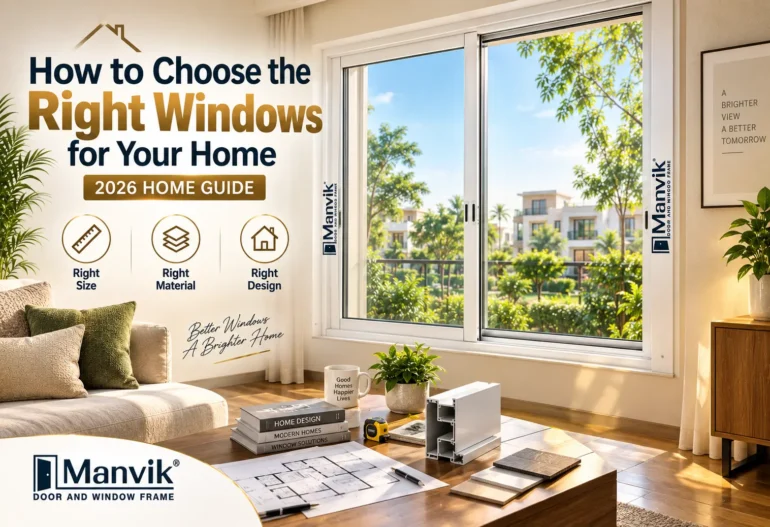
Windows are more effective inside the Indian house than homeowners realize. They battle the scorching summer heat as well as ward off monsoon rain and filter dust out of the streets, allowing the winter sun but still having to be attractive on the wall of your living space for at least the next twenty years. The choice of the best windows to suit Indian houses isn’t just an aesthetic option. It directly impacts the level of comfort, security, and maintenance-free your house will be. With the combination of humidity, heat, dust, ocean air, and heavy rain, many regions of India have to put windows through extremely tough conditions. That’s why choosing the “right” window differs from one room, house, or area to another. sliding window frame for balcony
This article will walk you through various window styles, frame materials, and options based on climate and rooms-by-room suggestions, as well as an easy buying procedure. Regardless of whether you’re building a brand new home or replacing older windows, you’ll make an informed decision that you will not regret within five years. Right Windows for Indian Homes,
What Are the Right Windows for Indian Homes?
Answer straight away: The right windows to choose for the Indian residence are based on your area’s climate, the windows’ orientation and position within the structure, as well as the area it will be used in, as well as the amount of sunlight and ventilation you require, the exposure to coastal or rain humidity, security and noise needs, maintenance preferences, and budget. There’s no one window style or frame material suitable for all Indian houses. A window that is perfect for a Delhi residence might not be the best suitable for homes located in the coastal region of Kerala or a hill city located in Himachal Pradesh.
The majority of Indian homeowners choose from only a handful of tried-and-true windows (sliding and casement windows fixed, combination, and sliding windows) and frames (wood, aluminum, and uPVC and PPGI). Knowing how they perform against actual conditions like dust, humidity, heat and wear-and-tear is the most efficient method to narrow your choices.
Types of Windows for Indian Homes
Sliding Windows
The sliding windows slide horizontally along tracks. This means that they aren’t able to swing either inside the room or on the balcony. This is a great alternative when balcony and floor space are restricted and is the typical circumstance within Indian apartment buildings and urban houses. They work best with big openings; they are also easy to operate from day to day, as well as their sleek horizontal designs blend seamlessly into contemporary Indian style homes. The sliding windows are particularly popular in living spaces and balconies as well as bedrooms, where homeowners need large glass windows with no compromise on area.
Casement Windows
Windows that are hinged on the other side and can open as if they were doors, providing an increased, clearer venting space than windows that slide similarly in dimensions. They are a great option for cross-ventilation in kitchens, stairs, and other rooms that require more active airflow than views. As they’re sealed tight when closed, casement windows could be very useful and require greater control of draughts as well as dust intrusion. right windows for Indian Homes
Fixed Windows
Fixed windows do not have any openings at all. The purpose of these windows is to allow natural sunlight and frame the view. Fixed windows are a great fit for staircases, living spaces with double heights, and spaces that are above cabinets or false ceilings and areas in which ventilation isn’t an essential requirement but sunlight is. As there aren’t moving components, fixed windows will require minimal maintenance over the course of time.
Combination Windows
There are many Indian houses that don’t have to choose just one style. Combination windows—such as one that is fixed with an operable casement or sliding section below—let you allow maximum light to pass through the fixed part but still regulate ventilation through the operable section. This is the most common method used for living spaces and bedrooms where owners require a large glass façade but without sacrificing the airflow.
Best Window Frame Material for Indian Homes
It’s the one that homeowners are most focused on, and for reasons that are valid. The frame material influences longevity, maintenance, and look, as well as how the window will hold up against the Indian climate over its lifespan. The following is a look at how common products compare. Keep in mind that the ideal window frame for Indian home construction depends on the project’s specifics, conditions, and the expectations regarding maintenance.
| Factor | PPGI | Wood | Aluminium | uPVC |
|---|---|---|---|---|
| Durability considerations | Coated galvanized steel base offers strong structural rigidity | Durable when well-seasoned and maintained, but reacts to moisture over time | Structurally rigid and widely used across India | Durable for standard residential use, less rigid over very large spans |
| Maintenance | Generally low, thanks to the factory-applied pre-painted finish | Needs periodic polishing, painting, or termite treatment | Low maintenance, though the finish can fade or pit near the coast over years | Low maintenance, minimal painting or sealing needed |
| Moisture considerations | Galvanized coating is designed to resist corrosion in humid conditions | Prone to swelling, warping, or fungal growth in high-moisture areas without upkeep | Generally moisture-resistant, though coastal salt air can affect the finish over time | Naturally resistant to moisture and does not rot |
| Appearance | Clean, modern, factory-finished look in various colours | Warm, traditional, natural-material appeal | Sleek, slim-profile, contemporary look | Neutral, clean look, usually available in limited colour ranges |
| Design flexibility | Good flexibility for sliding and standard residential configurations | High flexibility for custom carpentry and traditional detailing | High flexibility, including narrow modern profiles | Moderate flexibility, generally standard profile options |
| Residential suitability | Well suited to sliding windows and standard home openings | Traditional favourite, best where budget and maintenance effort allow | Popular in modern residential and high-rise construction | Popular for renovation and new residential projects |
| Commercial suitability | Used in residential and light commercial applications | Less common in commercial-scale projects | Widely used in commercial and residential construction | Used in both residential and select commercial projects |
| Long-term considerations | Performance depends on coating quality and correct installation | Long-term performance depends heavily on maintenance discipline | Long-term performance is generally strong with proper finishing | Long-term performance is generally strong for standard use cases |
No material wins on every count. The right decision comes down to what you’re prioritising — lower ongoing maintenance, a specific look, budget, or how the window will be installed and used.
PPGI Window Frames for Indian Homes
The term PPGI is a reference to the term “pre-painted galvanized iron. “ The base is made of galvanized iron (steel that is coated in zinc in order to prevent rust), which is later given the factory-applied finish of the protective coating. Galvanization is the process that makes the frame’s protection against corrosion. The coating layer is pre-painted to provide protection for the surface as well as a clear, uniform finish that isn’t required to be painted at the site.
In the case of Indian residences, this combo is crucial since window frames are continuously subject to rain, sun, and temperatures that fluctuate throughout the seasons. An expertly made PPGI window frame has been constructed to withstand the repeated stress and does not require frequent repainting or touches-ups. This is one of the important reasons why homeowners choose PPGI windows as a part of building new and remodeling projects.
When it comes to day-to-day usage, PPGI windows for home windows tend to be used for sliding layouts such as balconies, living spaces, bedrooms, and balconies with a clear manufacturing finish and less maintenance is a top priority. Similar to any frame material, the actual performance is contingent on the caliber of coating used, its correct manufacturing, and the proper placement. It is recommended to discuss the specifics of your application and place with your provider prior to finalizing your choice of window frame made of PPGI.
Choosing Windows According to Indian Climate
The climate of India varies greatly across regions, and your windows must reflect this.
Hot & Dry Regions
In areas such as Rajasthan as well as parts of central India, direct sunlight and heat are primary issues. Windows are able to benefit from adequate ventilation, which allows for airflow throughout the house, as well as shading elements (chajjas as well as overhangs or louvers for external use), which help to reduce heat gains from direct sunlight while not blocking out all light.
Hot & Humid / Coastal Regions
In the Indian coastline, humidity and the salty air are constant factors. Materials and finishes for frames that resist corrosion are crucial for this, while ventilation has to be carefully balanced—sufficient airflow for managing the humidity inside, but not letting it flood the interior with excessive humidity during monsoons.
Monsoon-Prone Areas
A heavy amount of rain during the summer months means that exposed water at the window’s frame and sill is an important issue. Quality drainage details, good sealing, and a careful installation is as crucial as the material of the frame; even a sturdy frame can be underperforming if the construction doesn’t take into account the runoff of water.
North Indian Climate
A large portion the region of North India deals with a large seasonal variation with extreme summer heat and dust. It is then and then frigid winters. The windows in this belt have to control dust intrusion through the summer months while still let light and warmth in through the winter season.
Cold / Mountain Regions
In the hill towns and in colder zones, thermal comfort is an important factor. The exposure to wind and the moisture (from snow or persistently humid conditions) must be taken into consideration along with glass options to help preserve the warmth inside.
Note: Actual temperatures or figures for performance differ based on the product’s specifications and the installation method; therefore, it is recommended to verify these figures directly with the window manufacturer instead of relying on general figures.
Right Windows for Different Rooms
- Living Room The larger sliding windows or combinations work great here, providing the natural light with nice views and moderately aerating. It’s less important to have privacy if your living space is located in an inner courtyard or on an upper floor. However, areas that are facing the street can be better served by tinted or frosted glass choices.
- Bedrooms: A balance of privacy and ventilation is essential. Windows that slide or have blinds or curtains offer an option for flexibility. They should also not be a direct sunlight source upon the bed in case that’s an issue.
- Kitchens: Active ventilation is essential to eliminate cooking odors and smoke, and it makes smaller or casement sliding windows over the counter an ideal choice. Frames that are easy to clean are an advantage when you are exposed to steam and grease.
- Bathrooms: Privacy and ventilation have precedence over the dimensions. The smaller windows with higher resolution, usually equipped with frosted glass, are ideal, as are products that can withstand constant water exposure.
- Balcony slide-in windows are a popular option, as they don’t clog up into the space of the floor as well as allow for large-sized openings to let in sunlight and airflow while capturing the outdoor view.
- Study Rooms: Good natural light with no glare from the screen is the most important thing. Fixed windows or combinations of windows that are placed to block direct sunlight at a desk are ideal.
- Staircases: Fixed windows are typical in this area because ventilation isn’t necessarily necessary; however, daylight coming in a stairwell could significantly decrease the requirement for lighting artificially.
- Utility area: Ventilation is the primary requirement in light of the fact that it is exposed to water and used for storage or laundry usage. Smaller window types like louvered or casement make a great solution.
Windows for New House Construction
If you’re building your own house, windows are simpler (and less costly) to install during the design phase rather than fixing later. Prior to deciding on your windows, think about these options:
- Size of the window Based upon the wall’s opening and the ratio of room to wall and not an overall size. It is not a standard.
- The orientation Which orientation of each window determines the exposure to sun and the impact of rain.
- Room necessity: Rooms with a lot of ventilation as opposed to rooms that are light-focused require various window styles.
- Frame Material—PPGI aluminum, wood, or uPVC, depending on your preferences.
- Glass options: transparent, colored, tinted, frosted, or toughened, according to the privacy and room requirements.
- The opening style—sliding, casement, fixed, or a mix of both.
- Ventilation—the amount of airflow a space really needs.
- Exposure to sun, particularly for rooms with south or west exposure in areas that are extremely hot.
- Privacy, especially in bathrooms that are oriented towards the street.
- Information about installation The design of the sill as well as drainage and sealing, all of which are just as important as the design of the window.
House owners looking for the most efficient windows for their new home construction or the most suitable window material for their new home projects will realize that making these 10 choices in the beginning will avoid costly repairs later. Retrofitting windows once a home is completed is typically expensive and more disruptive as compared to planning them ahead.
How to Choose the Right Windows for Indian Homes
First step: Learn about the nature of your environment. Start with the wide-ranging climate pattern for your area—hot-dry or hot-humid, coastal monsoon-heavy or cold—this will influence the majority of other decisions.
2. Examine the location of your window. Note the orientation as well as the floor’s level and the windows’ location in relation to an outdoor courtyard, street, or open space, as the orientation affects noise and sun as well as privacy.
Third step: Determine your ventilation needs. Kitchens and bathrooms generally require more ventilation than bedrooms or study rooms.
4. Think about the effects of sunlight as well as heat. West and south-facing windows located in hot zones might require shading options or tinted glass in order to control the heat loss.
5. Select windows of the same type. Match sliding, fixed, casement, or combination windows with the space limitations of the room as well as the functional requirements.
6. Pick the frame material. Weigh PPGI, aluminum, wood, and uPVC against your budget and maintenance requirements, as well as your design preferences.
7. Pick up the glass. Decide between clear, tinted, or toughened glass, based on light, privacy, and security requirements for every space.
8. Take into consideration the maintenance. Be honest about how much maintenance you’re prepared to commit. This alone could limit your materials of choice considerably.
Step 9: Comparing quotes. Get quotes from multiple suppliers for identical specifications. This way you can compare like-for-like.
10. Be sure to check the quality of your installation. A good frame badly installed may not perform as well. Ask for details on sealing, drainage, and the best-fitting techniques prior to placing your order.
Window Size & Design Considerations
Dimensions of windows must be determined by the opening of your wall and the proportions of your room, the structural limitations, and your concept of design. There is no one size-fits-all “standard” size. The most common configurations are
- Tiny windows designed for use in utility rooms, bathrooms, and stairwells with high-set openings.
- Big windows to living rooms as well as balconies where views and light are important.
- 2 panel sliding windows to allow for openings of moderate width.
- 3-panel sliding windows with larger openings like balcony facades.
- Fixed + sliding combination for doors that require an enormous glass space and a ventilator that can be operated.
- Custom-sized dimensions for openings that are not standard, particularly in the case of renovations or for homes that are architecturally distinctive.
Be sure to verify exact dimensions with the actual opening of your wall and the structural drawings, rather than thinking the standard dimensions will work.
Modern Window Designs for Indian Homes
Contemporary Indian homes are leaning more towards a handful of consistent style themes:
- Minimal frame appearance that maximizes the space of the glass.
- Large windows made of glass ideal for living rooms as well as space-sharing.
- Windows that slide, particularly for rooms with limited space and balconies.
- Windows sliding on balconies that have wide-screen layouts that allow uninterrupted views.
- Fixed and opening combinations that balance light and practical airflow.
- Modern designs that are compatible with floor plans that are open and have more glazed facades.
- Basic, neutral colors that work well with a variety of styles for interiors.
- Design-based, practical designs with ventilation that don’t compromise function to look.
Modern window designs are still in the process of making sure that they balance appearance and functionality and ventilation, privacy maintenance, climate compatibility, and safety, instead of picking a style solely due to aesthetics.
Cost / Price of Windows for Indian Homes
Window prices in India differ widely, and there’s not a standard number for all homes; the final price is contingent on various factors that interact.
| Cost Factor | How It Can Affect the Final Price |
|---|---|
| Material | Different frame materials (PPGI, wood, aluminium, uPVC) come at different base costs and fabrication complexity |
| Window size | Larger openings need more material and structural support, increasing cost |
| Frame specifications | Profile thickness, coating quality, and finish level all influence pricing |
| Glass type | Clear, tinted, toughened, or frosted glass carry different costs |
| Number of panels | More panels or tracks in sliding configurations add to material and hardware cost |
| Hardware | Locks, rollers, hinges, and handles vary in quality and price |
| Finish | Colour options and finish quality can affect the final quote |
| Customization | Non-standard sizes or configurations typically cost more than standard sizes |
| Installation | Labour, sealing, and sill work add to the overall project cost |
| Quantity | Bulk orders across a full house may be priced differently than single-window orders |
| Project location | Transport, site accessibility, and regional pricing differences affect the final number |
This is exactly why two homes with seemingly similar windows can receive very different quotations — the specifications, finish, hardware, and installation scope behind each quote are rarely identical. The most reliable way to get an accurate number for your project is to share your exact requirements with a supplier and request a detailed quotation rather than relying on a generic price range.
PPGI Window Frames by Manvik Door Frames
Manvik Door Frames works with PPGI-based door and window frame solutions, built around the same galvanized-and-pre-painted approach discussed earlier in this guide. Builders and homeowners who want to explore PPGI Window Frames as well as PPGI sliding Window Frames that slide to balconies or room layouts, Manvik also offers PPGI Door Frames, which include single Rebate Door Frames as well as Double Rebate Door Frames that can be used for various door configurations in the same house. door frame manufacturer in India
Because every project has its own unique requirements—window dimensions, openings, the configuration, position, and setup—the ideal next step would be to discuss these requirements directly with the entire team. This will allow for a specific review of the product and an estimate specific to the project you are working on instead of a general estimation. Learn about more on Manvik Doors and reach out using the contact form to begin the discussion. japani chaukhat
Frequently Asked Questions
Q1. What are the best windows for Indian homes?
Answer: The best windows for Indian homes depend on your climate, room, and priorities. Sliding windows suit space-constrained areas and balconies, casement windows suit rooms needing strong airflow, and fixed windows suit light-focused spaces. There’s no single “best” type — the right choice matches your specific home and location.
Q2. Which window frame material is best for Indian homes?
Answer: PPGI, wood, aluminium, and uPVC each have strengths depending on durability, maintenance, moisture resistance, and design needs. PPGI offers a factory-finished, corrosion-resistant option with low maintenance, while wood offers a traditional look but needs more upkeep. The right material depends on your budget, climate, and maintenance preference.
Q3. Are PPGI window frames suitable for Indian homes?
Answer: Yes, PPGI window frames are a suitable option for many Indian homes, particularly where low maintenance and corrosion resistance against humidity are priorities. The galvanized base combined with a pre-painted finish gives the frame protective coating layers suited to varied Indian weather, though performance depends on manufacturing quality and installation.
Q4. Which windows are best for hot Indian climates?
Answer: In hot, dry regions, windows that allow good ventilation combined with external shading (like chajjas or overhangs) work well to manage heat gain while still allowing airflow. Frame material choice also matters less than proper orientation and shading in reducing indoor heat.
Q5. Are sliding windows good for Indian homes?
Answer: Yes, sliding windows are a popular and practical choice for Indian homes, especially in space-constrained apartments and balconies, since they don’t swing into the room. They offer large openings for light and ventilation while keeping operation simple and space-efficient.
Q6. What is the best window material for a new house?
Answer: There’s no universal best material for a new house — it depends on your climate, budget, and maintenance expectations. PPGI, aluminium, uPVC, and wood are all used in new construction across India, and the right choice comes from comparing these against your specific project requirements.
Q7. Are wooden window frames good for Indian homes?
Answer: Wooden window frames offer a traditional, warm appearance and remain popular in many Indian homes, but they need regular maintenance such as polishing, painting, or termite treatment, and can be prone to warping or swelling in high-moisture regions without proper upkeep.
Q8. Is aluminium better than PPGI for windows?
Answer: Neither material is universally “better” — aluminium offers slim, modern profiles and strong structural performance, while PPGI offers a galvanized, pre-painted finish designed for corrosion resistance and low maintenance. The right choice depends on your design preference, budget, and project requirements.
Q9. Are uPVC windows suitable for Indian homes?
Answer: Yes, uPVC windows are widely used in Indian homes, particularly for renovation projects, due to their moisture resistance and low maintenance. They typically come in standard profile options, so homeowners looking for extensive design customization may want to compare them against other materials.
Q10. Which windows are best for monsoon-prone areas?
Answer: In monsoon-prone areas, windows with good sealing, proper sill drainage, and quality installation matter as much as the frame material itself. Materials with strong moisture and corrosion resistance, combined with careful fitting, help prevent water infiltration during heavy rain.
Q11. How much do window frames cost in India?
Answer: Window frame costs vary widely based on material, size, glass type, hardware, finish, customization, and installation. Because these factors differ from project to project, it’s best to request a detailed quotation based on your specific requirements rather than relying on a generic price figure.
Q12. What should I consider before buying window frames?
Answer: Consider your local climate, the window’s room and orientation, ventilation needs, sunlight exposure, frame material, glass type, maintenance expectations, and budget. Comparing quotations and checking installation quality before finalising your order also helps avoid issues later.
Q13. Which window type is best for a bedroom?
Answer: Bedrooms generally benefit from sliding or casement windows that balance ventilation with privacy, paired with curtains or blinds for flexibility. Orientation matters too — avoiding direct early-morning sun on the bed is worth considering during planning.
Q14. Which windows are suitable for balconies?
Answer: Sliding windows are typically the most suitable choice for balconies since they don’t intrude into limited floor space, allow wide openings for airflow, and frame outdoor views well, especially in 2-panel or 3-panel configurations.
Q15. How can I get PPGI window frame specifications or a quotation from Manvik?
Answer: You can share your window dimensions, number of windows, intended application, required configuration, and project location with Manvik Door Frames directly through their contact page for an appropriate product discussion and quotation tailored to your project.


