

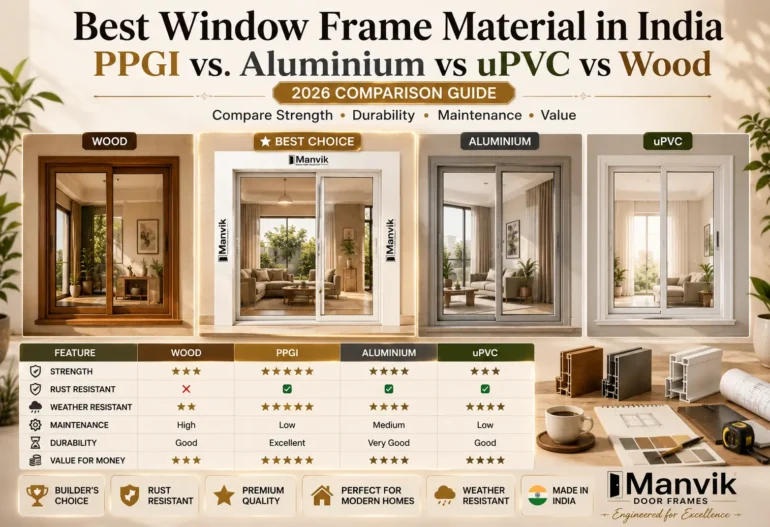
Choosing the best window frame material is one of those decisions that quietly shapes how a building performs for the next 20-30 years. Get it right, and you barely think about your windows again. Get it wrong, and you’re dealing with rusted hinges, swollen frames, peeling paint, or draughty rooms within a few monsoons.
This article explains the four different materials Indian buyers are actually comparing—PPGI, aluminum, uPVC, and wood—based on actual performance information and real-world buying experiences and straightforward trade-offs. There are no exaggerated promises, and there aren’t universally applicable solutions. It’s a simple guideline to aid homeowners, architects, developers, and contractors in selecting the appropriate design for their project. which type of door frame is best
Best Window Frame Material
There’s no one “best window frame material” to suit every circumstance The right material will depend on your climate and budget, your maintenance needs, and the type of building. However, this is the shortest version:
- Window Frames with PPGI provide the most effective overall combination of durability, resistance to corrosion Low maintenance, as well as cost, for Indian climates, specifically in coastal, humid, or high-pollution zones.
- Aluminum frames for windows are great to use for large windows as well as modern architectural designs; however, heating transfer and price are a trade-off.
- uPVC window frames are strong in sealing and insulation but weaker in structural strength, especially for long spans and areas of high heat.
- Windows made of wood with unbeatable looks as well as insulation; however, they’re very high maintenance and prone to termites and water.
If you’re seeking longevity, minimal maintenance, and value in exchange for your money when it comes to Indian temperatures, PPGI window frames always prove to be the ideal choice in commercial and residential construction as well.
Why Choosing the Right Window Frame Material Matters
Window frames aren’t simply an enclosure for glass. It’s an essential structural part that can affect the following:
- Efficiency in energy How much warmth, cold and noise enters your house
- Structural security How well the frame is able to withstand winds, storms, and everyday use
- Maintenance costs How often will you repaint, fix or replace the parts
- Resistance to weather How it handles monsoon humidity and coastal salt air or extreme summer temperatures
- Value of resales: Buyers and architects are increasingly noticing frame’s condition during inspections
- Long-term visual appearance—the frame’s appearance is great after 10 years, or begin peeling or warping
In India, particularly, window frames are exposed to the rigors of high humidity, intense exposure to UV as well as monsoon rain, as well as temperature fluctuations, and in several regions, salty air from the coast or industrial pollutants. The material that is able to perform flawlessly in an environment with mild temperatures could fail in this one. This is why the choice of material requires more consideration that it typically receives during the planning of construction.
Take a look at how many choices that are made in the building process get reviewed each year, such as paint colors, furniture, and even flooring, in certain cases. Window frames aren’t typically one of the choices. When they’re installed, they’re supposed to function quietly in the background for years, enduring many monsoons and hundreds of cycles that open and close as well as constant exposure to moisture and sun. It’s quite a bit to expect of a piece of equipment that typically is chosen in a hurry or late in the timeline of construction, in part due to the upfront cost.
It is the reason experts in the field and architects consider the choice of window frame materials as a long-term and structural choice, not merely the final decision. The same frame as the one you see in the showroom may behave differently over the course of five years in relation to coating quality and joint design as well as how it is matched to local weather conditions at the beginning.
What Is a PPGI Window Frame?
PPGI is a shorthand for pre-painted galvanized iron. A PPGI window frame is made of steel, which is galvanized (coated with zinc for protection against corrosion), followed by an application of protective paint by the factory. The combination of these two processes frames the frame with both durability and strength as well as long-term surface security.
The latest PPGI window frames made by producers such as Manvik Door Frames are produced by high-precision manufacturing, which is increasingly using welding-free technologies as well as technologies for rivets instead of traditional welding. These are important since welded joints can be common failing points. Heat generated by welding could damage the coating of paint and zinc just at the joints, making a weak point where corrosion begins first. A rivet-free and weld-free structure keeps the coating of protection intact over the whole frame, even joints.
The most important properties in PPGI window frames:
- High tensile strength of the steel core
- Zinc coating offers an sacrificial coating to protect against corrosion
- Factory coatings resist UV fading and also weathering
- Flexible profiles are possible because of steel’s durability (more steel frames, less glass)
- Naturally resistant to fire compared with wood or UPVC
- Dimensionally stable, isn’t prone to expansion, contraction or warp in the presence of humidity similar to wood
- Aluminum is less expensive than the same strength
PPGI is being increasingly utilized in homes as well as hospitals, villas, and hotels, as well as schools as well as factories, where customers want steel-like strength but not the corrosion problem.
What Is an Aluminum Window Frame?
Aluminum window frames are created of extruded aluminum profiles typically anodized or powder coated to protect the surface. It is corrosion resistant because it creates a thin oxide layer over its surface. It’s also lighter than its weight.
Principal characteristics of aluminum Window frames:
- It is light and strong but not heavy—great for large sliding or window casements.
- Naturally resistant to corrosion, the surface oxide layer
- Modern, slim profiles that are suited to the modern architectural style
- Isn’t warped, cracked, or broken. It doesn’t rot, warp, crack,
- Recyclable, which appeals to sustainability-focused projects
- Low thermal insulation unless broken profiles are utilized (adds the cost)
- Feel cold to the touch, and can conduct outdoor temperature inside
- Costs higher over PPGI to get the same strengths in many Indian markets
Aluminum is still popular in tall residential buildings, glass facades for commercial buildings, and contemporary homes in which massive glass panels with no gaps serve as the primary design objective.
What Is a uPVC Window Frame?
UPVC window frames are manufactured out of a strong, weatherproof plastic. They are often strengthened inside with galvanized steel or aluminum for bigger dimensions. The frames of uPVC are usually multi-chambered to aid in insulation as well as sound dissipation.
The main properties for uPVC Window Frames
- Superior thermal insulation because of the multi-chamber design
- Solid sealing is great for noise reduction as well as dust elimination
- Isn’t affected by rot or rust or cause corrosion
- Surface that is low maintenance There is no need to repaint
- UV stabilizers can help prevent coloration; however, the quality of these stabilizers varies substantially from brand to brand
- Very weak for extremely long spans with no internal reinforcement
- Discoloration or softening can occur when exposed to extreme heat when UV protection is not adequate.
- High-end to mid-priced based on the profile, the quality of the chamber, and the design.
uPVC is a great choice for insulation-oriented constructions for residential homes, specifically in urban areas that have a high volume of dust or noise levels, as long as you choose a trusted company that uses genuine UV-stabilized materials.
What Is a Wooden Window Frame?
Window frames made of wood are the most popular choice. They are valued due to the natural beauty, warmth, insulation, and warmth qualities. The most popular woods are sal, teak, and wood-based composites engineered.
The main characteristics of wooden frames for windows: Frames:
- The natural and premium look is ideal for traditional and historic architecture
- Natural insulation that is good against cold and heat
- The material can be easily carved into shapes, customized, or cut effortlessly
- At risk of termites, moisture absorption, warping, and swelling
- Regular maintenance is required, such as sealing, sanding and repainting
- The life span of wood is heavily contingent on quality, treatment, and exposure to climate.
- Most expensive maintenance costs over the long term of all the four substances
- Costs are increasing due to the increasing costs for timber as well as sustainability issues
Wood is still a popular choice in historic homes, luxury hotels, and spaces where aesthetics are an important factor and buyers are prepared to make the investment in maintaining their home.
Best Window Frame Material Comparison
Overall Performance Comparison
| Parameter | PPGI Window Frames | Aluminium Window Frames | uPVC Window Frames | Wooden Window Frames |
|---|---|---|---|---|
| Strength | High | High | Moderate | Moderate to High |
| Durability | Very High | High | High | Moderate |
| Corrosion Resistance | High (zinc + paint coating) | High (natural oxide layer) | Not applicable (plastic) | Not applicable (rot risk instead) |
| Weather Resistance | Excellent | Good | Good | Moderate |
| Moisture Resistance | High | High | High | Low to Moderate |
| UV Resistance | High (factory coating) | High | Moderate to High (brand-dependent) | Low without regular treatment |
| Fire Performance | Good (non-combustible core) | Good | Moderate (self-extinguishing but heat-sensitive) | Poor |
| Maintenance | Low | Low | Low | High |
| Lifespan | 25–30+ years | 25–30 years | 20–25 years | 10–20 years (climate dependent) |
| Appearance | Modern, customizable finishes | Sleek, modern | Clean, uniform | Warm, traditional |
| Sustainability | Recyclable steel + coatings | Highly recyclable | Recyclable but energy-intensive production | Renewable if sustainably sourced |
| Installation | Fast, precision-fit | Fast | Moderate | Slower, more skilled labor needed |
| Best Use Case | Residential, commercial, industrial, humid/coastal areas | Modern façades, large glazing | Insulation-focused, noise-sensitive projects | Heritage, premium interiors |
Cost vs Lifetime Value Comparison
| Material | Upfront Cost | Maintenance Cost (10 yrs) | Lifetime Value |
|---|---|---|---|
| PPGI Window Frames | Moderate | Low | High |
| Aluminium Window Frames | Moderate-High | Low | High |
| uPVC Window Frames | Moderate-High | Low-Moderate | Moderate-High |
| Wooden Window Frames | High (premium wood) | High | Moderate |
Decision Matrix: Which Material Fits Your Priority?
| Your Priority | Recommended Material |
|---|---|
| Lowest long-term maintenance | PPGI or uPVC |
| Best strength-to-weight for large windows | Aluminium or PPGI |
| Best thermal + sound insulation | uPVC |
| Best traditional/heritage appearance | Wood |
| Best for coastal/humid climates | PPGI |
| Best value for money | PPGI |
| Best for modern glass façades | Aluminium |
Myth vs Fact
The myth: Metal window frames will rust rapidly in humid environments.
The truth is untreated mild steel is the case. PPGI window frames are designed with zinc galvanization and the protection of a paint coat to ward off corrosion, even under coastal or humid climates.
Myth: Aluminum is constantly more efficient in comparison to steel-based frames. The truth: Standard aluminum actually is a good conductor of heat, but it requires the thermal break to be able for it to compete against well-designed PPGI and uPVC frames that are insulated.
The Myth: The wood option is usually the eco-friendly choice. The truth: Only sustainably sourced and certified wood is truly environmentally friendly. Inefficient logging can negate wood’s sustainable benefits, whereas contemporary steel and aluminum have excellent recycling rates.
Best Window Frame Material for Homes
The majority of residential construction projects – such as independent homes, row houses and villas Buyers are usually looking at durability versus a budget for the upfront. Window frames made of PPGI generally are the best choice for this since they offer structural durability with low maintenance. This is crucial for people who aren’t looking to paint or fix frames after a few years.
- If your house is located in a zone that is humid or near the coast, the corrosion resistance of PPGI is one of the major advantages.
- If you’re seeking expansive and uninterrupted views, the glass aluminum frames are a great choice. They have sleek profiles that increase the glass space.
- If you are concerned about noise or heat insulation being the top concerns (busy roads, hot heat), uPVC is worth more for.
- If the home you live in is built using a traditional or a heritage style or a distinct style the beauty of wood is unparalleled—if you’re ready for regular maintenance.
Many homeowners believe that PPGI Window frames provide the greatest balance of quality, aesthetics, and cost over time This is the reason builders are increasingly recommending them in new construction homes.
It is a good method to consider picturing two similar homes constructed 5 years apart in the same area, one that has plain mild steel frames as well as one that has properly coated, galvanized factory PPGI frames. One home will likely be having rust spots near the corners and hinges around the year 3 or 4 and especially after two or three years of heavy monsoons. The second one, which is protected by protected zinc plus paint, isn’t too far from the new condition. This isn’t about a “steel vs. non-steel” debate but rather the quality of the steel safeguarded in the first instance; this is precisely what the issue that the PPGI manufacturing process was created to resolve is.
If you are a self-builder and working in partnership with builders, it is helpful to consider a straightforward inquiry prior to deciding on a window frame purchase: What occurs at the corners or joints? A lot of performance problems in metal-framed windows do not begin from the middle of the frame. Instead, they begin at the joint joints that are welded, and heat from manufacturing can damage the coating. This is among the main reasons why being weld-free and made of rivets is now an effective differentiator, rather than being a mere manufacturing feature.
Best Window Frame Material for Apartments
Residential projects that are multi-story or apartments differ from independent houses—builders require components that can be used across multiple units, quick to set up, and maintainable to maintain the shared budget (since window repairs are typically borne by the housing society and not the individual homeowners).
- PPGI window frames are typically chosen by designers because they are installed fast and have tight tolerances in massive quantities; they don’t need an ongoing maintenance plan that wood needs.
- Aluminum is a common feature in tall buildings where the architectural glass is an attractive selling feature.
- uPVC can be found in mid- to high-end properties that advertise insulation and soundproofing.
- The wood is not common in residential developments because of the maintenance requirements across many apartments.
To developers who must balance costs as well as consistency and the long-term costs of maintaining society, PPGI generally offers the most reliable results.
Additionally, there is a pragmatic aspect of procurement that is important a significant amount at an small-scale, yet isn’t often brought to the forefront in smaller residential projects Order congruity. In the case of a building developer fitting hundreds of units that have windows, even minor variations in frame size or high-quality materials can cause visible discord on the exterior of a building, and costly rework on site. Precision-manufactured PPGI frames, produced to tight tolerances in a factory setting, reduce this risk considerably compared to materials that are more sensitive to manual fabrication variance on-site.
Facilities managers in residential complexes tend to choose materials that do not trigger frequent maintenance issues. The wooden window frames of the 200-unit apartment complex could, for example, be a large unpredictability in maintenance over several years. This includes painting, sanding, or changing swollen frames—and all this is then billed to the residents via costs for maintenance to the society. Materials that require minimal maintenance like PPGI and uPVC generally avoid this continual cost.
Best Window Frame Material for Commercial Buildings
Commercial buildings—offices, hospitals, schools, hotels, and factories—have their own priorities: durability under heavy daily use, fire safety compliance, and minimal facilities-management overhead.
- Window frames made of PPGI are extensively employed in schools, hospitals, and factories due to their durability, fire resistance, and minimal maintenance requirements for large windows.
- Aluminum dominates the corporate façades for offices and storefronts with the most significant design, where glazing areas are the primary consideration.
- uPVC is a common feature in office and hotel rooms, which emphasize audio comfort.
- The use of wood is typically restricted to boutique hotel interiors instead of commercially oriented glazing.
For large-scale commercial ventures with many window units, PPGI’s strength and the ability to resist fire and the lowest maintenance costs over time generally make it the most affordable option for long-term facilities teams.
Schools and hospitals deserve particular mention, as their window frame choices depend on compliance standards in addition to budget. The fire safety code as well as hygiene guidelines as well as the durability of constant usage (students or patients as well as personnel shutting and opening windows every day throughout the years) each push these facilities towards materials that will not degrade in the face of continuous use and heavy usage. In addition, non-corrosive and non-combustible PPGI frames are able to tick these boxes but not with the top price of aluminum or the isolation-focused (but limited in strength) shape of uPVC.
Factory and industrial facilities create another level of stress. Consumers of homes don’t often consider the possibility of exposure to chemicals, airborne fumes, dust, and machine vibration and, sometimes, the higher temperatures due to industrial processes. When these conditions are present, the steel’s structural stiffness as well as PPGI’s coating protection system is a good choice to beat lighter-duty materials, which were designed to provide comfort for homes, not industrial resiliency.
Best Window Frame Material for Coastal & High-Humidity Areas
High-humidity and coastal regions can be the toughest tests for window frames of any kind. The presence of salt-laden air can accelerate corrosion and continuous moisture strains joints, seals, and coatings.
- Window frames made of PPGI excel in this regard since the zinc galvanization coating offers sacrificial protection against corrosion; in other words, the zinc will corrode prior to the steel beneath, together with an industrial paint coat, which acts as a third security layer.
- Aluminum can also be used because of its oxide layer. However, marine-grade anodizing is suggested for the direct exposure to the ocean.
- UPC can withstand moisture because it’s a non-porous, non-metallic material. Frame reinforcement qualities vary by manufacturer.
- Wood is one of the worst performers in this setting—the absorption of moisture causes expansion and warping, as well as fungal decay, if not treated with vigor and regular maintenance.
If you’re building within couple of kilometers from the coastline Choose materials that are proven to be effective in corrosion engineering. PPGI and marine-grade aluminum are better than wood or uPVC.
It’s important to understand why the zinc coating is specifically effective and efficient in these situations, as it provides the reasons behind why PPGI is different from normal coated steel. Zinc can be described as a sacrificial anode; in the event that salt and moisture get to the surface, the zinc will corrode preferentially, thereby safeguarding the steel underneath even in the event of scratches or scratch marks in the course of installation. Normal painted steel does not have self-protection mechanisms—after the paint’s surface is damaged, the rust will spread beneath it and go unnoticed. This is an important difference in technology that’s hard to overlook when looking at frames with similar appearances in a showroom.
The buyers of coastal cities such as Mumbai, Chennai, Kochi, Vizag, and Goa are advised to consider the effects of wind-driven rain and salt spray, not only the humid air. Frames on the sea part of a structure generally have more intense exposure over walls that face the interior This is a further reason why a uniform protective coating (rather than a paint that is applied at the site) is more likely to last better over time.
Common Mistakes Buyers Make
Window frame issues that surface years afterward are the result of some of the mistakes made during the buying. The most common errors occur the most frequently:
- The decision to buy based solely on the cost upfront without incorporating the 10-15 year cost of maintenance.
- Insisting on local climate conditions A material that works well in Delhi’s dry temperatures could not work in Mumbai’s humid climate or in the coastal air of Kochi.
- In the event that all items of different types of material perform similar functions—uPVC as well as PPGI quality differs significantly among producers based on the thickness of coating and chamber size, as well as joint design.
- The construction of joints is often overlooked—welded joints (versus welding-free or riveted) could be a weakness in frames made of metal.
- No question regarding the warranty protection on coatings or corrosion as well as structural performance.
- Selecting wood in order to cut costs but not taking into account the ongoing maintenance expense that builds in the course of 10 years.
- Incorrectly confirming the thickness of zinc coating (GSM) when buying PPG—this directly affects the corrosion resistance.
- Not having a consultation specific to the site, specifically in industrial, coastal, or high-altitude sites that have particular weather stresses.
Buying Checklist Before Choosing Window Frames
Before finalizing your window frame material, confirm the following:
- What is the local climate — humid, coastal, dry, extreme heat, or extreme cold?
- What is the building type — residential, apartment, commercial, or industrial?
- What is the expected window lifespan you need (10 years vs 25+ years)?
- How much ongoing maintenance are you realistically willing to do?
- What is your budget for upfront cost vs total lifetime cost?
- Does the manufacturer specify zinc coating thickness (for PPGI) or chamber design (for uPVC)?
- Are the frame joints welded or weld-free/riveted?
- Does the supplier offer custom sizing for your window openings?
- What warranty is offered on the material and coating?
- Can the manufacturer support bulk or PAN India supply if needed?
- Is technical consultation available before you finalize the order?
Why Builders Prefer PPGI Window Frames
For commercial, residential and industrial construction, builders and contractors are increasingly recommending windows made of PPGI to satisfy a variety of good reasons
- A reliable performance in all conditions—from coastal cities that are humid to the dry regions of northern Europe The zinc-plus-paint system of PPGI is reliable.
- Faster installation—precision-manufactured frames with tight tolerances reduce on-site fitting issues.
- A lower number of calls and low maintenance needs mean there are fewer problems after handovers with corrosion, warping, or peeling.
- Cost-efficiency at size For huge projects that have hundreds of windows, PPGI usually has a greater cost-to-strength ratio than aluminum.
- Structural stability: Steel’s natural strength lets frame profiles be slimmer without jeopardizing safety. Architects love to maximize the glass surface.
- The latest in rivet and welding technology—the latest PPGI frames are free of weaknesses that are susceptible to corrosion in traditional joints that are welded, increasing frame lifespan significantly.
That’s why PPGI is no longer a niche industrial substance but the standard choice of designers and contractors in everyday commercial and residential construction.
Additionally, there’s a commercial reason why contractors prefer PPGI, as fewer complaints following handover will mean fewer site visits as well as protecting their image and margins from a project. The contractor who puts wooden frames to a tight-budget project might find themselves dealing with warranty inquiries about the growth of termite or fungus damage in 2 or 3 monsoons, which can eat away at the profits and reputation of projects already shut out. Frames that can perform with no intervention are, in the most literal sense, beneficial to everyone that is a part of the construction and not only for the final customer.
Why Choose Manvik Door Frames
Manvik Door Frames manufactures premium PPGI Window Frames, PPGI Door Frames, and Weld-Free Door Frames as well as Rivet Technology Door Frames specifically designed to meet Indian weather conditions.
What is it that sets Manvik Door Frames apart from other door frames?
- Premium PPGI materials correctly coated and galvanized to give you real durability against corrosion, not only the paint that is applied to surfaces.
- Precision Manufacturing – Consistent tolerances throughout every frame. This helps to reduce difficulties with installation.
- Weld-free technology removes weak points that can cause corrosion in welding joints.
- Rivet Technology HTML0 Rivet Technology A stronger and more durable joint structure that keeps the protective coating on the whole frame.
- Corrosion Resistant: Designed for humid, coastal, as well as polluted areas throughout India.
- High-maintenance frames that aren’t in need of repainting or repairs in the long run under normal circumstances.
- Custom sizes customized for your window openings and requirements for architectural design.
- PAN India Supply—reliable logistics for individual contractors and big developers as well.
- bulk orders Pricing and production capacities that are suitable for commercial development, apartment complexes, and dealer networks.
- Technical Consulting Expert guidance for matching the appropriate specifications for your frame to the construction’s structural and climate requirements.
If you’re looking at window frame material to use in an apartment complex, home or commercial venture Consider asking for a quotation or speaking with Manvik’s technical staff before committing to your design. If you require a modest home-based order or large quantities to build a huge construction, Manvik Door Frames can offer customized PPGI window frames designed to meet the exact specifications of your project and even possibilities for you to be an agent when you’re involved in the construction materials industry.
Get in touch with Manvik Door Frames today for an estimate, inquire about bulk prices, or chat with our tech team regarding what PPGI window frame specification fits the needs of your project.
Frequently Asked Questions
1. Which is the best window frame material? There’s no universal answer, but for most Indian conditions — especially humid or coastal climates — PPGI Window Frames offer the best balance of strength, corrosion resistance, low maintenance, and cost among the four major materials.
2. Is PPGI better than aluminium? PPGI generally offers better cost efficiency and comparable strength, while aluminium offers superior slimness for large glazing. Neither is universally “better” — the right choice depends on your budget, design goals, and climate.
3. Is PPGI better than uPVC? PPGI typically offers higher structural strength and fire resistance, while uPVC offers slightly better thermal and acoustic insulation. For humid or coastal regions, PPGI’s corrosion engineering often gives it an edge.
4. Which window frame lasts the longest? Both PPGI and aluminium window frames typically last 25–30+ years with minimal maintenance, outperforming uPVC (20–25 years) and wood (10–20 years, climate-dependent) in most Indian conditions.
5. Which window frame is best for Indian weather? PPGI Window Frames tend to perform most consistently across India’s varied climate zones — humid coastal cities, high-UV regions, and monsoon-heavy areas — due to their zinc-plus-paint corrosion protection system.
6. Which window frame needs the least maintenance? PPGI and uPVC window frames both require minimal maintenance — no repainting or sealing is typically needed for many years, unlike wood which requires regular upkeep.
7. Which window frame is best for homes? For most homes, PPGI Window Frames offer the best combination of strength, low maintenance, and cost-effectiveness, though aluminium and uPVC are strong alternatives depending on design and insulation priorities.
8. Which window frame is best for commercial buildings? PPGI Window Frames are widely used in commercial buildings like hospitals, schools, and factories due to their fire performance, structural strength, and low facilities-maintenance requirements at scale.
9. Are PPGI window frames worth buying? Yes, for buyers prioritizing durability and low lifetime maintenance cost — PPGI frames typically deliver strong long-term value, particularly in humid and coastal regions, as long as coating quality is verified.
10. Which window frame gives the best value for money? When you factor in both upfront cost and 10–15 year maintenance expenses, PPGI Window Frames generally deliver the best overall value among the four materials for Indian buyers.
11. What does PPGI stand for? PPGI stands for Pre-Painted Galvanized Iron — steel that is zinc-galvanized for corrosion resistance and then finished with a factory-applied protective paint coating.
12. Do PPGI window frames rust? Properly manufactured PPGI frames with adequate zinc coating thickness and intact paint finish resist rusting for decades. Poor-quality coatings or damaged joints (common with traditional welding) can reduce this resistance, which is why weld-free construction matters.
13. Is aluminium good for window frames in hot climates? Standard aluminium conducts heat readily, which can make interiors warmer unless thermally broken profiles are used. It remains structurally reliable in hot climates but isn’t the most energy-efficient option without added insulation features.
14. Does uPVC turn yellow over time? Lower-quality uPVC without adequate UV stabilizers can yellow or become brittle under intense sun exposure over years. Choosing a reputable manufacturer with proper UV-stabilized material reduces this risk significantly.
15. Is wood a good choice for window frames in humid areas? Wood is generally not recommended for consistently humid or coastal areas unless it’s properly treated and well-maintained, as moisture exposure leads to swelling, warping, and potential fungal decay over time.
16. What is weld-free technology in window frames? Weld-free technology uses mechanical joining methods, such as rivets, instead of welding to construct frame corners and joints. This avoids the heat damage welding can cause to protective zinc and paint coatings, resulting in more consistent corrosion resistance across the whole frame.
17. How long do PPGI window frames last? With proper manufacturing and adequate coating thickness, PPGI window frames typically last 25–30 years or more under normal conditions, with minimal maintenance required.
18. Can PPGI window frames be customized in size? Yes, manufacturers like Manvik Door Frames offer custom PPGI window frame sizing to match specific architectural openings and project requirements.
19. Are PPGI window frames fire-resistant? Steel-based PPGI frames are non-combustible, offering better fire performance compared to wood and generally comparable performance to aluminium, making them suitable for fire-code-sensitive buildings like hospitals and schools.
20. Where can I buy PPGI window frames in bulk? Manufacturers such as Manvik Door Frames offer bulk and wholesale PPGI window frame supply, PAN India delivery, and dealer partnership options for contractors, developers, and building material dealers.
Final Verdict
If you’re renovating or building in India and you require windows made of a material that combines the strength of steel and its resistance to corrosion with low maintenance and value over the long term, PPGI window frames generally are the best choice for residential, apartment, commercial, and industrial projects, especially in coastal and humid and other high-pollution zones.
Aluminum is still the preferred choice for big, modern windows and architecture-inspired façades. Upvc is worth the cost for those who want insulation and comfort are your top concerns. Wood remains a great option in the world of heritage design as long as you’re prepared for regular maintenance. door or window frame
Whatever direction you choose to take for your project, the final performance will depend on its production quality; the thickness of coating, the joint’s construction, and even the profile’s design are all important more than just the category of material all by itself.
Do you have the appropriate window frames for your next project? Request a free estimate by Manvik Door Frames, get bulk prices for your work, or contact our technical staff for the possibility of custom PPGI window frames that are designed for your specific climate and needs. door window frame


