

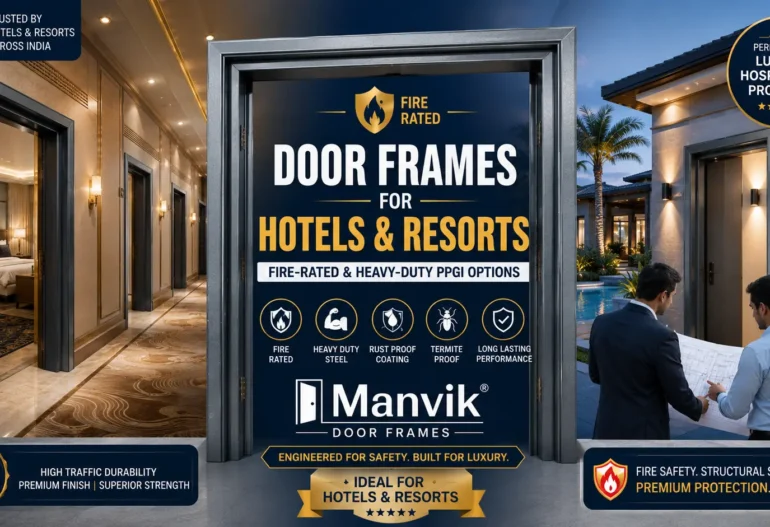
Fire-Rated & Heavy-Duty PPGI Door Frames for Hotels & Resorts
Door Frames for Hotels & Resorts: When you’re building a hotel or resort, there are so many important decisions to make. And let’s be honest, door frames are not usually the first thing on your mind. But experienced builders in the hospitality industry know that choosing the wrong door frames can be a really costly mistake. If you pick door frames that aren’t suitable for a hotel or resort, they can warp because of the humidity, corrode if they’re near the coast, fail safety inspections, and need to be replaced all the time because so many people are walking through them. This can lead to unexpected maintenance costs, problems for your guests, and issues with regulations – all things that developers want to avoid.
This guide is written for hotel owners, resort developers, procurement managers, architects, and interior designers who want to make informed, long-term decisions when selecting door frames for hotel and resort construction. We will walk you through exactly what to look for, why PPGI (Pre-Painted Galvanised Iron) door frames are setting the new benchmark in hospitality infrastructure, and how Manvik Door Frames supports commercial projects across India with premium, fire-rated, and heavy-duty solutions. door window frame
So you’re thinking of building a fancy hotel by the beach or maybe a more modest place for business travelers. Or perhaps you’re just giving an old hotel a makeover. Either way, you’ll want to know all about door frames. This guide has got you covered, no matter what kind of hotel or resort you’re working on. It’s got all the information you need to make sure your door frames are just right.
Why Choosing the Right Door Frames for Hotels & Resorts Matters
A door frame is not merely a structural border around a doorway. In a hotel or resort, it is a load-bearing, safety-critical, aesthetically important, and operationally significant element that interacts with dozens of other building systems. Here is why the selection process deserves serious attention.
High-Traffic Demands
In hotels, doors are used a lot more than in homes. This is especially true for doors in corridors, lobbies, banquet halls, and service areas. A hotel room door can open and close many times a day, which is much more than a door in a house. If the frames of these doors are not made to handle all this use, they can start to have problems. They might become loose, get out of line, or get damaged on the surface. This can happen pretty quickly if the frames are not strong enough for all the opening and closing.
Safety and Compliance
Hotels and resorts are subject to National Building Code (NBC) requirements, fire safety regulations under NBC 2016, and local municipal standards. Non-compliant door frames put occupancy certificates, fire NOCs, and insurance coverage at risk. Fire-rated door frames are not optional in escape routes, stairwells, service corridors, and boiler rooms — they are mandated.
Aesthetic Continuity
When people visit a hotel, they often get their first impression from the little things, like the door frames. If the frames are peeling, rusting, or warped, it can make the whole place look cheap, no matter how much money was spent on making it look fancy. The right kind of material for the frames can keep them looking good for years, without needing a new coat of paint or any other kind of fix-up. This way, the hotel can keep its high-end feel without spending a lot of extra money on maintenance.
Total Cost of Ownership
When you’re buying a door frame, you need to think about more than just the price tag. Sure, a wooden frame might look nice, but if it needs to be repainted every couple of years, that’s going to add up. And standard steel frames aren’t much better – they can rust and fall apart in humid environments. Over the lifetime of a property, which can be 20 or 30 years, these maintenance costs can really start to pile up. So, choosing a high-quality door frame from the beginning isn’t just an expense, it’s a smart investment. You’re saving yourself money and hassle in the long run. It’s worth taking the time to pick the best hotel door frames, even if they cost a bit more upfront. Door Frames for Hotels & Resorts
Key Requirements of Modern Hotel Door Frames
When it comes to hotel door frames, there are certain things they need to do. These are the same for almost every hotel project. Before you start looking at materials and suppliers, it’s a good idea to know what you’re looking for. What are the must-haves for modern hotel door frames?
• Structural rigidity: Frames must maintain dimensional accuracy over decades of continuous door operation without loosening from walls or bending out of plumb.
• Fire resistance: Escape routes, stairwells, and high-risk areas require frames that can withstand fire exposure for 30, 60, or 90 minutes as specified in the fire safety plan.
• Moisture and corrosion resistance: Humidity in bathrooms, kitchens, laundry areas, and coastal environments degrades materials rapidly. Frames must resist moisture ingress and corrosion over the building’s lifetime.
• Low maintenance: Hotel operations cannot tolerate regular frame maintenance. The chosen material must retain its finish without painting, varnishing, or rust treatment.
When it comes to guest rooms, the door frames play a big role in keeping the noise out. They need to help block sound from the corridors and other rooms, so the whole place can be nice and quiet. This is all part of making sure the building is designed with good sound quality in mind.
• Aesthetic compatibility: Frames must accommodate hotel-grade finishes and blend with the interior design language—whether contemporary, heritage, or minimalist. When it comes to hotels and other hospitality projects, you often find that the doors and entrances are not your average size. This is especially true for fancy suites, big lobby entrances, and service areas. They usually have unique dimensions that don’t fit the standard mold.
• Bulk availability: Large hotel projects may require hundreds or thousands of identical frames on tight construction schedules. The supplier must deliver consistent quality at scale.
Fire-Rated Door Frames for Hotels & Resorts
Fire-rated door frames for hotels are among the most critical safety components in any hospitality construction project. In the event of a fire, properly specified fire-rated frames serve as a barrier that slows the spread of fire and smoke, giving occupants time to evacuate and emergency services time to respond.
What Makes a Door Frame Fire-Rated?
A fire-rated door frame is made from special materials that can withstand fire and keep its shape for a certain amount of time – usually 30 minutes, 60 minutes, or 90 minutes. To make sure it’s safe, the frame has to be tested and meet certain standards, like IS 3614 and the National Building Code of India. What’s really important is that these frames don’t deform or fail quickly when they’re exposed to fire, like regular frames might. Instead, they stay strong and keep the door working as a barrier to the fire. This is crucial because it helps prevent the fire from spreading and gives people more time to get out safely. The testing and certification process is rigorous, and it’s what sets fire-rated door frames apart from standard ones. By using these special frames, buildings can be made much safer, and the risk of fire spreading can be greatly reduced. Door Frames for Hotels & Resorts
PPGI (Pre-Painted Galvanized Iron) fire-rated door frames meet these demands with their inherent steel construction, supplemented by fire-resistant coatings and intumescent seals where required. Steel does not burn, and galvanization protects against the structural weakening that rust can cause in an emergency scenario. rebate in door
Where Fire-Rated Frames Are Mandatory in Hotels
• Staircase enclosures and emergency exit routes
• Fire escape corridors and refuge areas
• Mechanical and electrical rooms, boiler rooms, and generator areas
• Kitchen fire exits and service corridors connecting cooking areas
• Storage areas for flammable materials
• Basement parking entrances connected to guest areas
When it comes to fire safety, you can’t just stop at the door itself. The frame around it is just as crucial. If you’ve got a fire-rated door, but it’s sitting in a frame that’s not rated, then you’re not really getting the protection you need. The frame will likely fail long before the door does, which kind of defeats the purpose. So, it’s essential to make sure you’re specifying fire-rated door frames to go along with those fire-rated door leaves, especially for any openings that require a certain level of fire protection. This way, you can have peace of mind knowing that your doors and frames are working together to keep you safe.
Heavy-Duty PPGI Door Frames for High-Traffic Hospitality Areas
When it comes to hotels or resorts, fire protection is just one part of the equation – the doors also have to be able to withstand the constant flow of people coming and going. That’s where heavy-duty door frames come in, and PPGI door frames are the go-to solution for this problem. They’re built to last, even with continuous use, so you don’t have to worry about them wearing out anytime soon.
Understanding PPGI
PPGI is a type of material that’s made by taking a steel base and giving it a special coating. First, the steel is dipped in a hot bath of zinc, which helps protect it from rusting. Then, a layer of paint or coating is applied on top of the zinc in a factory. This process creates a strong and durable frame that’s resistant to corrosion, thanks to the zinc, and also looks good because of the paint. The steel gives it strength, the zinc keeps it from rusting, and the paint makes it look nice. Door Frames for Hotels & Resorts door and window frame design
This product is really different from a regular steel frame that’s been painted on the spot. When you paint something on-site, the quality can be all over the place, the coverage is often uneven, and it’s easy for the paint to chip or peel off. But PPGI frames are different – their finish is actually a part of the product itself, bonded to the galvanized surface in a factory where conditions are tightly controlled. This is something that just can’t be replicated when you’re painting in the field. The result is a much more durable and consistent finish that will last a lot longer.
Why Heavy-Duty PPGI Is Ideal for Hotel Corridors and High-Use Areas
• Guest room corridors: With high foot traffic and door operation all day and night, corridor door frames need commercial-grade wall anchor strength and resistance to impact damage from luggage carts and housekeeping trolleys.
• Behind the scenes, hotels have areas like kitchens, loading bays, laundry rooms, and maintenance hallways that are always in use. The frames in these areas have to deal with harsh conditions – they’re exposed to strong chemicals, moisture, high temperatures, and physical damage. If you used cheaper materials, they would fall apart quickly.
• Fitness centers and spa areas: High humidity environments require moisture-resistant frames that will not swell, warp, or corrode over years of exposure.
• Poolside and outdoor areas: Coastal resorts and properties with outdoor water features need corrosion-resistant door frames that withstand salt air and intermittent water contact.
• Conference and banquet facilities: Large, heavy doors serving high-traffic event spaces need frames with the structural mass to support frequent, forceful operation.
Benefits of PPGI Door Frames in Hotel Construction Projects
In India, when it comes to building hotels, most developers now use PPGI door frames as a standard. So, what makes them so popular? Let’s take a look at the advantages that make PPGI door frames the go-to choice for serious developers in the hotel construction industry.
1. Unmatched Durability: Steel is inherently stronger than timber. PPGI frames maintain their structural geometry under load, vibration, and thermal cycling in a way that wood cannot. Over a 20-to-30-year building lifecycle, PPGI frames consistently outperform wooden and standard steel alternatives.
2. Zero Maintenance After Installation: One of the best things about PPGI frames is that they come with a special coating from the factory, so you don’t need to paint, varnish, or treat them for rust. This is a huge plus for hotels – it means their door frames don’t need any extra work, so rooms don’t have to be closed for painting, and they don’t have to keep spending money on materials and labour over and over again. It’s basically a maintenance-free solution, which can save hotels a lot of time and money in the long run.
3. Full Corrosion Resistance: The special zinc coating on PPGI frames helps stop rust from forming. If the surface gets scratched, the zinc layer still protects the steel underneath. This is really important for buildings like hotels that are near the ocean, in humid areas, or where monsoons happen. The zinc galvanisation layer keeps working even when the surface is damaged, which helps keep the steel from rusting. This is a big deal in places where the weather can be tough on buildings.
4. Fire Safety Compliance: PPGI frames can be made to meet strict fire safety rules, like FD30, FD60, and FD90, which depend on how the wall is built and what the door looks like. This means they’re good for any situation where fire safety is important, like in hotels or resorts, and it’s easier to buy them because you only need one type of frame for the whole project.
5. Dimensional Consistency: Factory manufacturing ensures every PPGI frame meets exact dimensional tolerances. This is vital for large hotel projects where hundreds of identical frames must be installed quickly and accurately. Dimensional inconsistency between frames creates misaligned doors, air gaps, and acoustic leakage—all problems that PPGI manufacturing eliminates.
6. Aesthetic Quality: The paint job on PPGI frames is really consistent and shiny, which is something you can’t easily replicate when painting on site. This is a big deal for high-end hotels and fancy resorts, where the little details can make a huge difference in how guests feel about their stay.
7. Sustainable Construction: Steel is really good for recycling, especially when it comes to building things. Using PPGI frames is a better choice for the environment in the long run compared to wooden frames. This is because wooden frames need trees to be cut down constantly and also require a lot of chemicals to keep them from rotting, which isn’t great for the planet.
Hotel Room Door Frames vs Corridor Door Frames
Not all door frames in a hotel serve the same function, and the specification should reflect this. The two primary categories are hotel room door frames and corridor door frames, and they have meaningfully different requirements.
| Specification Criteria | Hotel Room Door Frames | Corridor Door Frames |
| Primary function | Guest privacy, acoustic separation, security | Fire containment, high-traffic flow, emergency egress |
| Traffic intensity | Moderate — room occupant use only | Very high — all guests, staff, carts, equipment |
| Fire rating requirement | FD30 to FD60 in most codes | FD60 to FD90 on escape routes |
| Acoustic performance | High priority — sound transmission reduction | Secondary consideration |
| Width | Standard 900mm to 1000mm | Often 1000mm to 1200mm for trolley clearance |
| Surface finish | High-visibility, premium finish preferred | Durable, impact-resistant finish |
| Hardware integration | Electronic lock, viewer, door closer | Panic hardware, automatic closers, signage |
| Recommended material | PPGI with premium surface finish | Heavy-duty PPGI, fire-rated where required |
Moisture & Corrosion Resistance for Coastal Resorts
India’s coastline, which stretches from Gujarat to Kerala and all the way to the Andaman Islands, is where you’ll find some of the country’s most impressive resort developments. But when you’re building in coastal areas, you’ve got a big problem to deal with – corrosion. This is something that projects on the mainland don’t have to worry about as much. The salty air and water in coastal areas can cause buildings and structures to deteriorate faster, which means that developers have to take extra steps to protect their investments.
The air near the ocean is really bad for buildings. It’s a mix of spray from the sea, tiny salt particles, and wet wind from the ocean. This combination is one of the worst things that can damage buildings. If you use regular steel frames in a coastal area, they’ll start to rust on the surface in just a few months. And if you use wood frames, they’ll absorb all the moisture, swell up, and become warped, which makes them unreliable for holding up the building. Neither of these materials is good enough to use in a project for a coastal resort. door or window frame
Why PPGI Frames Excel in Coastal Conditions
The special coating on PPGI frames is the main protection against damage from salty air. This coating is made of zinc, which is more likely to react with air than the iron in the frame, so it protects the frame by corroding first – this is called sacrificial cathodic protection. Even in harsh coastal conditions, a properly coated PPGI frame will stay strong for a long time, often for many decades.
The special paint on the frame acts as a backup protection, keeping the zinc surface safe from the air and stopping moisture from getting in through the joints and edges. When the frame is put in properly with the right seals where it meets the wall, it creates a door frame system that can withstand even the harsh conditions found in coastal resort areas.
Expert Tip for Coastal Projects
For coastal areas, it’s best to use PPGI frames with a zinc coating weight of at least 275 g/m2. This is more than the standard 180 g/m2 used for areas that are not near the coast. The extra coating helps protect the frames from the salty air in coastal locations. If you need frames that can withstand the coastal conditions, Manvik Door Frames can make them to this specification if you ask. They can provide the extra protection needed for areas near the sea.
Fire Safety Standards and Hospitality Building Compliance
India’s hotel and resort sector is subject to a layered regulatory framework for fire safety. Understanding these requirements is essential for anyone specifying door frames for a commercial hospitality project.
Key Regulatory Frameworks
- National Building Code of India (NBC) 2016: Provides baseline requirements for fire safety in buildings, including door specifications in fire-compartmented areas.
- Bureau of Indian Standards (BIS) IS 3614: Covers fire check doors and door frames. Compliant frames are tested to resist fire penetration for specified durations.
- Local Municipal Corporation Requirements: State fire departments and municipal bodies may impose requirements stricter than the NBC. Always verify local NOC requirements before finalising frame specifications.
- Ministry of Tourism Hotel Classification Standards: Star-rated hotels are subject to safety inspections that include checking fire door compliance. Non-compliance can affect or revoke the star classification.
Compliance Documentation
When procuring fire-rated door frames for a hotel project, always obtain test certificates for the relevant fire resistance duration, documentation confirming the frame was manufactured in the same configuration as tested (wall interface, masonry type, etc.), BIS certification where applicable, and the manufacturer’s installation guidelines, which form part of the compliance package.
Manvik Door Frames provides complete compliance documentation with its fire-rated product range, supporting architects and project managers through the NOC and occupancy certificate process.
PPGI Door Frames vs Traditional Wooden Door Frames
The comparison between PPGI and wooden door frames is one that comes up in virtually every hotel specification meeting. Here is a comprehensive, objective comparison.
| Comparison Factor | PPGI Door Frames | Wooden Door Frames |
| Structural strength | High — steel construction maintains geometry indefinitely | Moderate — prone to warping, swelling, and loosening |
| Fire rating | Available in FD30, FD60, FD90 | Very limited — wood is combustible; treated wood offers minimal rating |
| Moisture resistance | Excellent — galvanised zinc layer prevents rust and moisture damage | Poor — absorbs moisture, swells, warps, and rots over time |
| Corrosion resistance | Excellent — suitable for humid and coastal environments | Vulnerable — requires chemical treatment that degrades over time |
| Maintenance requirements | None after installation — no repainting or treatment required | High — repainting every 2-3 years, termite treatment, swelling repairs |
| Lifespan in hotel use | 25-40 years with minimal intervention | 8-15 years before significant deterioration in commercial use |
| Termite/pest susceptibility | Immune — steel is not a food source for pests | Highly susceptible — termite damage is a major cost in tropical India |
| Acoustic performance | Excellent when combined with appropriate seals | Good but degrades as wood shrinks and creates gaps |
| Fire compliance | Full compliance across all required ratings | Cannot meet FD60+ requirements; unsuitable for escape routes |
| Environmental impact | 100% recyclable at end of life | Requires ongoing timber harvest; treated wood is non-recyclable |
| Initial cost | Moderate — higher upfront than basic wood | Low to moderate — lower upfront but high lifecycle cost |
| Total lifecycle cost | Low — minimal maintenance over project life | High — recurring maintenance and early replacement costs |
| Recommendation for hotels | Strongly recommended for all hotel applications | Not recommended for commercial hospitality projects |
Common Mistakes Hotel Developers Make While Selecting Door Frames
Over years of supplying commercial door frames to hospitality projects across India, certain specification errors come up repeatedly. Understanding these pitfalls can save your project significant time, money, and compliance headaches.
Mistake 1: Treating All Door Frames as the Same Specification
A hotel has multiple distinct environments — guest rooms, corridors, kitchens, outdoor areas, plant rooms. Each has different demands. Specifying a single frame type across the entire project without regard to location-specific requirements inevitably leads to premature failures in the more demanding zones.
Mistake 2: Choosing Frames Based on Initial Purchase Price Alone
When you’re building something, the cheapest frame might not be the best choice in the long run. Think about it, wooden frames need to be repainted every few years, and that can add up quickly. And then there are mild steel frames that rust easily, or those super cheap imported products that don’t even fit together properly – they might seem like a good deal at first, but they can end up costing you way more in the end. All those extra costs can really add up over time, and before you know it, you’ll be wishing you had just spent a bit more money upfront.
Mistake 3: Neglecting Fire Rating Requirements
When it comes to commercial buildings, following fire safety rules is a must. But sometimes, developers try to cut corners by using regular frames in places where they should be using fire-resistant ones. This can happen because they want to save money or because they didn’t double-check the specs carefully enough. Either way, it’s a big mistake that can lead to serious problems with the law and costly fixes down the line.
Mistake 4: Ignoring the Local Environment
A frame specification that works well for a landlocked city hotel may be entirely inappropriate for a coastal resort. Developers who reuse an inland project specification for a beachfront property without adjusting for coastal corrosion requirements will see deterioration within the first few monsoon seasons.
Mistake 5: Not Verifying Manufacturer Credentials
When it comes to steel frames for big projects, like hotels, you need to make sure you’re getting high-quality products. Not all companies that make steel frames are careful about keeping their products consistent and making sure they meet the right standards. If you buy from a company that hasn’t been checked out, just to save some money, you’re taking a risk. You might end up with frames that aren’t all the same, or with materials that have been switched without telling you. And if something goes wrong after they’re installed, you might not have any way to get help or fix the problem.
Mistake 6: Delaying Frame Specification Until Late in the Design Process
When it comes to building design, the specs of a door frame can have a big impact on several things – like how thick the walls are, the size of openings, how sound travels, and even fire safety plans. If you wait too long to figure out the frame details, it can cause problems with other decisions that have already been made, leading to costly changes. That’s why it’s a good idea to work with a specialist supplier, like Manvik Door Frames, right from the start. This way, you can avoid running into issues later on that might slow down your project. By getting the door frame specs nailed down early, you can ensure that everything works together smoothly and that your design stays on track.
How Manvik Door Frames Supports Hotel & Resort Projects Across India
Manvik Door Frames is a company that makes special door frames for buildings. They work with people who build hotels, offices, and homes all over India. What makes Manvik different is that they can do more than just supply door frames – they have some extra skills that can help hotel and resort builders in particular.
Manufacturing Quality
Manvik makes door frames using really good galvanised steel and special coatings that are applied in a factory. They make sure the frames are all the same size, so they fit perfectly, even in big projects like hotels where they need hundreds of frames that are identical. This way, the installation is always good and consistent.
Fire-Rated Product Range
Manvik makes door frames that can stop fires from spreading, which is really important in hotels and other places where people stay. They have different types of frames that can withstand fires for 30, 60, or 90 minutes, so they can meet all the safety rules. When you buy these special frames, Manvik gives you all the paperwork you need to prove they meet the safety standards.
Custom Manufacturing Capability
When it comes to hotel and resort projects, you often need doors that are a bit bigger than usual – think wide entrances to the lobby or oversized doors to suites. And let’s not forget about custom service bays. Manvik can make door frames that fit these unique sizes perfectly, using a special kind of steel called PPGI. This means you don’t have to change the structure of the building to fit a standard-sized door, which can be a real hassle. With Manvik, you can get custom-size door frames that match your project’s exact specs.
Bulk Supply for Large Projects
Imagine a huge hotel with 200 rooms – it needs a lot of doors, around 600 or more, for all the guest rooms, corridors, and common areas. Manvik is set up to provide these big hotel projects with doors that are all made to the same high standard, packaged in a way that makes sense, and delivered on a schedule that fits with the construction timeline. This way, the hotel can get everything it needs, when it needs it, and the doors will all match and work properly.
PAN India Delivery
Manvik Door Frames is a company that provides door frames to hotels and resorts all over India. They work with big cities, smaller towns, and even places by the beach or in the hills. When someone asks about their products, they talk about how they will get them to the site and when they will arrive, so it fits with the building schedule. This way, everyone knows what to expect and things can run smoothly.
Technical Support
The team at Manvik has a lot of experienced technical people who can help architects, quantity surveyors, and procurement managers with choosing the right frames and writing down the details. They can also help with things like calculating fire ratings, figuring out what’s best for coastal areas, and checking that all the paperwork is in order. This means they can support them every step of the way, from picking the frames to making sure everything meets the rules.
Buying Guide – How to Select the Best Door Frames for Hotels & Resorts
Use the following structured approach to specify the right door frames for your hotel or resort project.
Step 1: Map Your Project Zones
Create a door schedule that categorises every door opening by zone: guest rooms, corridors, emergency exits, service areas, outdoor and pool areas, kitchen and wet areas, plant rooms, and public spaces. Each zone will have different requirements.
Step 2: Identify Fire Rating Requirements
Work with your fire safety consultant or architect to establish which zones require fire-rated frames and to what rating. Get this locked in before finalising the frame specification, as fire-rated frames have different construction and cost implications.
Step 3: Assess Environmental Conditions
For coastal locations, specify galvanisation weight of at least 275 g/m2. For high-humidity internal areas such as pool buildings, spas, and laundries, ensure moisture resistance is prioritised in the frame specification.
Step 4: Define Dimensional Requirements
Compile exact opening dimensions from the architectural drawings. Identify any non-standard openings that will require custom manufacturing. Share this schedule with potential suppliers early to confirm their capability.
Step 5: Evaluate Supplier Capability
Ask suppliers to demonstrate their manufacturing quality controls, provide test certificates for fire-rated products, share evidence of comparable hotel projects supplied, and confirm their bulk supply and delivery capability for your project volume and schedule.
Step 6: Request Samples
Before committing to a large hotel door frame order, obtain physical samples for review by the architect, interior designer, and site team. Assess finish quality, dimensional accuracy, and hardware interface against the project specification.
Step 7: Confirm Documentation and Warranty
Ensure that fire rating certificates, material test reports, and warranty documentation will be provided with the supply. This documentation is required for occupancy certificates and fire NOCs in most jurisdictions.
Cost, ROI and Long-Term Maintenance Benefits
When hotel developers and procurement managers run the numbers on PPGI door frames versus wooden alternatives, the case becomes compelling very quickly.
Initial Cost Comparison
When you compare PPGI door frames to basic wooden ones, it seems like they cost more at first. But that’s not the whole story. You have to think about how much it costs to install them, and steel frames are often cheaper to put in because they’re all the same size. And then there’s the cost of keeping them in good shape and replacing them over time. That’s where the real difference is. If you look at the whole picture, PPGI door frames might not be so expensive after all. In fact, they could even save you money in the long run.
Maintenance Cost Over 20 Years
In a hotel corridor, a wooden door frame will probably need to be repainted or resurfaced every few years – we’re talking two to three years. And, to be honest, it’s likely to need replacing altogether within 10 to 15 years. When you think about it over a 20-year period, the maintenance costs for a single wooden frame can really add up – we’re talking two or three times the original price of the frame. On the other hand, a PPGI frame is a different story. Over the same 20-year period, it needs virtually no maintenance, which makes it the cheaper option in the long run.
Replacement Cost Avoidance
Replacing a door frame in a hotel that’s still open for business is a big deal. It’s not just about the cost of the materials. You have to consider the room being out of commission while the work is being done, the hassle it causes for guests, getting rid of the old stuff, and paying licensed contractors to do the job in a busy hotel environment. If you can avoid having to replace just one door frame over the life of the project, you’ll save a lot of money – way more than what you’d pay extra for a high-quality PPGI frame upfront.
Operational Benefit
Hotels these days rely heavily on how happy their guests are, and this is something that’s shared with the public through reviews. If a hotel looks well taken care of, with everything matching and doors that work properly, people are more likely to leave good reviews and the hotel can charge more for its rooms. Having good quality door frames isn’t just about saving or making money, it’s also about how people see the hotel’s brand. It’s all connected – a hotel that pays attention to the small details, like door frames, shows that it cares about its guests and wants to give them a great experience. This, in turn, can lead to a stronger reputation and more loyal customers.
Frequently Asked Questions
1. Which door frame is best for hotels?
PPGI (Pre-Painted Galvanised Iron) door frames are the best choice for hotels. They offer the highest combination of structural strength, corrosion resistance, fire safety compliance, dimensional consistency, and low maintenance cost of any commercially available door frame material. For fire-rated locations, specify certified PPGI fire-rated frames to the required FD rating.
2. Are PPGI door frames fire-rated?
Yes. PPGI door frames can be manufactured to meet fire resistance ratings of FD30, FD60, and FD90. The fire rating depends on the specific construction of the frame, the wall interface, and the door leaf with which it is used. Always request test certificates and compliance documentation for fire-rated applications.
3. What is the best door frame material for resorts?
For resorts — particularly coastal or high-humidity locations — PPGI door frames with a minimum zinc coating of 275 g/m2 are the best specification. The galvanisation provides cathodic protection against salt air corrosion, and the factory-applied coating seals the surface from moisture ingress. No other commercially available frame material offers comparable corrosion resistance at this price point.
4. How long do hotel door frames last?
High-quality PPGI door frames in hotel applications have a service life of 25 to 40 years with minimal intervention. Wooden frames in the same environment typically last 8 to 15 years before significant deterioration requires repair or replacement. Standard mild steel frames in humid or coastal environments may show structural rust within 5 to 10 years.
5. Are steel door frames better than wooden frames for hotels?
Yes, unambiguously for commercial hospitality use. Steel frames — and specifically PPGI frames — outperform wooden frames on every commercially relevant metric: structural durability, fire resistance, moisture resistance, corrosion resistance, maintenance requirements, total lifecycle cost, and pest immunity. Wooden frames may have an aesthetic advantage in some heritage or natural design concepts, but this can typically be addressed with PPGI frames in appropriate finishes.
6. Which door frames require less maintenance?
PPGI door frames require the least maintenance of any commercially available door frame type. The factory-applied galvanised and painted finish does not need repainting, rust treatment, or surface refinishing under normal hotel operating conditions. This is a significant operational advantage for hotel managers compared with wooden frames, which require repainting every two to three years.
7. Can PPGI door frames be used in coastal areas?
Yes. PPGI frames are specifically recommended for coastal locations because of their galvanised zinc coating, which provides cathodic protection against salt air corrosion. For the most aggressive coastal environments, specify a minimum zinc coating weight of 275 g/m2 and a premium-grade factory coating system. Manvik Door Frames manufactures coastal-grade specifications on request.
8. What are commercial grade door frames?
Commercial grade door frames are frames engineered to meet the structural, safety, and performance demands of commercial buildings — including hotels, offices, hospitals, and institutions. They differ from residential-grade frames in their heavier-gauge steel construction, fire rating availability, dimensional precision, and suitability for continuous high-use operation over decades.
9. Why do hotels use steel door frames?
Hotels use steel door frames because they offer the combination of fire safety compliance, structural durability, low maintenance, and corrosion resistance that wooden frames cannot match in a commercial environment. The shift from wood to steel — and specifically to PPGI — in the Indian hospitality sector reflects both tightening fire safety regulations and a growing awareness of the total cost of ownership advantages that steel frames provide.
10. How to choose hotel door frames?
To choose hotel door frames: map your project zones and their specific requirements; identify fire rating mandates from your fire safety consultant; assess environmental conditions (coastal, humid, or standard); define dimensional requirements from your door schedule; evaluate suppliers on manufacturing quality, certification, bulk supply capability, and post-supply support; request physical samples; and confirm full compliance documentation will be provided.
11. What is the hotel door frame price in India?
Hotel door frame prices in India vary based on material grade, frame dimensions, zinc coating specification, fire rating certification, and order volume. PPGI door frames generally command a moderate premium over basic steel or wooden frames, but this premium is recovered within a few years through reduced maintenance costs. Contact Manvik Door Frames for a current project-specific quotation that reflects your exact specifications and quantities.
12. Can door frames be custom-sized for hotel projects?
Yes. Manvik Door Frames manufactures custom-size PPGI door frames to precise project specifications. This capability is particularly important for luxury hotel projects where lobby entrances, premium suite doors, and non-standard architectural openings require frames that cannot be sourced from standard stock sizes.
13. What is the minimum order quantity for bulk hotel door frame supply?
Minimum order quantities vary by product type and project requirement. Manvik Door Frames is structured to supply both large-volume hotel projects requiring hundreds or thousands of frames and smaller boutique property orders. Contact the team to discuss your project volume and confirm applicable pricing and lead times.
14. Are Manvik PPGI door frames suitable for luxury hotels?
Yes. Manvik Door Frames supplies premium PPGI door frames with high-quality factory finishes suitable for luxury hotel and resort projects. The consistent finish quality, dimensional precision, and range of available configurations make Manvik frames an appropriate specification for five-star and boutique luxury properties across India.
15. Do PPGI door frames support acoustic performance in hotel rooms?
PPGI frames support acoustic performance through their structural rigidity and compatibility with acoustic sealing systems. A steel frame does not warp or shrink over time, meaning that perimeter seals between the frame and door leaf maintain their integrity throughout the building’s life. This consistent sealing is essential for achieving the acoustic separation between guest rooms and corridors that hospitality standards require.
Final Thoughts
When it comes to your hotel or resort, the door frames can either be a lasting part of the structure or a constant headache that affects the overall quality of your property for years to come. It really depends on how you choose to specify them. If you get it right, they’ll be a durable feature that withstands the test of time, but if you don’t, they can become a recurring maintenance issue that you’ll be dealing with for decades. The decision is yours, and it’s crucial to get it right to ensure your property maintains its quality and reputation.
When it comes to building hotels and resorts in India, people are looking for the best way to make sure their doors are safe and last a long time. PPGI door frames are the way to go because they meet all the rules for fire safety, are strong, don’t rust, and always look good. Whether you’re building a fancy hotel by the beach, a tall hotel in the city, or a budget-friendly place to stay, using PPGI door frames makes sense because they save you money in the long run. They’re perfect for any project where you want to make sure your doors are safe, strong, and look great without needing a lot of upkeep. Japani chokhat door frame
When it comes to choosing door frames for your hotel or resort, there are some common mistakes that can easily be avoided. For instance, don’t just focus on the initial price – consider all the factors that can affect your decision. You also shouldn’t ignore things like how the environment might impact your choice, or forget to check if your doors meet the right fire safety standards. And then there’s the importance of working with suppliers you can trust. By being aware of these potential pitfalls, you can make a more informed decision and choose the right door frames for your project. With the right guidance, you can do this with confidence and avoid costly mistakes down the line.
Manvik Door Frames is all set to help you with your project. They offer top-notch fire-rated and heavy-duty PPGI door frames, and they can even make them to your exact specs. If you’re working on a big hotel project, they can supply you with all the door frames you need in bulk. Plus, their team of experts will make sure that everything is just right from the very beginning, so you can trust that your project will turn out perfectly.
Partner with Manvik Door Frames for Your Hotel Project
When you pick Manvik Door Frames, you’re going with a company that has the right credentials, can definitely get the job done, and is fully committed to giving you door frames that will last as long as your property does. They’re all about making sure their door frames work perfectly for years to come, so you can have peace of mind knowing you’ve made a great choice.
We offer:
- Premium-quality PPGI door frames manufactured to exact specification
- Fire-rated frames certified to FD30, FD60, and FD90 — with full compliance documentation
- Heavy-duty commercial-grade construction for high-traffic hotel environments
- Custom sizes for non-standard openings including luxury lobby entrances and suite doors
- Bulk supply capability for large hotel and resort projects
- Coastal-grade specifications with enhanced zinc coating for seaside developments
- We can get things to construction sites all over India quickly and reliably, no matter where they are in the country.
- Competitive, transparent pricing with bulk discount options
- Expert technical support through specification, procurement, and installation
Request a Free Quote | Get Bulk Pricing | Talk to Our Experts | Enquire Now
Contact Manvik Door Frames Today and get the right door frames for your hotel or resort project — on specification, on time, and built to last.


