

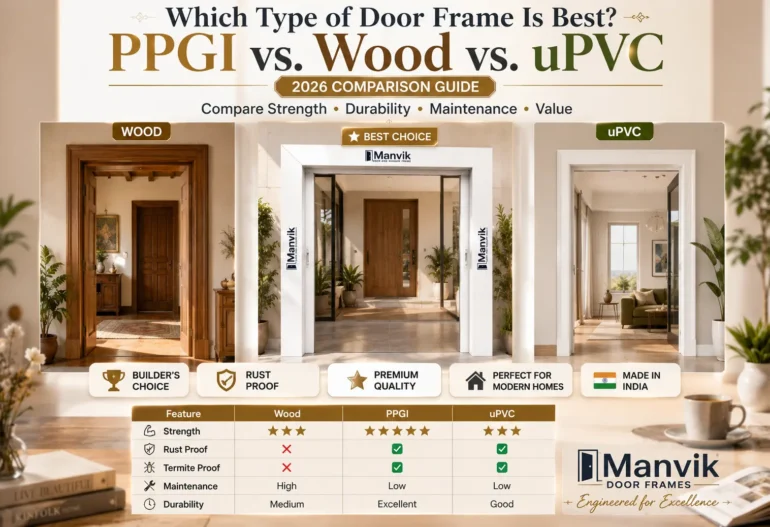
Which Type of Door Frame Is Best: If you’ve ever sat in a hardware store, or looked through a contractor’s estimate looking for what kind of door frame is the most suitable and which one is the best, you’re not the only one. This is among the most frequent questions homeowners or builders are asked prior to deciding on the budget for renovation or construction — and it’s among the most confusing questions, since each material has its own collection of supporters.
This guide breaks it down in a straightforward manner. We will compare the PPGI (Pre-Painted Galvanized Iron) door frames, wooden door frames and doors made of UPVC in relation to the aspects which are important during the lifetime of a building, including durability maintenance, water and termite resistance price, and appearance. We also briefly discuss WPC as well as aluminium frame to provide further information.
At the end of the process you’ll know what door frame material is best suited to your plan, whether it’s a new residence or a commercial building or a manufacturing facility.
Key Takeaways
- door frames fabricated from PPGI generally provide the greatest balance of strength as well as low maintenance and life-long value in the majority of Indian climates.
- Doors made of wood are still a good choice for buyers who want a natural appearance and are willing to commit to ongoing maintenance.
- Door frames made of UPVC work well in humid areas like bathrooms and coastal homes however at a higher cost and a lower adaptability.
- What is the “best” material always depends on the climate and budget, as well as maintenance tolerance and the particular construction type.
- The life-time cost — not only the initial cost — will determine the final price.
Which Type of Door Frame Is Best?
The Quick Solution: For most Indian commercial and residential properties, PPGI door frames are the most effective all-around option since they can withstand termites corrosion, moisture and termites without warping, swelling or pest damage typical in wood. They also cost less in the long run than UPVC. Wooden frames work well for those who prefer a classic look and are prepared to commit to ongoing maintenance. However, UPVC frames are ideal for humid coastal regions where cost isn’t a factor. The answer to this question is contingent on the budget, climate and maintenance requirements.
Understanding Different Types of Door Frames
Door frames are the part of the structure which holds the door in place, it transfers loads to the wall and determines the degree to which the door is sealed against noise, weather, and insects. Making the wrong choice could result in a frame that expands close during monsoons, then rusts on the bottom or is in need of replacement within 10 years.
The door frame market is currently centered around three main materials:
- PPGI frame for doors Pre-painted galvanized iron frames that are becoming sought-after in modern commercial and residential construction
- Door frames made of wood are the most common option, admired for its natural beauty
- door frames made of UPVC -A plastic-based option that is known for its resistance to moisture
Two other substances, WPC (Wood Plastic Composite) and aluminum are utilized in specific circumstances and will be discussed briefly in this guide to provide purposes of.
Every material performs differently based on the climate, type of building and the way in which the frame is utilized day-to-day. A frame designed for a bustling commercial entryway will experience different stresses than one designed for a peaceful bedroom door as well, and so that is why the “best” material shifts accordingly.
It is also important to know the reasons behind why door frames tend to break down over time, since this is the thing that separates the best material choice from one that isn’t. In the real world, most failures of door frames are due to four main causes that include moisture absorption, insect infestation corrosion of metal that has not been treated or repeatedly causing mechanical stress to hinges and locks. The real-world performance of a material is a reflection of its resistance to these four causes of failure over a period of 15-25 years which is about the time frame for renovations on most homes, and also the time frame for operational planning for commercial developments in the majority of cases.
This is why the quality of the manufacturing process is just as important as the choice of raw material. Two frames constructed from identical PPGI coil will perform different based on the coat thickness, joints construction and the dimensional tolerances. Similar is the case with timber — a badly well-seasoned lot made of “premium” timber can underperform the well-seasoned middle-grade batch. When comparing different materials it is important to remember that the manufacturing process of the manufacturer is as crucial in the same way as what is actually being made.
What Is a PPGI Door Frame?
The doorframe made of PPGI is constructed using Pre-Painted Galvanized iron -steel sheet that is galvanized first (coated using zinc) to prevent corrosion and afterwards, it is coated with a baked-on coating to give it a look and provide additional protection. The zinc layer functions as a barrier to sacrifice that corrodes before the steel beneath it does. This is the reason that gives PPGI its longevity even in coastal and humid conditions.
Modern makers, like Manvik Door Frames, produce PPGI frames with weld-free technologies as well as technologies like rivets which increase precision in dimensional accuracy, and eliminates the weaknesses which traditional joints create over the course of time. Precision manufacturing also ensures that the frames arrive ready to be installed, reducing manufacturing errors that occur on site.
In real terms the real world, an PPGI door frame
- Does not decay or expand, or draw termites
- Keeps its shape even when there is a lot of humidity and heavy rain.
- Comes pre-finished, reducing on-site painting
- It is more lightweight than real wood, but it is also more structurally stable because of its profile design.
Builders who work in gated community, residential towers and commercial developments are increasingly choosing PPGI door frames due to the fact that they are strong and durable, with a the factory finish that is not required for painting for years.
Pros & Cons of PPGI Door Frames
| Pros | Cons |
|---|---|
| Excellent corrosion, moisture, and termite resistance | Higher upfront cost than budget-grade wood |
| Long lifespan (20–30+ years) with minimal maintenance | Limited “natural wood” texture compared to real timber |
| Strong fire performance for code-sensitive projects | Requires quality manufacturing to avoid coating damage at cut edges |
| Precision, factory-finished dimensions speed up installation | Fewer ultra-decorative carving options than premium wood |
| Consistent quality across bulk orders | — |
A quick myth worth addressing here: many buyers assume any painted metal frame will eventually rust the way an untreated iron gate does. Myth: “Metal door frames always rust over time.” Fact: Properly galvanized and pre-painted PPGI frames are specifically engineered to resist corrosion — the zinc coating actively protects the steel even where the paint layer gets scratched, which is different from how an ordinary painted iron surface behaves.
What Is a Wooden Door Frame?
The wood doorframe is the standard option that is typically constructed from woods such as saal, teak, or engineered wood in more affordable projects. The main reason for its appeal is aesthetic—its natural look, the warmth, and the flexibility of wood are difficult to duplicate with any other material, which is the reason it is still popular in high-end and traditional homes.
But it is an organic, porous material that has some negative consequences.
- It sucks up moisture, which could cause warping, swelling, or cracking, particularly during monsoons.
- It is a risk to wood-boring and termite infestations when not properly maintained and treated
- It is usually required to be polished or varnished to maintain its condition.
- Quality is highly variable based on the kind and quality of wood utilized
High-quality, well-maintained wood (like teak that is seasoned) will last for a long time. However “well-maintained” is the operative term — wood performance is heavily dependent on the ongoing maintenance of humidity control, as well as what is the grade of original timber, which may not be always consistent from batch batch.
Pros & Cons of Wooden Door Frames
| Pros | Cons |
|---|---|
| Natural aesthetic and warmth, hard to replicate synthetically | Vulnerable to moisture-related swelling and warping |
| Highly customizable — carving, staining, finishing options | Requires periodic polishing, painting, and pest treatment |
| Can last decades if high-grade and well-maintained | Quality varies significantly by timber grade and seasoning |
| Familiar, traditional installation methods | Combustible unless specially treated |
| Suitable for premium, heritage-style interiors | Higher long-term maintenance cost |
Myth: “All wood door frames are equally durable if they’re made from wood.” Fact: Durability depends heavily on the specific timber species, how well it was seasoned before manufacturing, and whether it received proper termite and moisture treatment — two frames labeled “wood” can have very different real-world lifespans.
What Is a UPVC Door Frame?
An UPVC door frame is made of unplasticized polyvinylchloride, an extremely rigid plastic that doesn’t take in moisture. This makes UPVC an excellent choice for very humid and coastal areas where wood and untreated metal may struggle.
The key features for UPVC door frames are the following:
- Naturally insensitive to humidity and won’t cause rot
- Does not attract termites because it isn’t an organic material.
- It doesn’t require painting and has good color retention. However, excessive exposure to sun can result in some brittleness or fading over many years
- It generally has weaker rigidity than frames made of steel with a similar profile. Therefore, doors that are heavier or larger might require reinforcement
UPVC frames typically have more upfront costs as opposed to wood or PPGI in a variety of markets, and the variety of finishes is smaller as compared to painted natural wood grain or PPGI. It’s still a great market, especially in bathrooms, beach homes, and other installations in which moisture is a major problem.
Pros & Cons of UPVC Door Frames
| Pros | Cons |
|---|---|
| Excellent moisture and termite resistance | Higher upfront cost in many markets |
| No painting or pest treatment required | Lower structural strength; may need reinforcement for large doors |
| Good performance in coastal/humid climates | Limited color and finish variety |
| Consistent factory manufacturing | Can fade or become slightly brittle after prolonged sun exposure |
| Low day-to-day maintenance | Less “premium” visual appeal than wood or finished PPGI |
Myth: “UPVC never needs any care at all.” Fact: While UPVC does not need painting or pest treatment, prolonged direct sun exposure over many years can still cause fading or minor brittleness, so frame placement and installation quality still matter.
PPGI vs. Wood vs. UPVC – Detailed Feature Comparison
Here is a side-by-side look at how the three materials compare across the factors that matter most over the life of the frame.
Durability & Strength
| Feature | PPGI Door Frame | Wooden Door Frame | UPVC Door Frame |
|---|---|---|---|
| Structural strength | High – steel core resists dents, warping, and impact | High initially, but weakens with moisture damage or age | Moderate – can flex under heavy doors without reinforcement |
| Dimensional stability | Excellent – does not expand/contract with humidity | Poor to moderate – prone to swelling and shrinking | Good – stable in most conditions, minor expansion in extreme heat |
| Resistance to physical impact | High | Moderate (dents/scratches show, but material is tough) | Moderate – can crack under heavy impact |
Maintenance
| Feature | PPGI Door Frame | Wooden Door Frame | UPVC Door Frame |
|---|---|---|---|
| Repainting needed | Rarely – factory pre-painted finish | Yes – periodic polishing/painting required | No painting needed |
| Pest treatment | Not required | Required periodically | Not required |
| Cleaning | Simple wipe-down | Requires care with polish-safe cleaners | Simple wipe-down |
Moisture, Weather & Termite Resistance
| Feature | PPGI Door Frame | Wooden Door Frame | UPVC Door Frame |
|---|---|---|---|
| Moisture resistance | High (zinc + paint coating) | Low to moderate (depends on treatment) | High |
| Termite resistance | Complete – not an organic material | Vulnerable unless treated | Complete – not an organic material |
| Weather resistance (monsoon, humidity, heat) | Strong across climates | Weak in high humidity without upkeep | Strong, especially in humid/coastal climates |
Fire Performance
Steel-based PPGI door frames offer better inherent fire resistance than wood or UPVC, since steel does not combust, making it a common specification requirement in commercial and institutional buildings. Wood is combustible unless treated with fire-retardant coatings. UPVC can soften and deform at high temperatures. For projects with strict fire-safety codes, this is a meaningful differentiator.
Lifespan
| Material | Typical Lifespan (with normal use) |
|---|---|
| PPGI Door Frame | 20–30+ years, minimal degradation |
| Wooden Door Frame | 10–25 years, heavily dependent on wood grade and maintenance |
| UPVC Door Frame | 15–25 years, dependent on sun exposure and installation quality |
Appearance
Wood offers unmatched natural warmth and grain variation, which is why it remains popular in premium residential interiors. PPGI door frames now come in a wide range of factory finishes and colors that can mimic wood tones or offer a clean modern look, appealing to contemporary architecture. UPVC typically offers a more limited palette, most commonly white or light shades, with a smoother, less textured appearance.
Installation
PPGI frames, particularly those built with weld-free and rivet technology, are manufactured to precise dimensions and install faster with fewer on-site adjustments. Wooden frames often require on-site cutting, fitting, and finishing, which extends installation time. UPVC frames install reasonably quickly but may need additional reinforcement for larger door sizes.
Cost vs. Lifetime Value
| Material | Upfront Cost | Maintenance Cost Over 10 Years | Overall Lifetime Value |
|---|---|---|---|
| PPGI Door Frame | Moderate | Low | High |
| Wooden Door Frame | Varies widely (low to very high for premium wood) | Moderate to high | Moderate |
| UPVC Door Frame | Moderate to high | Low | Moderate to high |
Best Applications
- PPGI door frames — residential apartments, villas, commercial buildings, hospitals, schools, hotels, industrial facilities
- Wooden door frames — premium residential interiors, heritage-style homes, low-humidity regions
- UPVC door frames — bathrooms, coastal homes, high-humidity regions, budget-conscious buyers prioritizing moisture resistance over aesthetics
Decision Matrix: Which Door Frame Fits Your Priority?
| If your top priority is… | Best-suited material |
|---|---|
| Lowest long-term maintenance | PPGI Door Frame |
| Natural wood aesthetic | Wooden Door Frame |
| Maximum moisture resistance in a bathroom | UPVC or PPGI Door Frame |
| Fire-code compliance for commercial projects | PPGI Door Frame |
| Heritage or carved interior detailing | Wooden Door Frame |
| Coastal or high-humidity climate | PPGI or UPVC Door Frame |
| Large-scale bulk procurement with consistent quality | PPGI Door Frame |
| Lowest possible upfront cost (with maintenance trade-off) | Wooden Door Frame (budget-grade) |
A Simple Material Selection Flowchart
If you’re not sure which direction to take, go through this straightforward decision route:
- Do you think the frame is in an area with high moisture (bathroom or coastal region or a heavy monsoon climate)? If yes, then you should consider PPGI as well as UPVC. If not, all three materials are in use.
- Are fire code compliance or heavy use a necessity (commercial or institutional)? If yes, PPGI is typically the better choice due to its fireproofing and durability.
- Do you consider natural wood appearance an unassailable design requirement? If yes, and you’re ready to maintain it over time, A high-quality wooden frame could be worth the price.
- Is reducing the need for long-term maintenance your primary goal? If yes, PPGI generally has the most optimal balance between low maintenance and affordable cost, as does UPVC as an alternative.
- Do you have a bulk or large-scale purchase that requires consistent quality across multiple models? If yes, the precision manufacturing of PPGI typically makes it the most secure choice for large-scale orders.
Expert Tips From the Field
- Request the thickness of your frame in any PPGI frame The weight of the zinc coating (measured by GSM) directly influences corrosion resistance. Reputable manufacturers will divulge this information easily.
- Look for the certificate of seasoning for wooden frames when feasible, especially for bulk orders. Incorrectly seasoned wood is among the main causes of early warping.
- Get details on reinforcement written in writing for UPVC frames with heavy doors, as reinforced UPVC frames can be susceptible to sliding in time.
- Request samples of finishes prior to finalizing any materials that are factory-applied PPGI colors and UPVC shades may appear different under natural light as opposed to indoor lighting.
- Check the joinery method (welded or weld-free or riveted) on the frame of your metal because this impacts the appearance of the frame as well as long-term structural stability in the corners.
Which Door Frame Is Best for Homes?
For the majority of homeowners the door frame has to keep three things in mind It should look nice, be able to withstand the local weather without constant maintenance, and be within the budget of the homeowner.
In areas that experience strong monsoons and high humidity, PPGI door frames generally outperform wooden frames since they don’t swell to the point of warping or swell when moisture levels increase—the most frequent complaint homeowners face with wooden frames found in older homes. In the case of a brand-new house, that means fewer calls for repairs and callbacks during the years following the purchase, which is important for homeowners as well as the contractors who are able to stand behind their work.
Buyers who want the natural look of wood throughout their homes and who are willing to plan for regular maintenance might still choose doors with wooden frames for specific rooms, such as the main entrance door with massive carving. For bathrooms and other areas in which the moisture exposure is high, UPVC door frames are an ideal choice for a low-maintenance solution.
For many homeowners, the most practical solution is a mix of PPGI or UPVC frames for kitchens, bathrooms, and areas of utility that are prone to damp, with a few wooden frames for display interior doors, where the cost of maintenance is more than the benefits of aesthetics. This type of planning for rooms, instead of a blanket of materials for the entire home, usually provides the most optimal combination of durability, appearance, and price.
It’s also worth looking at the long-term and resale angle. Doors that have been swollen, twisted, or manifested visible damage from pests are often a major negotiating factor in resale inspections. Frames that have remained in their form and look for at least a decade, like PPGI and UPVC usually do, can be a tiny but important advantage when it’s time to lease or sell the property.
Which Door Frame Is Best for Commercial Buildings?
Commercial developments, including retail, office spaces, and mixed-use developments, have higher foot traffic and more frequent use of doors and, often, more strict building codes than residential developments. This is why the door frames made from PPGI generally outperform the competition.
Their combination of strength in the structural as well as fire-proofing and low maintenance makes them suitable for areas that have repair times that are expensive and where uniformity across dozens or hundreds of doors is crucial. Precision manufacturing also ensures that commercial customers who purchase in bulk will receive identical quality across all units, which is difficult to ensure with wood that comes from various timber batches. sliding window frame in india
Commercial developers should also consider lifecycle planning in a different way than home owners. A single door frame made of wood that requires repainting can be an inconvenience of a small size; however, hundreds of wooden frames throughout the office building that require repainting in a similar time frame are a major maintenance item and one that facilities managers tend to overlook at the stage of design. PPGI frames remove this cost per hour from the budget for maintenance and are the main reason why facilities management teams are pushing to specify metal frames in the design and purchasing phase.
There’s also a procurement efficiency angle. Since PPGI doors are produced in accordance with precise, reproducible specifications, commercial buyers are able to establish standard sizes for frames across various types of properties or stages of development, easing both installation and future replacement parts sourcing, which is much more difficult to achieve in the case of natural wood, whose grain and size vary in each piece.
Which Door Frame Is Best for Hospitals, Hotels & Schools?
Institutional buildings, such as hospitals as well as hotels and schools, include some of the most stringent demands of any type of building with a high volume of daily usage, rigorous hygiene standards, and fire codes, as well as long operating lifespans with very few maintenance windows.
Door frames made of PPGI are a great frame for this application due to several reasons:
- Factory-painted, non-porous surfaces are less difficult to wash as well as disinfect, and this is vital in the healthcare setting.
- Improved fire resistance in the building supports the compliance of fire safety codes for institutions.
- Long-term service with low maintenance is ideal for facilities that are unable to simply schedule downtimes for repairs or repainting
- Consistent, precision-manufactured dimensions simplify large-scale procurement for schools and hotel chains ordering hundreds of frames at once
Hospitals are in particular subject to additional concerns. The protocols for controlling infections typically require surfaces to be scrubbed clean using disinfectants over and over again without degrading the condition of the surface. This is a situation where the smooth painted surface of a factory-made PPGI frame lasts longer as compared to wooden frames, which are susceptible to absorbing water from frequent cleaning and ultimately form cracks. Hotels, for instance, value their appearance as well as the durability of their frames due to the constant turnover of guests and the constant flow of housekeeping. PPGI frames painted in wood-tone colors are becoming more popular to provide a high-end appearance without the hassle that wood frames carry in busy corridors. hospital door frames
Schools pose a distinct problem: door frames absorb substantial physical wear and tear from school traffic, backpacks, and other general usage. The steel-based frame is a good indicator of their ability to stand up better in the face of repetitive mechanical stress than either UPVC or wood, which reduces the number of repairs facilities teams must manage throughout the academic year.
Common Mistakes Buyers Make
Even seasoned buyers can make costly mistakes when choosing door frames. A few of the most commonly made mistakes:
- The decision to buy based solely on the cost upfront without taking into account the cost of maintenance over a period of 10 to 15 years, which could make an “cheap” wooden frame more costly than PPGI throughout its life
- Not paying attention to the local conditions — putting up untreated timber in a high-humidity coastal zone, for example is often a cause of the wood to expand and then warp.
- Assuming that all wood is of the same grade the wood grade, seasoning and treatment can vary greatly and the low-grade wood that is advertised under the label of “premium” is a common complaint
- Do not ask about termite treatment and the treatment of moisture in wooden frames prior to installation
- Not complying with fire safety regulations for institutional or commercial projects, where frame material may impact the code’s compliance
- The manufacturing process is not being checked Welded frames of steel that are not precision-crafted could create weak joints over time. This is why rivet-free or weld-free construction is something to consider particularly
Buying Checklist Before Choosing a Door Frame
Before completing a frame purchase, buyers must verify:
- The climate-suitability — will the material work well in your local rain and humidity levels?
- Maintaining expectations Are you willing to paint or polish the frame regularly or do you prefer an easy-to-maintain option?
- Code of Fire and Building needs particularly for institutional or commercial projects.
- Quality manufacturing — precise fabrication, rivet-free or weld free construction and constant dimensions
- Warranty and support after-sales provided by the manufacturer
- Cost of ownership total It’s not only the purchase pricetake into account the expected maintenance and replacement expenses
- Reliability of the supplier Can they guarantee consistent quality in the quantities you require including bulk or customized orders?
Why Builders Prefer PPGI Door Frames
Contractors and builders dealing with the realities regarding construction timeframes, callbacks and long-term customer satisfaction are increasingly recommending doors with PPGI frames due to a variety of consistent reasons:
- Speedier installation thanks to its precise factory-finished dimensions, which require minimal or no adjustments on site
- There are fewer complaints post-handover regarding swelling warping, sagging, or pest damage than wood
- Consistent quality across huge orders that is important for those who design hundreds or dozens of units
- Repair and callback cost during the warranty period because PPGI is not required to be repainting or pest control
- Improved compatibility with current and low-maintenance building specifications that consumers increasingly require
This doesn’t mean wood or UPVC do not have a placethey’re still suitable for specific budget or aesthetic situations, however, for builders who are looking to maximize high-quality reliability, PPGI has become a common recommendation in the construction industry of today.
Sustainability Considerations
Sustainability is a frequently asked buyer’s question The truth is that every material has trade-offs.
The wood is renewable in theory however, the source of wood is crucial – timber that is sourced from unsustainable logging has an environmental burden, whereas certified, responsible source wood is a completely sustainable option. Wood’s ability to degrade at the end of time is a major advantage that is in its favor, if it’s not treated with chemicals that can cause problems for removal.
PPGI can be recycled completely at time of death, as zinc and steel can both be recycled without losing the quality of the material. The long life of the material also implies fewer replacement cycles throughout the life of a building, which decreases the total manufacturing footprint and material when relative to a product that requires replacement every 10 years.
UPVC It is a petroleum-derived plastic. although it’s strong and long-lasting, it’s more difficult to recycle than steel, and it does not biodegrade. Its lengthy service life helps offset this, however buyers who are committed to sustainability tend to weigh the pros and cons of this choice carefully.
For those who are interested in sustainability, the best method is to consider the total impact of a product’s lifecycle including sourcing the material, its service life, and recyclability at the end of its life — instead of focusing on a one aspect alone.
A Brief Note on WPC and Aluminium Door Frames
To provide additional context, two additional materials are often included in this comparison:
- WPC (Wood Plastic Composite) Door frames incorporate wood fibers with plastic polymers, providing superior resistance to moisture compared to solid wood and retaining a wood-like textures. They are in the middle of the road in terms of price and performance and are getting recognition as a middle-of-the-road alternative.
- Door frames made of aluminum provide a high weight-to-strength ratio and are resistant to corrosion, however they are typically used to make windows and glass-paneled doors as opposed to standard door frames and generally have an additional cost to achieve the same strength.
Both are worth a look However, for the majority of commercial and residential door frame choices the main distinction remains between PPGI wood, PPGI, as well as UPVC.
Why Choose Manvik Door Frames
Manvik Door frames produces high-end door frames made of PPGI designed specifically to alleviate the problems buyers experience with metal and wood alternatives. What sets them apart:
- High-quality PPGI Materials Pre-painted galvanized iron that is sourced and processed to ensure an unwavering durability and corrosion resistance.
- Weld-Free Technology removes structural weakness that is of traditional weld joints.
- Rivet Technology provides exact, secure joinery that is guaranteed to ensure long-term stability of dimensionality
- Precision Manufacturing -Every frame is manufactured precisely to the specifications of the customer, which helps reduce fitting issues on-site
- Resilience to Corrosion designed to work in humid, coastal and high-rainfall zones
- low maintenance No repainting or painting, no pest treatments minimum maintenance for decades of usage
- Custom Sizes frames that are constructed to meet the requirements of your project for commercial, residential, and institutional usage
- Bulk Supplies -Quality that is reliable and consistent for contractors and developers with large-scale projects.
- PAN India Delivery — capability to supply across climates and regions
- Technical Assistance provides guidance to builders, architects and dealers on specification and installation
If you’re considering the options for door frames to build a new home or renovation work, Manvik Door Frames will help you evaluate the specifications to your needs.
Frequently Asked Questions
1. Which type of door frame is best overall? For most climates and budgets, PPGI door frames offer the best balance of durability, low maintenance, and lifetime value, though wood and UPVC remain valid choices depending on aesthetic priorities and local humidity.
2. Is PPGI better than wood for door frames? PPGI generally outperforms wood on moisture resistance, termite resistance, and maintenance requirements, while wood offers a natural aesthetic that some buyers still prefer for specific interior applications.
3. Is PPGI better than UPVC for door frames? PPGI typically offers greater structural strength and better fire performance than UPVC, while both materials share strong resistance to moisture and termites.
4. What does PPGI stand for? PPGI stands for Pre-Painted Galvanized Iron, a steel sheet coated with zinc for corrosion resistance and finished with a baked-on paint layer.
5. Which door frame lasts the longest? Well-maintained PPGI door frames commonly last 20–30+ years with minimal degradation, often outlasting wood and matching or exceeding UPVC lifespan.
6. Which door frame requires the least maintenance? PPGI and UPVC door frames both require minimal maintenance since neither needs repainting or pest treatment, unlike wooden frames.
7. Are PPGI door frames termite-proof? Yes, PPGI door frames are made from metal, not organic material, so they are not vulnerable to termites or wood-boring insects.
8. Do wooden door frames need regular maintenance? Yes, wooden door frames typically need periodic polishing, painting, and pest treatment to maintain their appearance and structural integrity.
9. Are UPVC door frames good for bathrooms? Yes, UPVC door frames perform well in bathrooms and other high-moisture areas because they do not absorb water or swell.
10. Which door frame is best for coastal or humid regions? PPGI and UPVC door frames both perform well in humid and coastal regions due to their moisture and corrosion resistance, generally outperforming untreated wood.
11. Are PPGI door frames suitable for commercial buildings? Yes, PPGI door frames are widely used in commercial buildings due to their strength, fire resistance, and low maintenance requirements.
12. Do PPGI door frames rust? Quality PPGI door frames resist rust due to their zinc coating, which protects the underlying steel from corrosion, though improper installation or damage to the coating can create vulnerable points over time.
13. What is weld-free technology in door frames? Weld-free technology assembles door frame components without traditional welding, reducing structural weak points and improving long-term dimensional stability.
14. What is rivet technology in door frames? Rivet technology uses precision riveted joints to assemble door frame components, offering secure, consistent joinery compared to some welded alternatives.
15. Which door frame is more cost-effective over time? When maintenance and replacement costs are factored in, PPGI door frames often provide better lifetime value than wood, despite wood sometimes having a lower upfront cost.
16. Can PPGI door frames be customized in size? Yes, most PPGI door frame manufacturers, including Manvik Door Frames, offer custom sizing for residential, commercial, and institutional projects.
17. Are wooden door frames better for premium homes? Wooden door frames remain popular in premium homes for their natural aesthetic, though buyers should budget for ongoing maintenance to preserve their appearance and durability.
18. Which door frame is best for fire safety? PPGI door frames offer better inherent fire resistance than wood or UPVC, since steel does not combust, making them a common choice for fire-code-sensitive commercial and institutional projects.
19. Do PPGI door frames come in different finishes? Yes, PPGI door frames are available in a range of factory-applied colors and finishes, including options that mimic wood tones for a natural look.
20. Where can I buy premium PPGI door frames in bulk? Manvik Door Frames supplies premium PPGI door frames in bulk and custom sizes with PAN India delivery for builders, developers, and dealers.
Final Verdict
There’s no single doors frame materials that is a winner in all situations However, for the vast majority of commercial, residential, or institutional applications, PPGI door frames provide the best combination of strength, low maintenance, termite and moisture resistance, and long-term value. The wooden door frames have appeal to buyers who prefer traditional design and are willing to put in the effort for maintenance, whereas UPVC frames are a reliable and low-maintenance option for environments that are high in humidity, like bathrooms.
If you’re looking for frames that are reliable throughout the seasons, need minimal maintenance, and last for years of usage, PPGI door frames made by Manvik Door Frames, constructed with rivet and weld-free technologies to guarantee durability and precision, should be considered your ideal choice for the next building project. door frame manufacturer in sonipat


