

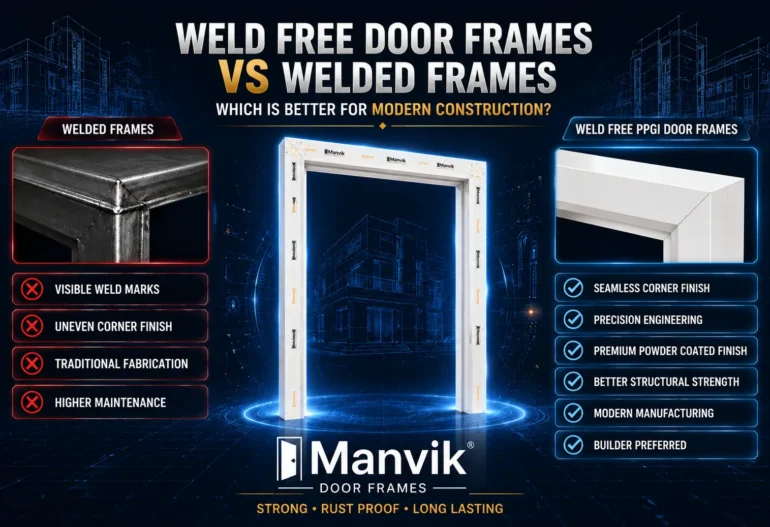
Weld Free Door Frames vs Welded Frames – Complete Comparison Guide
Weld Free Door Frames vs Welded Frames: Each construction project, be it an apartment block or commercial buildings or an industrial plant, ultimately boils down to a deceivingly simple question: which door frame? It may sound trivial until the paint begins peeling three years later, the frame warps following the monsoon season, or the construction is slowed down by massive, bulky steel sections. The decision between doors that are weld-free and frames that are welded is increasingly a gap that separates projects that age gracefully from those that do not. This guide provides an in-depth, honest analysis of both systems to help you make the right decision on which side you’re on. PPGI Door Frame Manufacturer in Chandigarh
Quick Answer—What Is a Weld-Free Door Frame?
A weld-free door frame is a precisely engineered steel door frame constructed using cutting-edge riveting technologies and interlocking mechanical joints; there is no need for heat-based welding. Made from PPGI (Pre-Painted Galvanised) steel These frames are fully finished, ready for installation and free of weak points that heat from welding could cause.
What Are Weld-Free Door Frames?
Door frames that are made of welds represent an important shift in the way the steel frames for doors are produced and transported onto construction locations. Instead of being constructed using welding sections of steel in a factory or workshop, they are manufactured in a controlled manufacturing environment with high-grade PPG (Pre-Painted Galvanized) steel coils. The sections are cold-rolled according to exact tolerances, joined with mechanical rivets and interlocking joints, and then finished with powder-coat applied by the factory or electrostatic paint before they are ever delivered to your building. Rivet Technology Door Frames Manufacturer
The result is a door frame manufactured by a factory that is dimensionally precise, structurally stable, and cosmetically flawless as soon as it is removed from the manufacturing line. There is no zone that is affected by heat, which weakens the steel. There are no exposed welding seams that require grinding, priming, or repainting. The corrosion-proofing built into the PPGI substrate—it is a zinc-based layer that is directly bonded to the steel in the mill—is intact throughout the entire production process. Weld Free Door Frames vs Welded Frames
Modern weld-free frames utilize technology known as rivets specifically designed for structural use within the aerospace and automotive industries, where resistance to vibration and strength against fatigue are more important than the practicality of welding. In the case of door frame manufacturing, it implies joints that are more secure during cyclic loading, distribute more stress over a greater area, and resist the possibility of loosening more effectively than fillet welds made of thin-section steel. Weld Free Door Frames vs Welded Frames
Definition—Weld-Free Door Frame
A door frame with no welding is a prefabricated steel framework constructed without welding by using mechanical-joint or rivet technology. It is made of PPGI steel and painted by a factory It offers excellent corrosion resistance with precise measurements and quick installation on site. It is the most preferred option for commercial and residential as well as industrial buildings.
What Are Traditional Welded Door Frames?
Traditional doors with welded frames have been a feature of Indian construction for a long time. In this process mild steel sections, generally MS (Mild Steel) box sections or angles, are cut to size, then joined with MIG or arc welding or in a smaller fabrication facility or directly on site. After welding, the frame must be smoothed and primed before being painted either prior to or after the installation.
The process of welding produces a hot-affected region (HAZ) around every joint. In this zone, the structural structure of the steel grain is changed due to extreme localized heat, which makes the material more brittle and harder as compared to the metal around it. The process of corrosion tends to begin in these areas because the paint or zinc layers later applied must bridge an uneven surface brimming with porosity, spatter, and micro-cracks caused due to the welding procedure. Weld Free Door Frames vs Welded Frames
On construction sites that are busy, the quality control of the welded joints can be extremely difficult. Weld quality is contingent on the skills of the individual who is fabricating it as well as the grade of wire or electrode that is being used, as well as the conditions of the surroundings at the time of. A joint that has passed an inspection visually at the time of installation could fail before the time it is exposed to the real-world stresses such as door slamming, building settlement, or the seasonal contraction and expansion that is typical in the Indian climate. Weld Free Door Frames vs Welded Frames
Definition — Welded Door Frame
A welded frame for doors is a standard steel door frame that is made using welding MS (mild steel) sections via the arc as well as MIG welding. It requires grinding on site prior to priming, painting, and grinding following fabrication. Although they have been widely used in the past, welded frames are vulnerable to corrosion at weld joints, inconsistency in dimensions, and higher long-term maintenance costs when compared to weld-free alternatives.
Weld Free Door Frames vs Welded Frames – Key Differences
The table below compares both frame types across every factor that matters to builders, architects, contractors, and owners. The intent is to be genuinely useful, not to oversell — so where welded frames still have a legitimate use case, that is noted. weld free door frame manufacturer in India
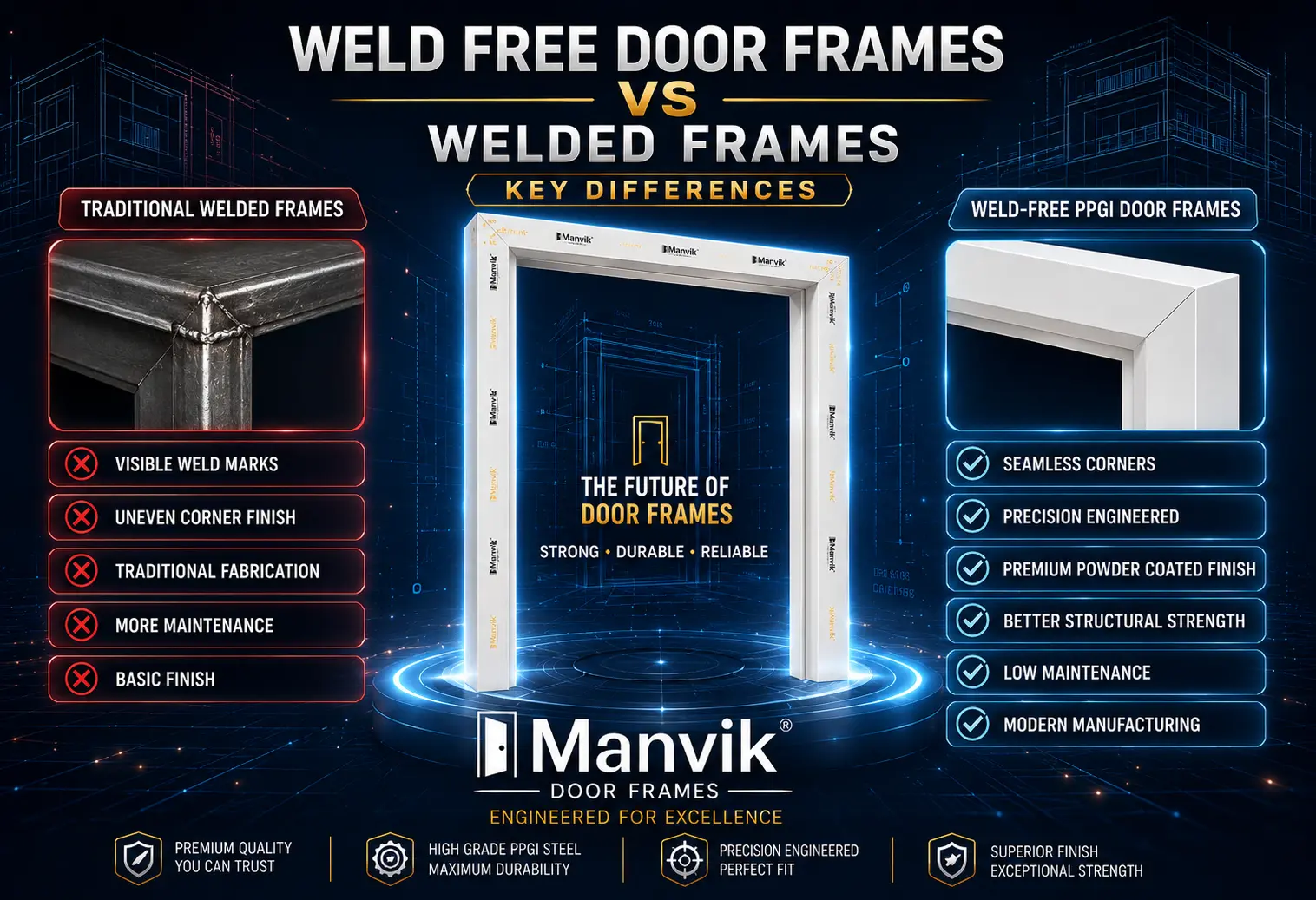
| Parameter | Weld Free Door Frames Modern | Traditional Welded Frames |
|---|---|---|
| Manufacturing Process | Factory cold-rolling + rivet / mechanical-joint assembly. Zero on-site fabrication. | Workshop or on-site arc/MIG welding of MS sections. Quality varies by fabricator. |
| Structural Strength | Consistent high strength throughout — no heat-affected zone. Riveted joints distribute load across a wider area. | Variable. Strength concentrated at weld points; HAZ can be weaker than the parent metal. |
| Material Grade | PPGI steel — galvanised at mill for inherent corrosion resistance before any paint is applied. | Typically plain mild steel (MS). Corrosion resistance depends entirely on surface treatment applied later. |
| Dimensional Accuracy | Factory-controlled tolerances. Every frame is identical and fits standard door blanks without adjustment. | Manual fabrication introduces variation. On-site trimming or shimming is common. |
| Appearance / Finish | Smooth, factory-applied electrostatic paint. No visible weld marks, spatter, or grinding lines. | Finish depends on the skill of the grinder and painter. Weld marks often visible under paint over time. |
| Corrosion Resistance | Excellent. Galvanised substrate + factory paint creates a multi-layer barrier. Ideal for coastal and humid environments. | Moderate to poor. Corrosion initiates at weld zones where protective coatings are thinnest. |
| Installation Speed | Fast. Frames arrive ready-to-install. No on-site welding, grinding or priming required. | Slower. Fabrication, welding, grinding, priming, and painting add significant time. |
| Maintenance Required | Near zero. Factory finish holds for years. No repainting cycles needed under normal conditions. | Regular. Typically requires touch-up painting within 2–3 years; full repaint every 5–7 years. |
| Initial Cost | Slightly higher per unit than basic MS welded frames. | Lower unit cost. On-site labour and materials can erode this advantage quickly. |
| Total Life-Cycle Cost | Lower. Minimal maintenance, no premature replacement, no rework labour costs. | Higher. Repeat maintenance, corrosion-driven replacement, and early paint failure add up. |
| Lifespan | 25–30+ years under normal conditions. | 8–15 years typical before significant corrosion or structural concerns arise. |
| Fire Rated Option | Available. PPGI frames can be supplied with fire-rated specifications. | Available, but certification is more complex for site-fabricated frames. |
| Environmental Impact | Lower. Factory production reduces waste; no flux, grinding dust, or primer overspray on site. | Higher site waste. Welding fumes, grinding dust, and solvent-based primers are on-site hazards. |
| Best For | Residential apartments, commercial complexes, hospitals, hotels, institutions, and industrial facilities. | Custom non-standard openings, heritage/retrofit projects, low-budget temporary structures. |
Why Builders Prefer Weld Free Door Frames in Modern Construction
If you talk to a project director who manages a residential project of 200 units, you’ll hear constant complaints about the welded frames, such as the time spent on site, the inconsistency across floors, and the cost for callbacks when paint is not working during the first monsoon. This isn’t a matter of personal experience; it’s a structural issue in the way small-workshop fabrication is performed at a large scale. Door Frames for Hotels & Resorts
When a construction company requires 400 door frames to complete an apartment project, the difference between the initial and final welded frame made by a small company is quantifiable and can be a factor. The head has gaps or frames that aren’t completely square, or joints that aren’t penetrating are not visible in a hurry. They appear after the construction is completed, after which the responsibility falls on the contractor. Weld Free Door Frames vs Welded Frames
Doors that do not require welding remove this variance completely. Because they are precisely engineered in a manufacturing facility to precise tolerances, the 400th frame will be exactly like the first. Installation teams—even those with skilled welding skills—can install them quickly, making use of standard masonry anchors. There’s no welding equipment to rent or grind or priming to do and no painting schedule to plan. A frame that would take an experienced welding professional two hours to build, install the frame, grind it, and prime is installed by a mason in just 30-40 minutes.
Advantages of Weld Free Door Frames
- Factory-controlled manufacturing ensures every frame is structurally identical
- PPGI steel substrate provides galvanic corrosion protection that no post-weld paint can match
- No heat-affected zones — full parent metal strength at every joint
- Factory-applied electrostatic paint finish is more durable and uniform than site-applied paint
- Fast installation — frames arrive ready to set in masonry without on-site preparation
- No on-site welding fumes, grinding dust, or solvent primer hazards for workers
- Dimensional accuracy means consistent door gaps and perfect swing geometry every time
- Significantly lower lifetime maintenance cost
- Ideal for coastal, humid, and industrial environments where corrosion is a serious concern
- Custom sizes available for non-standard openings, with factory precision retained
- Slightly higher unit cost than basic MS welded frames (offset by lower installation and maintenance cost)
- Requires accurate site measurement upfront — adjustments are harder than with field-welded frames
- Lead time from manufacturer should be factored into procurement planning
Disadvantages of Traditional Welded Door Frames
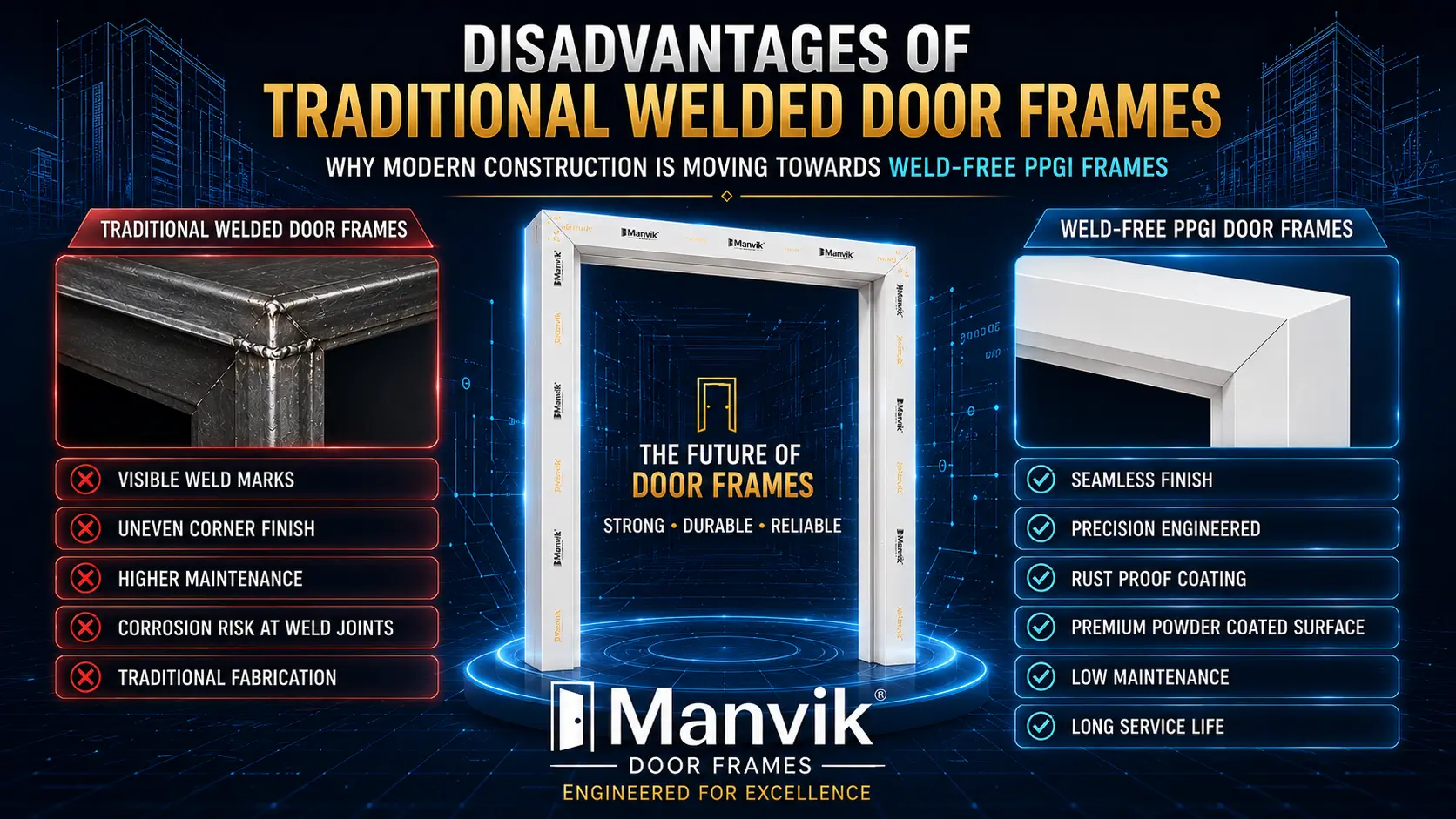
It’s important to be clear regarding this: welded door frames aren’t necessarily bad technology. Arc as well as MIG welding are both mature, efficient processes that can be used by skilled fabricators using suitable materials. The challenge in manufacturing is the requirements for high-quality welding are not always adhered to consistently. The results are evident several years later, when repair becomes costly and disruptive.
- Corrosion of the seams of welding is the main cause of premature frames failing in India. Galvanizing or zinc primer applied after welding doesn’t provide the same level of protection as mill-applied galvanizing applied to PPGI steel.
- Inconsistency in dimensions between frames of the same project causes problems with door fitting as well as squeaking hinges and gaps that expand over time.
- On-site fabrication risks Welding fumes, UV radiation from an arc flash, and grinding sparks can cause occupational health and fire hazards that aren’t present with weld-free systems.
- Problems with adhesion of paint are easily predicted structurally. The flux residue and weld spatter as well as the oxide layer that forms in the process of welding all decrease adhesion of paint at areas that are under the greatest stress. Rusting beneath the film begins around these areas.
- The cost of maintenance for a 20-year ownership period typically exceeds the initial cost of the material and installation for an alternative that does not require welding.
- Control of quality is dependent on the individual. There is no method to test how well a file works without destroying the joint. Builders rely on visual inspections of joints that could be weakened internally.
Weld Free Door Frames for Residential Projects
For residential construction ranging from single homes and villas to huge apartment developments, the case for welding doors that are free is incredibly sturdy. The homeowners engage with their door frames on a daily basis. They see peeling paint and rust staining the masonry and creaking hinges caused by frames that are not square. These aren’t structural issues in the extreme sense, but they’re expensive nuisances that can cause builder calls and can harm reputations.
PPGI frames that do not require welding maintain their original finish throughout periodic humidity fluctuations or monsoon exposure. They also resist condensation that forms on door frames in air-conditioned rooms. The galvanized surface is able to resist corrosion, even if the paint is scratched in the course of installation. This is a significant benefit over mild steel frames, where a scratch to the bare metal begins the corrosion clock. Weld Free Door Frames vs Welded Frames
For use in residential construction, lighter-gauge weld-free frames are a great choice at a reasonable cost. For exterior doors as well as main entrance frames and bathroom/wet-area openings, heavy-gauge PPGI frames with adequate security against corrosion are the option that is recommended to any quality-conscious construction company. PPGI vs uPVC Door Frames
Ideal Weld Free Frame Specifications for Residential Use
-
- Standard room doors: 16 gauge PPGI weld free frame
- External / main entrance doors: 14 gauge PPGI, heavy-duty section
- Wet areas and bathrooms: PPGI with additional corrosion-resistant paint system
- Fire exits and stairwells: Fire-rated weld free frames to relevant IS standards
Weld Free Door Frames for Commercial Buildings
Commercial buildings include hotels, offices, hospitals, retail complexes, and educational institutions. The size of procurement ensures the consistency of manufacturing frames that are not weld-free, making them much more valuable. The requirement of having the same frames in a hospital project and getting 500 frames that are actually identical instead of 500 different fabricated estimates is a significant advantage. This directly impacts an efficient installation process, a uniform appearance throughout the building, and a predictable maintenance schedule.
Commercial buildings also experience more intense traffic to their doors than homes. Frames that have to endure thousands of cycles each day have to be able to keep their finish and geometry through years of use. The joints that are rivet-assembled in free frames perform better than the joints that are welded under cyclic load conditions since rivets keep their clamping power without the stress concentration that occurs in the toe area of the weld.
For facilities that have special requirements such as hospitals (antimicrobial surface issues), the hospitality industry (premium aesthetic) and the education sector (impact resistance) Weld-free frames are able to be specified with appropriate surface treatments, and all of them are applied at the factory level, where quality assurance is superior to on-site implementation.
Weld Free Door Frames for Industrial Applications
In industrial environments, the resistance to corrosion of weld-free PPGI frames is what sets them apart from mild steel options that are welded. Warehouses, factories, food processing facilities, chemical plants, and pharmaceutical handling facilities all expose doors to cleaning chemicals, moisture, temperature cycling, and, in certain cases, corrosive vapors. Under these conditions an untreated plain steel welded frame could be susceptible to significant corrosion within 18-24 months. A weld-free PPGI frame with the right specifications will provide 10 years of use in the same setting.
The large section sizes that are made available with weld-free technology allow these frames to be used for industrial doors as well as fire-rated emergency exits as well as access doors for walls that bear loads where the frame’s structural strength is a security requirement instead of merely commercially preferred.
Common Mistakes Buyers Make While Choosing Door Frames
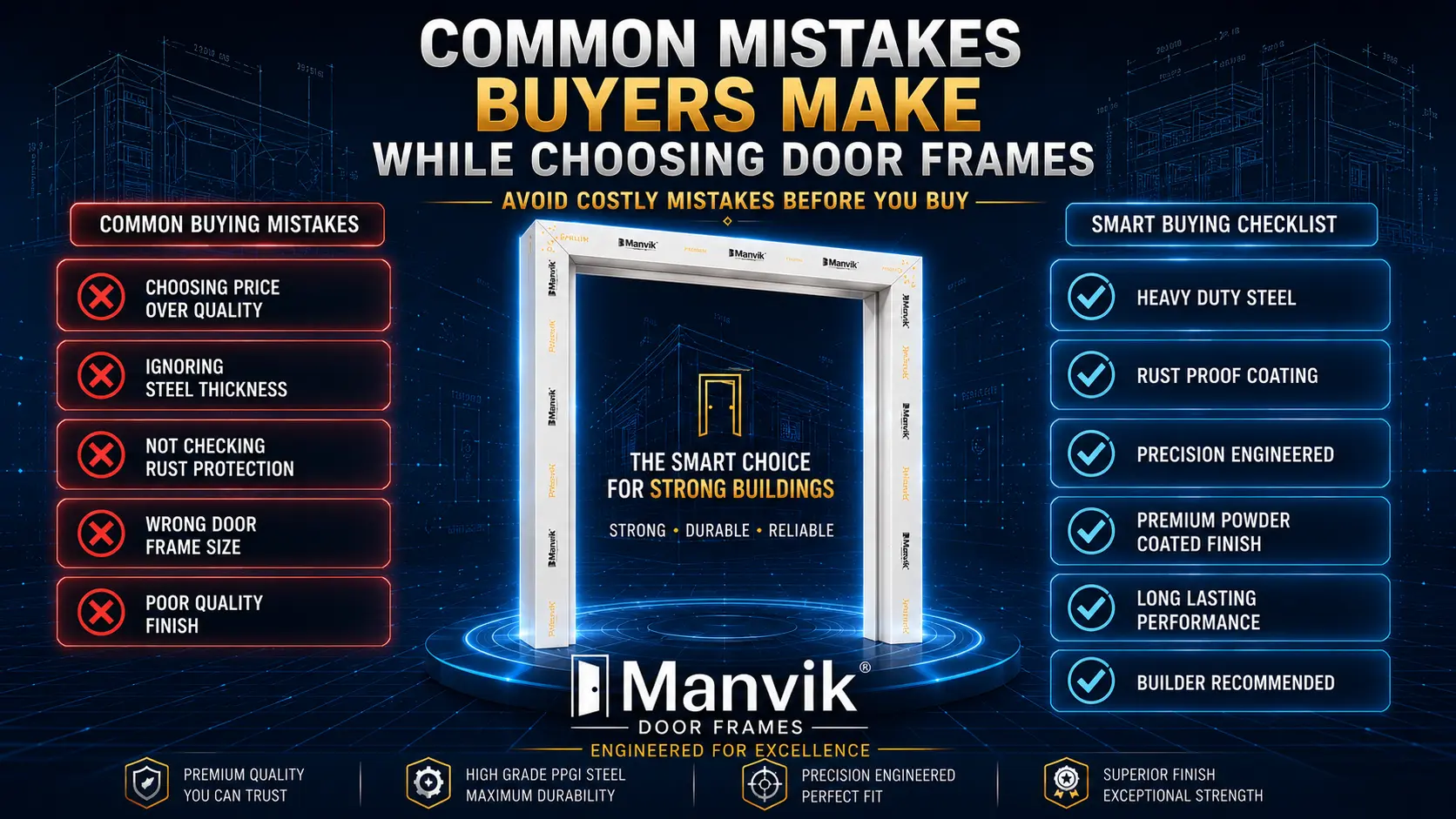
- Selecting a unit’s price by itself. The cheapest welded frame currently is probably not the most affordable frame in 10 years. The total cost of ownership should include the installation maintenance, replacement, and repair.
- The gauge is not specified in the app. Using a lightweight frame designed for homes in a commercial space can cause the distortion of alignment and premature failure.
- It is not confirming the PPGI certificate. Some suppliers offer “galvanized” frames that are just cold-rolled or hot-dip dipped mild steel coated with a thin zinc coating. Genuine PPGI steel comes with mill certifications, which should be sought.
- Do not pay attention to the measurement rules for the site. Weld-free frames are made to the dimensions you provide. Unreliable measurements indicate frames that do not fit, and unlike a site-fabricated frame that is welded, it isn’t possible to grind an additional 10 mm off during the day.
- Assuming that all welding-free frames are identical. Manufacturing quality, paint system, steel grade, and joint design can differ greatly between the different manufacturers. Get technical data sheets as well as certifications.
- Don’t plan ahead for lead times for delivery. Factory-manufactured frames require the planning of procurement. Making an order with just a few days’ notice or working with a local welding shop is not feasible for high-quality frames that do not require welding.
Buying Guide – How to Choose the Right Door Frame
Step-by-Step Door Frame Procurement Checklist
- It is important to define the purpose clearly—whether commercial, residential, or industrial—as well as the specific setting (interior, outside, exterior, wet zone, coastal, or industrial).
- Find the right size and gauge of section to accommodate the door’s weight, frequency of usage, and the needs for the structure.
- Verify if fire-rated frames exist. mandated by building codes or a fire consultant.
- Take precise measurements of openings and give precise dimensions to the manufacturer. Consider structural openings vs. the dimensions of the finished frame.
- Request material certifications, specifically, the PPGI steel mill certificate, the weight of the zinc coating, and the thickness of the paint film specifications.
- Find out about the quality control procedure and whether frames are inspected prior to shipping.
- Assess the total life-cycle cost, not just unit costs: include the cost of installation, maintenance, and expected service duration.
- To place a bulk order, ask for samples from the production batch, not samples from the production area.
- Verify delivery times and packaging. Frames must be secured against any damage up to the factory finish.
- For larger projects, you might consider calling the technical support department for specifications and installation advice.
Myth vs Fact: Weld Free Door Frames
- Welded frames are stronger because welding is used in structural steel construction.
- Weld free frames can’t be made in custom sizes.
- PPGI coating is just paint — it’s no better than a primed welded frame.
- Weld free frames are expensive and only suitable for premium projects.
- Structural welding in buildings uses heavy sections with full-penetration welds and certified welders. Door frame welding in typical construction is fillet welding in thin sections with no quality verification. Riveted joints in PPGI frames outperform these under real-world loading.
- Reputable manufacturers like Manvik Door Frames supply custom-sized weld free frames for non-standard openings with full factory precision retained.
- PPGI steel is galvanised at the mill before coiling. The zinc layer is metallurgically bonded to the steel, not applied after fabrication. It provides sacrificial cathodic protection that post-fabrication paint cannot replicate.
- Weld free frames are available across a range of specifications and price points. When total cost of ownership is calculated, they are the economical choice for any project with a design life beyond 10 years.
Why Manvik Door Frames Is the Preferred Choice
Manvik Door Frames has built its reputation by focusing on what actually matters to builders, contractors, and project owners: frames that arrive right, fit fast, and last long. Every frame produced carries the assurance of factory-controlled manufacturing, certified PPGI steel, and a finish that is applied under controlled conditions — not by a painter on a scaffold in the wind. door frame manufacturer in India
The company’s rivet technology manufacturing process is engineered for structural integrity without compromise. Unlike some competitors who use mechanical clips or simple press-fit connections, Manvik’s rivet joints are dimensioned for load distribution and pull-out resistance appropriate to each frame section.
Manvik Door Frame Manufacturing Advantages
-
-
- Premium PPGI steel sourced from certified steel mills with full traceability
- Advanced rivet technology joints — engineered for structural integrity under cyclic loading
- Factory electrostatic paint finish for uniform coverage, superior adhesion, and long service life
- Custom sizes available for non-standard project requirements
- Bulk supply capability for large residential, commercial, and infrastructure projects
- PAN India delivery with project scheduling support
- Dedicated technical support team for specification guidance
- Competitive manufacturer-direct pricing — no distributor markup
- Dealer and contractor partnership programmes across India
-
Cost vs Long-Term Value Comparison
Let us look at this concretely. Consider a 100-unit residential apartment project requiring 400 door frames (4 per apartment on average).
| Cost Element | Welded MS Frame (per frame) | Weld Free PPGI Frame (per frame) |
|---|---|---|
| Material cost | Lower | Slightly higher |
| Fabrication / manufacturing | Workshop labour + consumables | Included in factory price |
| On-site installation time | ~2 hrs (welding + grinding + priming) | ~35–45 minutes (set and anchor) |
| Paint (Year 3) | ₹400–800 per frame (touch-up) | Nil under normal conditions |
| Full repaint (Year 7) | ₹1,200–1,800 per frame | Not required |
| Replacement cost (Year 12–15) | Common due to severe corrosion | Not required — frames still serviceable |
| 10-year total cost | Significantly higher | Lower overall |
The numbers are directional rather than prescriptive — actual costs vary by project, location, and specification. But the principle is consistent: the initial price difference between weld free and welded frames is erased within 2–3 years by lower installation labour, and the weld free frame continues delivering savings for the remaining 20+ years of its service life.
Ready to Upgrade to Weld Free Door Frames?
Manvik Door Frames supplies premium weld free door frames across India — directly from manufacturer to project. Get competitive pricing, technical support, and fast delivery for residential, commercial, and industrial projects of any scale.
Frequently Asked Questions
Q. What is a weld free door frame?
A weld free door frame is a steel door frame manufactured using rivet technology and mechanical joints — no welding involved. It is made from PPGI (Pre-Painted Galvanised Iron) steel in a factory environment, arriving at site ready to install with a factory-applied paint finish. It is the modern alternative to traditional welded mild steel frames.
Q. Are weld free door frames stronger than welded frames?
In most practical applications, yes. Weld free frames use riveted joints that distribute stress over a wider area than fillet welds in thin steel sections. They also avoid the heat-affected zone (HAZ) created by welding, which can weaken the steel at the joint. Under the cyclic loading that a door frame experiences over years of use, riveted connections have demonstrated superior fatigue resistance.
Q. Do weld free door frames rust?
Weld free frames made from genuine PPGI steel have extremely high corrosion resistance. The galvanised steel substrate provides sacrificial zinc protection even if the surface paint is scratched. Under normal conditions, quality weld free frames show no meaningful corrosion over 20–25 years of service. They are particularly suitable for coastal, humid, and industrial environments.
Q. Which is better: weld free door frames or welded frames?
For most modern construction applications, weld free door frames are the better choice. They offer superior corrosion resistance, dimensional accuracy, faster installation, a better factory finish, and lower total life-cycle cost. Traditional welded frames may still be appropriate for custom non-standard openings in low-budget temporary structures, but for any project with a 10+ year design life, weld free is the clear recommendation.
Q. Why are builders choosing weld free door frames over welded frames?
Builders choose weld free frames primarily for three reasons: faster installation (no on-site welding or grinding), consistent dimensional quality across large projects, and significantly lower callbacks due to paint failure or corrosion. On large residential and commercial projects, the time savings alone typically offset any difference in unit material cost.
Q. What is PPGI steel and why does it matter for door frames?
PPGI stands for Pre-Painted Galvanised Iron. It is steel strip that has been galvanised (zinc-coated) at the steel mill and then coated with paint — all before the steel is cut or formed into door frames. This means the corrosion protection is integral to the material, not applied afterward. It provides far superior corrosion resistance compared to priming and painting a welded mild steel frame on site.
Q. What is rivet technology in door frame manufacturing?
Rivet technology refers to the use of mechanical rivets to join door frame sections without welding. The technique creates a joint that distributes load over a larger area than a weld, resists vibration and cyclic fatigue, and leaves the PPGI protective coating intact at the joint area. It enables factory assembly with consistent quality that site welding cannot match.
Q. Are welded door frames outdated?
For standard residential and commercial applications, welded mild steel frames are increasingly being replaced by weld free PPGI alternatives. Welded frames are not obsolete — they remain viable for some custom, heritage, or temporary applications — but for builders prioritising quality, durability, and installation efficiency, welded frames are no longer the default choice they once were.
Q. Can weld free door frames be made in custom sizes?
Yes. Manufacturers like Manvik Door Frames produce weld free frames in custom dimensions for non-standard openings. The factory manufacturing process retains its dimensional accuracy regardless of frame size — a significant advantage over site-fabricated custom welded frames where accuracy depends entirely on the individual fabricator.
Q. Are weld free door frames suitable for commercial buildings?
Yes, they are exceptionally well suited to commercial buildings. The consistency of factory manufacturing is highly valuable when specifying hundreds of identical frames for an office, hotel, hospital, or retail complex. The premium factory finish suits commercial aesthetics, and the higher durability is essential in high-traffic environments.
Q. Which door frame lasts longer — weld free or welded?
Weld free PPGI door frames consistently outlast traditional welded mild steel frames. Quality weld free frames have a service life of 25–30+ years under normal conditions. Welded mild steel frames typically show significant corrosion or dimensional issues within 8–15 years, particularly in humid or coastal environments.
Q. Do weld free door frames need repainting?
Under normal residential and commercial conditions, weld free PPGI door frames do not need repainting during their service life. The factory-applied electrostatic paint is far more durable than site-applied paint, and the galvanised substrate continues to protect even if the paint film is locally damaged. In harsh industrial environments, a maintenance check every 5–7 years is recommended.
Q. What is the price difference between weld free and welded door frames?
Weld free PPGI door frames typically carry a higher unit material cost than basic mild steel welded frames. However, when total project cost is calculated — including installation labour, on-site preparation, initial painting, and maintenance over 10 years — weld free frames are almost always the more economical choice. Manufacturer-direct pricing from Manvik Door Frames further reduces the cost differential for bulk orders.
Q. Are weld free door frames available for industrial applications?
Yes. Heavy-duty weld free steel door frames are manufactured in heavier gauges and larger section sizes for industrial use — factories, warehouses, food processing facilities, and pharmaceutical plants. Their superior corrosion resistance makes them particularly suited to industrial environments where chemical exposure or aggressive humidity would rapidly degrade welded mild steel frames.
Q. How do I order weld free door frames from Manvik?
Contact Manvik Door Frames directly through the website or phone. Provide your project details, required frame specifications (gauge, section size, finish), quantities, and delivery requirements. The Manvik technical team will advise on specification and provide a competitive manufacturer-direct quote. Bulk project orders and dealer partnerships are also available.
Q. Are fire-rated weld free door frames available?
Yes. Manvik Door Frames supplies fire-rated weld free door frames for applications requiring fire resistance compliance — emergency exits, stairwell access doors, and other fire compartmentation openings — to relevant Indian Standard requirements.
Q. Does Manvik Door Frames supply across India?
Yes. Manvik Door Frames supplies weld free door frames PAN India — covering residential developers, commercial contractors, architects, government infrastructure projects, and dealers across the country. Bulk supply, dealer network partnerships, and project-specific procurement support are all available.
Final Verdict: Which Door Frame Should You Choose?
For any construction project with a 10-year or longer design life, weld free PPGI door frames are the technically superior and economically sounder choice. They offer better corrosion resistance, more consistent structural performance, faster installation, and a fraction of the long-term maintenance cost. The higher unit price versus basic welded frames is recovered quickly through lower installation labour and eliminated maintenance cycles.
The door frame market has evolved, and the advantages that once made on-site welded frames the default option — flexibility and low upfront cost — no longer hold when measured against what modern weld free technology delivers. Factory manufacturing has removed the quality variability that has long plagued site-fabricated frames. PPGI steel has given door frames a corrosion resistance that painted mild steel cannot match. best door frame for bathroom
Choose weld free PPGI door frames if you are building residential, commercial, or industrial structures with a design life exceeding 10 years, if you value installation efficiency on large projects, if your project is in a humid or coastal environment, or if you want a maintenance-free outcome for the building owner.
Welded frames may still be appropriate for one-off custom openings in retrofit or heritage projects, low-cost temporary structures, or situations where extremely non-standard geometry cannot be accommodated even with custom factory production.
For the vast majority of modern Indian construction, weld free door frames from a trusted manufacturer like Manvik are the correct specification.
Explore Related Products at Manvik Door Frames
- PPGI Door Frames — Our full range of pre-painted galvanised iron frames for all applications
- Rivet Technology Door Frames — The engineering behind our weld free manufacturing
- Commercial Door Frames — Heavy-duty frames for offices, hospitals, hotels, and institutions
- Residential Door Frames — Precision-engineered frames for homes and apartments
- Fire Rated Door Frames — Compliant fire compartmentation solutions
- Steel Door Frames — Full steel frame range by gauge, section, and application


