

Introduction: The Groove That Changes Everything
Single Rebate vs Double Rebate Door Frames: When you’re specifying or sourcing a door frame — whether for a new residential build, a commercial project, or a home renovation — one technical detail can silently determine how well your door performs for the next 20 years: the rebate.
Most buyers skip right past it. They focus on door style, colour, or price. But experienced builders, architects, and joinery contractors know that getting the rebate type right affects everything from thermal performance and weather resistance to sound insulation and long-term security.
This guide cuts through the confusion between single rebate and double rebate door frames with honest, experience-backed information — so you can make the right choice for your specific situation.
What Is a Door Rebate? (And Why It Matters More Than You Think)
A door rebate — sometimes written as “rabbet” in North American literature — is a stepped groove or recess machined into the edge of a door frame. When the door closes, the door leaf sits into this groove, creating a physical seal between the door and the frame.
The rebate performs three critical jobs simultaneously:
- It stops the door from swinging through the frame opening
- It creates a compression point for the weather seal or draught strip
- It resists direct lateral force, making the door harder to force open
Without a rebate, a door would simply close flush against a flat surface — leaving visible gaps, poor weather exclusion, and virtually no resistance to forced entry.
The number of rebates — one or two — dramatically changes how well a frame handles all three of those functions.
Single Rebate Door Frames: The Standard Workhorse
What Is a Single Rebate Frame?
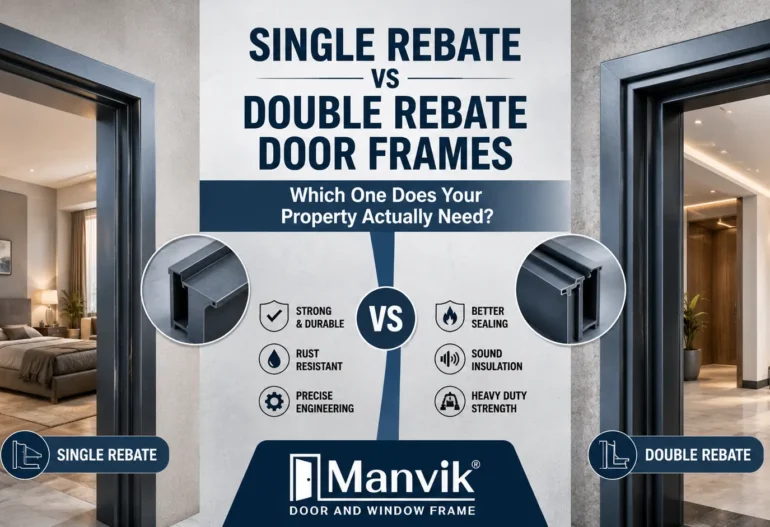
A single rebate door frame (also called a single rebated jamb) has one stepped profile cut into the frame. The door leaf presses against this single rebate shoulder when closed, engaging one weather seal or door stop.
Single rebate frames are the industry default for most internal doors and many standard external doors. They are simpler to manufacture, easier to fit, and less expensive than double rebate alternatives.
Where Single Rebate Frames Are Most Appropriate
- Internal room doors — bedroom, bathroom, living room, kitchen
- Light-duty external doors in sheltered locations with low wind/rain exposure
- Budget residential builds where cost management is a primary concern
- Partition walls and secondary openings
- Single-door openings that do not require a security door in front
Structural Profile of a Single Rebate Frame
The typical single rebate door jamb has a rebate depth of approximately 12–15 mm and a rebate width that matches the door slab thickness (usually 35 mm for internal, 44 mm for standard composite external doors). One seal line is formed where the door leaf contacts the rebate shoulder. Single Rebate vs Double Rebate Door Frames
Key Limitations of Single Rebate Frames
- One seal line only — a single point of failure for weather exclusion
- Lower resistance to air infiltration under positive wind pressure
- Not suitable for double-door (French door) setups requiring a security screen door
- Less acoustic performance compared to double rebate equivalents
- Does not accommodate triple glazing in door panels without modification
Double Rebate Door Frames: The High-Performance Alternative
What Is a Double Rebate Frame?
It is a double rebate frame for doors includes two stepped grooves – one on the inside and the other on the exterior side of the profile. The dual-shoulder design permits the door to connect two sealing lines simultaneously with one pressing from outside and the other from inside. Single Rebate vs Double Rebate Door Frames
This results in a significantly more secure, weather-resistant, and also acoustically better connection between frame and door.
Where Double Rebate Frames Are Most Appropriate
- Primary doors for entry for exposed elevations (coastal hillsides and high-wind zones)
- External door sets that need the highest thermal efficiency (low U-value target)
- Openings that are a combination of an entry door for security and an entrance door with a solid structure
- High-footfall and commercial environments (retail hotels lobbys of offices)
- Doors that are acoustic for medical and recording facilities or in high-noise areas
- Passive House or low-energy construction projects
- Doors that are thicker than 44 millimeters (such as 70 or 68 millimeter composite slabs)
Structural Profile of a Double Rebate Frame
The double-resistance jamb usually will accommodate door slabs ranging between 55 mm up to 70 millimeters of thickness. Two rebate shoulder are placed to ensure they both are connected to the frame separately. Two compression seals, typically EPDM Rubber or thermoplastic Elastomer Strip sare placed within every rebate channel forming an airtight barrier that is layered to protect against sound, moisture, and.
The Security Advantage of Double Rebate Frames for Dual-Door Setups
The majority of Australian as well as South Asian construction practice particularly double rebate jambs is the most common solution when both an screening door for security as well as the steel or solid timber entry door are affixed within the exact frame. The door that is the outer part of the front rebate while the main entrance door is in the back rebate. This method does away with the need for separate frame for the screen door completely, thereby saving money and reducing the time to install.
Head-to-Head Comparison: Single Rebate vs Double Rebate
| Feature | Single Rebate | Double Rebate |
|---|---|---|
| Number of seal lines | 1 | 2 |
| Typical door slab thickness | 35–44 mm | 55–70 mm |
| Weather resistance | Standard | Superior |
| Air infiltration resistance | Moderate | High |
| Acoustic performance | Basic | Enhanced |
| Thermal performance (U-Value) | Standard | Better (lower U-values achievable) |
| Security screen compatibility | Limited | Yes — accommodates dual door setup |
| Triple glazing compatibility | No | Yes |
| Cost (frame only) | Lower | Higher |
| Installation complexity | Simple | Moderate |
| Best use case | Internal / standard external | External / high-performance / commercial |
Energy Efficiency: Why the Number of Seals Is a Thermal Game-Changer
In the age of increasing prices for energy and tightening of regulations for building, door performance isn’t just an issue of comfort; it’s a financial one.
The single door rebate is only one bridge of thermal near the junction of the door and frame. Even with a premium weather strip, wind will find its way through one seal, even under the high conditions of wind pressure.
Double-rebate frames create two separate breaks in the thermal envelope. Even if external wind pressure may compromise the seal on the outside, the inside seal protects its thermal envelope. This is why double rebated composite doors typically have U values of 0.85 or 1.0 W/m²K, which is well above the U-value standards that are set by most building codes across Europe and the UK and increasing green construction standards (GRIHA ECBC-compliant structures).
For developers and builders looking to construct zero- or close-to-zero-energy buildings, recommending double-rebate door sets for exterior doors is among the best envelope enhancements that are available.
Sound Insulation: The Overlooked Benefit of Double-Rebate Design
External doors can transmit noise. is among the most frequent post-occupancy issues in commercial and residential structures Yet it is not often discussed in frame specification discussions.
Each seal line within a door frame that is rebated acts as an acoustic divider. One rebated frame can provide an airborne reduction of one stage of sound transmission. A double rebate frame is the appearance of a two-stage labyrinth of acoustic energy, which is a sound wave that enters the seal faces’ resistance from the seal inside before it enters the space.
When combined with heavy-core doors slabs (solid composite, acoustic-rated timber and multi-layer steel) Double rebate frames are able to achieve Rw ratings between 35 and 45 dB that are ideal for rooms that are located near traffic-heavy roads, industrial kitchens and plant rooms, or entertainment spaces.
Material Compatibility: What Door Slab Works With Which Frame Type
Timber Door Frames
Traditional softwood and hardwood frames for doors are made using single or double rebate profiles based on the door’s type. Frames made of engineered timber for exterior usage are now being offered as double rebates in top joinery packages.
Steel / Cold-Rolled Door Frames
Frames made of pre painted steel (PPGI/PPGL) are commonly employed in commercial and are increasingly being used in residential settings across South Asia. Double rebate frames from steel have important advantages, including interlocking corners, incorporated hinge cavities, and resistance to warping caused by moisture. The two-rebate design of steel frames distributes the weight of doors more evenly, which reduces the stress on hinges over time.
UPVC Frames
uPVC door frames that are designed for external use are typically made in double-rebate designs as part of composite door sets. A multi-chamber uPVC extrusion, when combined with the double rebate design, greatly improves the thermal efficiency of the door set in general.
Composite Door Systems
Composite doors with high performance—usually with a thickness of 68-70 millimeters—are generally combined by double-rebatement frames. The extra slab thickness demands an expanded rebate depth, which one rebate frame cannot accommodate.
Installation Considerations: What Contractors Need to Know
Rough Opening Dimensions
Double rebate frames have an opening that is marginally bigger than single rebate counterparts due to the increased frame’s depth. Always verify your frame’s overall dimensions and not only the clear opening when determining the size of the structural opening in the construction phase.
Hinge Positioning and Load Distribution
Double rebate frames, especially those made of timber or steel, need careful hinge placement. Because the slab of the door weighs more (thicker core, double seals, possibly triple-glazed panels), hinge centers should be calculated to reflect the weight of the door. The use of rivet-fixed hinges is standard in steel double rebate frames. Mortise hinges are still common in wood.
Threshold and Sill Integration
The base of the frame Double rebate doorsets must have an appropriate threshold or sill profile that is compatible with the dual-seal design. If the threshold is not properly matched, it can negate the benefits of weatherproofing of the double-rebate design completely. Choose sill profiles from the same doorset when feasible.
Finishing and Decoration
Single Rebate vs Double Rebate Door Frames: Double rebate frames feature an architrave that is slightly more pronounced than single rebate frames. Internally, the architrave and plaster profiles should be able to accommodate this depth. This is an insignificant detail, but it is one that can annoy installers who switch between frames in the same project without changing their schedule for finishing.
Cost Analysis: Is the Upgrade to Double Rebate Worth It?
Upfront Cost Difference
Double rebate frames generally cost 15 to 35 percent higher than a single rebate frame made of the same material and dimensions due to the extra material that is used in the profile of the frame and the more intricate extrusion process or machining.
For the standard 2100 x 990 millimeter external doorset, the premium could be a low amount that is often less than one year’s extra energy loss due to a poorly performing one-rebate doorset.
Lifetime Value Calculation
When you consider:
- Lower energy use for heating and cooling during 20-30 years of service
- Lower maintenance cost (fewer sealing failures and less penetration of weather damage)
- Increased security reduces risk of insurance
- Greater perceived value of property and the ability to sell
…the double rebate is increasingly justified, especially for exterior primary doors in any climate that has significant seasonal temperature fluctuations.
When to Stay With Single Rebate
For doors that are internal and secondary openings, a light-duty double rebate frame does not provide any substantial performance improvement over a single rebate option. In these situations, a double rebate will cost you more, but it does not provide any return on investment. Single Rebate vs Double Rebate Door Frames
Frequently Asked Questions
Can I retrofit a double rebate frame into an existing single rebate opening? In most cases, yes — but it requires careful assessment of the structural opening width. The additional frame depth of a double rebate section may require the rough opening to be widened by 10–20 mm on each side. In masonry openings this can mean cutting back blockwork or brick reveals, which adds labour cost.
Are double rebate frames suitable for fire doors? Yes. Many fire-rated doorsets — FD30, FD60, and higher ratings — use double rebate frames because the dual seal geometry also accommodates intumescent strips more effectively. Always verify that the complete doorset (slab + frame + hardware) is tested and certified together.
What is the difference between a rebate and a door stop? A planted door stop is a separate timber batten nailed to a plain flat frame after installation — a common DIY and budget construction technique. A rebated frame has the stop machined as an integral part of the frame section. A machined rebate is always structurally superior to a planted stop, offering better security and more consistent seal compression.
Do double rebate frames work with sliding or bifold doors? No. Double rebate frames are designed for hinged door configurations. Sliding and bifold door systems use entirely different frame profiles — typically track-based extrusions with no rebate geometry.
Which rebate type is required by Indian building codes? The National Building Code of India (NBC) does not prescribe rebate type directly but does specify performance requirements for external doors in terms of water penetration resistance and thermal transmittance. Double rebate frames are increasingly specified in ECBC-compliant commercial projects and in projects targeting GRIHA or IGBC green ratings, where envelope performance is scored and audited.
PPGI Door Frame Dealer Near Me in Sonipat


