

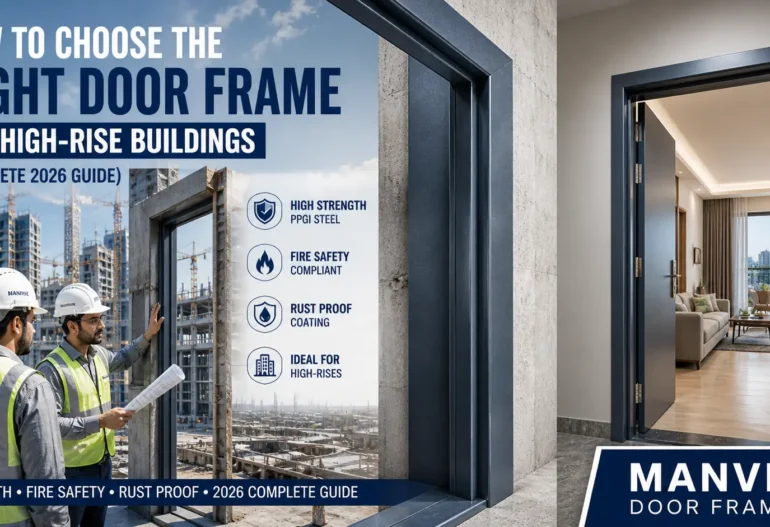
Best Door Frame for High Rise Building : In the process of building high-rise structures, the majority of builders and architects focus on the structural integrity and façade material as well as interior layouts. However, one aspect that is usually overlooked can be the frame of a door. The wrong door frame in a building with a high rise isn’t only a visual issue; the frame can also become dangerous, a maintenance headache, and ultimately a lasting cost burden.
We are Manvik Door Frames; we have been designing and manufacturing high-quality door frames that are specifically crafted for residential towers with multiple floors, commercial complexes, and mixed-use high-rises. This manual will take you through everything you have to know about frames’ materials and demands to costs, height adjustment, and best practices for installation. door window frame
If you’re a construction worker or architect, an interior designer, or a property developer, this source will be your primary source when it comes to choosing the ideal door frame for construction with high rises.
What Is a Frame Structure in a High-Rise Building?
Prior to deciding on a door’s frame choices, it’s crucial to comprehend the larger structure. Frame structures in the context of a building with a high rise is the frame skeleton—usually constructed out of reinforced concrete (RCC) or structural steel that supports all horizontal and vertical loads.
When it comes to this kind of structure in this type of construction, the frame for the door does take on any structural burden by itself. Instead, it’s inserted into an opening in a load-bearing wall or partition. This does not suggest that you should compromise the high-end quality of your door frame. If you live in a high-rise area, the door frame must
- Resist the constant mechanical strain of everyday use on hundreds of floors
- Refrain from fire, particularly in stairwells, exit doors entryways, and pathways for escape from fire
- Feel the vibration of vibrations from elevators and wind.
- Stabilize the dimensionality in different temperatures and levels of humidity.
- Meet the requirements of national and local codes of construction for the safety of your family and for egress
The frame structure and the door frame function together. If buildings or walls shift or move, the door frames must be strong enough to resist the tendency to be able to break, warp, or become jammed—critical to ensure safety when building a multi-floor structure.
Manvik Door Frames engineers each product with these real-world high-rise demands in mind, ensuring you get frames built for the long game.
Why Choosing the Right Door Frame for High-Rise Buildings Matters
The door frame required for high-rise buildings isn’t identical to the frame used for a low-rise house or an individual home. It is a fundamentally different matter:
- Dimension and Scale For example, a 25-floor building could include 400+ door openings. A defect in the material or design can be multiplied by hundreds.
- Fire Safety Compliance: Regulatory authorities require fire-rated doors in stairwells, corridors, and exit ways.
- Acoustic Performance: For residential high-rises, sound insulation between the apartments is crucial. Door frames play an important function in the sealing of acoustics.
- Wind Pressure and Load: On higher floors there is a significant increase in wind pressure. Door frames on balconies and outside have unique environmental stresses.
- Frameworks for waterproofing on exterior surfaces or areas that are wet must be sealed and resist water ingress.
- Aesthetic uniformity: in large developments, consistent door frame designs on all floors will ensure an elegant, professional look.
Which Is Better: PVC, WPC, or PPGI Door Frame?
This is one of the most common questions builders ask when selecting a door frame for high-rise building projects. Let’s break down the three most popular material options:
| Feature | PVC Frame | WPC Frame | PPGI Frame |
| Material | Polyvinyl Chloride | Wood-Plastic Composite | Pre-Painted Galvanized Iron |
| Fire Resistance | Low | Medium | High |
| Moisture Resistance | High | High | Medium (with coating) |
| Load Bearing | Low | Medium | High |
| Durability | 5–10 years | 10–15 years | 20–30+ years |
| Best For | Budget residential | Mid-range projects | High-rise, commercial |
| Cost | Lowest | Moderate | Best value long-term |
PVC Door Frames
PVC frames are incredibly light-weight as well as moisture-proof and cost-effective. They are ideal for affordable residential construction projects as well as in places where humidity is high, such as bathrooms. But for buildings with high rises, PVC frames are generally not a good choice for entry doors as well as fire exit doors or corridors with high traffic because of their weak structural strength and a lack of resistance to fire.
WPC (Wood-Plastic Composite) Door Frames
Door frames made of WPC provide the perfect balance of design and function. They are reminiscent of timber, while also being impervious to termites and water. For middle-rise construction (up 10 stories), WPC frames are an increasingly popular option in interior use. But they aren’t as effective in fireproof applications as well as under the heavy winds common to tall towers.
PPGI (Pre-Painted Galvanized Iron) Door Frames
To frame a door to be used in high-rise construction, PPGI is widely considered to be the industry standard. Here’s why:
- Superior strength structurally is able to handle door loads of large flush doors as well as doors that are fire-rated.
- Excellent resistance to fire—exceeds IS:1038 and many other Indian as well as international fire safety standards.
- Life-long service—galvanized coating stops rust; the pre-painted finish wards off the effects of corrosion
- Dimensional precision — manufactured within tight tolerances, which ensures uniform door fitting on the entire floor
- No maintenance: there is no painting, varnishing or re-treating needed
Manvik Door Frames specializes in PPGI door frames engineered for high-rise and commercial-grade construction — offering fire-rated, moisture-resistant, and dimensionally stable solutions.
What Is a PPGI Door Frame?
PPGI refers to pre-painted galvanized iron. The PPGI door frame is made out of galvanized steel sheets, which are coated with a coating of zinc to resist corrosion and then coated with high-adhesion, UV-resistant paint in a controlled factory.
The main benefits of PPGI door frames are the following:
- Precision factory: Unlike the site-fabricated frames, PPGI frame doors formed by press or roll with precise dimensions
- Uniform finish: The painted surface is smooth and consistent and is ready for installation without work on site.
- Structural rigidity: Steel cores offer a more robust door stop and jamb profiles in comparison to plastic or wood alternatives.
- Safety compliance: PPGI frames, when coupled with shutters for doors that are fire-rated, can be used to complete a fire door system
- Environment-friendly: Long lifespan reduces replacement frequency; no VOC-heavy site finishes required
For high-rise structures, PPGI door frames are employed for main entrance doors to apartments as well as corridor fire doors, stairwells, utility door entrances, and the building zones of service. Manvik Door Frames manufactures PPGI frames with a variety of sizes of wall thickness (75 mm, 90 mm, 100 mm, and 125 mm) for different types of drywall or masonry.
Types of Door Frames for High-Rise Buildings
1. Interior Door Frame for High-Rise Buildings
Frames for doors in the interior of the high-rise buildings are utilized to create apartment doors, bathrooms, and bedrooms as well as utility room openings. They are generally put in walls of partitions. Important requirements for internal door frames for buildings with high rises:
- The lightness and stability does not add dead weight
- Sound attenuation helps reduce noise transmission between rooms
- Waterproof for areas that are wet, such as kitchens and bathrooms.
- Compatibility with flush doors, panel doors, and sliding systems. Compatible with flush doors, panel doors, and sliding
Manvik’s interior PPGI doors come with specifically engineered rebate profiles that guarantee an airtight seal. lessening loss of cooling as well as increasing energy efficiency in apartments.
2. Exterior Door Frame for High-Rise Buildings
External door frames face significantly more demanding conditions—wind-driven rain, thermal expansion/contraction, UV exposure, and physical security demands. An exterior door frame for a high-rise building must:
- Be structurally able to support high-end security doors or double-leaf doors.
- Seals for weatherproofing and flush anchoring the structure wall.
- Follow the calculations of wind load that are specific to the building’s elevation and position
- Protect against corrosion caused by moisture, rainfall, and air pollution in urban areas.
In high-rise outdoor applications, Manvik recommends heavy-gauge PPGI frames that have sealing grooves, wall anchors, and sealant grooves for safe embedding.
3. Fire-Rated Door Frames
Door frames that are fire-rated are mandatory in a few zones of high-rise structures according to the National Building Code (NBC) and the local fire NOC requirements. They include doors for stairwells and hallway fire doors (typically each 20-30 m), fire escape exit doors, and entrances to electrical rooms and utility spaces.
A fire-rated door frame has to meet a certain durability rating for fire, generally 30 minutes (1 hour), 60 minutes (1 hour), or 120 minutes (2 hours) and not permit the heat, flame, or smoke to enter the frame.
Manvik Door Frames offers fire-rated PPGI frames tested to IS and international fire safety standards, complete with certification documentation required for fire NOC compliance.
Door Frame for High-Rise Building: Price & Cost Guide
Door Frame for High-Rise Building Price
Pricing depends on material type, frame dimensions, finish, and fire rating. Here is a general pricing guide:
| Frame Type | Material | Price Range (Per Unit) | Best For |
| Standard PPGI Frame | Galvanized Iron | ₹1,800 – ₹3,500 | Interior doors |
| Heavy-Duty PPGI Frame | Thick-gauge GI | ₹3,500 – ₹6,500 | Exterior / main doors |
| Fire-Rated PPGI Frame | Certified steel | ₹5,000 – ₹12,000 | Fire corridor doors |
| WPC Frame | Wood-Plastic | ₹1,500 – ₹3,000 | Interior / budget |
| PVC Frame | Polyvinyl Chloride | ₹800 – ₹1,800 | Bathrooms / utility |
Door Frame for High-Rise Building Cost: Total Project Estimation
For a developer planning a 20-floor residential tower with 10 apartments per floor, each apartment having 5 door openings, you are looking at approximately 1,000 door frames per project. At this volume, Manvik Door Frames offers project pricing and bulk procurement advantages that can significantly reduce your per-unit door frame for high-rise building cost. door or window frame
Factors that affect overall project cost include:
- Frame material and gauge thickness
- Custom vs. standard dimensions
- Fire-rating certification requirement
- Surface finish (standard paint, powder coating, wood grain)
- Delivery and site logistics across multiple floors
- Installation labour and hardware fitting
Manvik offers turnkey supply solutions for large-scale projects with dedicated project coordination and on-time delivery guarantees.
How to Increase the Height of a Door Frame in a High-Rise Building
After construction, sometimes homeowners or architects realize that the frame’s height is not sufficient—whether due to aesthetics (taller doors are becoming more popular for high-end construction projects), accessibility needs of those with disabilities, or the practical need for transporting large equipment or furniture.
This is how you can raise the size of your door frame:
Option 1: Frame Extension Insert
If the door opening on the wall is higher than the frame that is currently in place, the frame extension piece (also known as a frame riser, also known as a head extender) is fabricated in a factory to be affixed onto the frame’s top. This is the most efficient and most economical method, perfect for when a small rise in height (50-150 mm) is required.
Option 2: Wall Opening Modification
To achieve a greater rise in height, the opening of the structural structure must be expanded upwards. It is necessary to break open the masonry that is above the lintel and then either make a new lintel in an elevated position or use the structural angle lintel. This must be done under the supervision of a structural engineer, as altering openings for high-rise concrete or walls of masonry should not affect the load distribution.
Option 3: Full Frame Replacement
If the height of the wall opening is already altered The door frame will be taken off and a brand new, larger frame will be made. Manvik Door Frames can manufacture customized-height frames according to exact specifications and with fast turnaround times.
Important: In high-rise buildings, never modify structural wall openings without approval from the project’s structural engineer. Altering load paths without proper design can compromise building safety.
Key Factors to Consider When Choosing a Door Frame for High-Rise Buildings
1. Wall Thickness Compatibility
The high-rise structures use different wall designs—115 mm single brick and 230 mm double brick. AAC block walls and gypsum walls. The door’s frame’s depth should precisely match the thickness of your wall. Manvik frames come in various dimensions (75mm up to 150mm) to fit any wall installation.
2. Fire Safety Rating
Make sure to check the drawings for fire safety as well as NBC standards before deciding on door frames to be used in specific zones. Corridors and fire stairwells are legally obliged to use doors and frames that are rated.
3. Structural Anchoring System
High-rise frames need to be securely secured to the structural frame or wall with hold-fast anchors embedded in the wall and expansion bolts. Manvik frames come with anchor lugs that are pre-welded or bolt holes to ensure secure, code-compliant installations.
4. Acoustic Performance
For apartments in residential areas Acoustic sealing is just as crucial as security physical. Pick frames with continuous gasket channels made of rubber or acoustic sealing to stop leakage of sound across the units.
5. Supplier Reliability & Project Support
With over 1,000 frames to be used for each project, the supplier’s capability to ensure high standards of quality, keep to schedule, and provide your installation needs is crucial. Manvik Door Frames provides dedicated project managers to manage high-rise purchases and supply chain management that ensures zero delays for your supply chain.
Installation Tips for Door Frames in High-Rise Buildings
- Always dry-fit the frame in the opening before final grouting or anchoring
- Use a plumb bob and level to ensure frames are perfectly vertical and horizontal
- Embed hold-fast anchors in structural mortar at a minimum of 3 anchor points per jamb
- Apply sealant between frame and masonry on both internal and external faces for waterproofing
- For fire doors, ensure the door frame certificate matches the door leaf certificate (same manufacturer or tested assembly preferred)
- Allow mortar curing time (minimum 24–48 hours) before hanging the door shutter
- Apply anti-corrosion touch-up paint on any cut edges or site-drilled holes before installation
Frequently Asked Questions About Door Frames for High-Rise Buildings
Q1. What is a frame structure in a high-rise building?
A frame structure in a high-rise building is the load-bearing skeletal system — typically RCC or structural steel — that supports all floors, walls, and roof loads. Door frames, in contrast, are non-structural components fitted into wall openings. However, they must be selected to withstand the specific environmental and safety demands of tall building environments.
Q2. Which is better: PVC, WPC, or PPGI door frame for high-rise buildings?
For high-rise buildings, PPGI (Pre-Painted Galvanized Iron) door frames are the best choice due to superior structural strength, fire resistance, longevity, and compliance with building codes. PVC is limited to budget interior applications; WPC is suitable for mid-rise projects; but for any multi-storey commercial or residential development, PPGI is the professional standard.
Q3. How to increase the height of a door frame?
You can increase door frame height through a frame extension insert (quick and low-cost), modification of the masonry wall opening with a new higher lintel (requires structural oversight), or full frame replacement after wall modification. Always consult a structural engineer before modifying openings in high-rise buildings.
Q4. What is a PPGI door frame?
A PPGI door frame is a Pre-Painted Galvanized Iron frame — manufactured from zinc-coated steel sheets that are factory-painted with corrosion-resistant finishes. PPGI frames offer exceptional durability, dimensional precision, fire resistance, and minimal maintenance, making them ideal for high-rise and commercial construction.
Q5. What is the price of a door frame for high-rise buildings?
Door frame for high-rise building price starts from approximately ₹1,800 per unit for standard interior PPGI frames and goes up to ₹12,000 or more for fire-rated heavy-duty frames. Bulk project pricing and customization are available through Manvik Door Frames for large-scale developments.
Q6. What is the cost of interior door frames for high-rise buildings?
Interior door frame for high-rise building projects typically costs between ₹1,800 to ₹3,500 per frame depending on gauge, finish, and dimensions. For full-project supply (hundreds of units), Manvik provides competitive project pricing with no compromise on quality.
Q7. What are the best exterior door frames for high-rise buildings?
Exterior door frame for high-rise building applications should be heavy-gauge PPGI frames with weatherproofing seals, corrosion-resistant coatings, and strong masonry anchoring systems. Manvik offers purpose-built exterior frames tested for wind load, UV resistance, and long-term weather performance.
Why Choose Manvik Door Frames for Your High-Rise Project?
We are Manvik Door Frames; we do more than just make and sell doors—we collaborate with architects, builders, and developers to provide products that will endure the test of years. What sets us apart is the following:
- More than 20 years of experience in the field of door frames and deep knowledge of commercial and high-rise projects.
- Frames manufactured by factory using the latest roll-forming techniques and CNC technology to ensure constant dimensional precision
- The wide selection of WPC and PPGI as well as speciality fire-rated door frames
- Custom-made manufacturing of non-standard sizes Wall thicknesses, as well as the design specifications
- Fire-rated frame assemblies certified by the NFRC with full documentation to prove Fire NOC conformity
- Pan-India delivery, with specialized project logistics to multi-floor development
- Support for installation and technical assistance by experienced engineers for the site.
- Pricing is transparent and there are no hidden charges. Discounts on bulk projects are offered
Manvik Door Frames: Where Engineering Meets Excellence. Built for India’s High-Rise Future.
Conclusion
The right door frame for your building with a high rise isn’t an easy decision. It affects the security appearance, durability, and overall compliance of your project. From understanding frame structure and materials to understanding cost planning, fire ratings, and changes to heights—everything is crucial when building to the sky.
An experienced partner can make an impact. When you partner with Manvik Doors and Frames, you will receive industry-leading products, honest pricing, and the knowledge to make sure that each door opening on each floor of the building is properly fitted with a stunning finish and constructed to last.
Are you ready to choose door frames for the next tall project? Call Manvik Door Frames today for an initial consultation on your project, a custom quote, and a sample review.
📞 Contact Manvik Door Frames | 🌐 www.manvikdoorframes.com | ✉ info@manvikdoorframes.com


